Examining the Progressive Demographic Change in Long Term Care - - PDF document

examining the progressive demographic change in long term
SMART_READER_LITE
LIVE PREVIEW

Examining the Progressive Demographic Change in Long Term Care - - PDF document

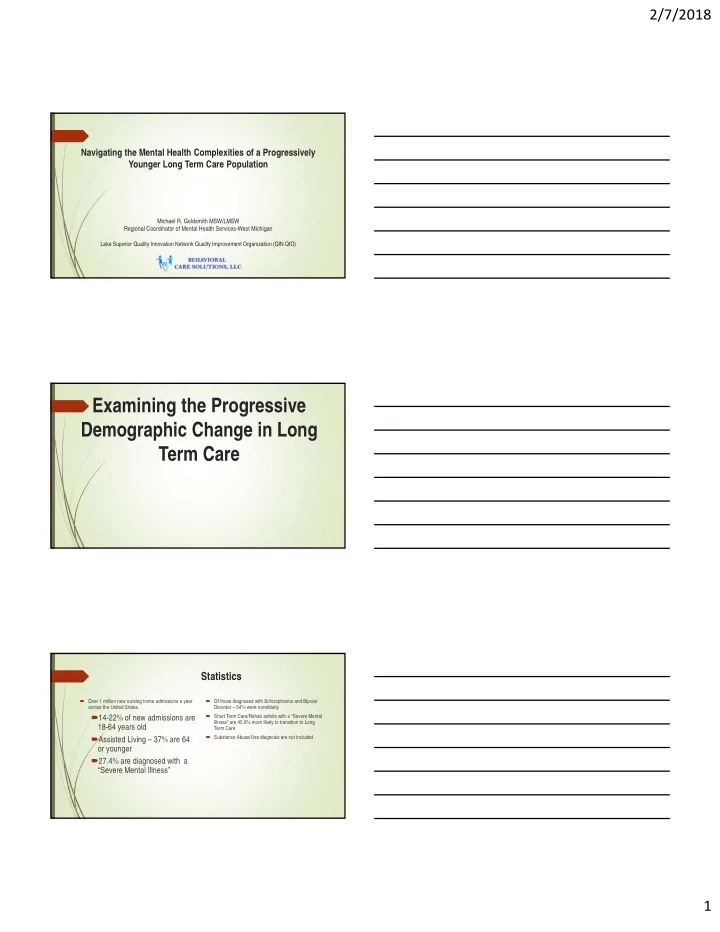
2/7/2018 Navigating the Mental Health Complexities of a Progressively Younger Long Term Care Population Michael R. Goldsmith MSW/LMSW Regional Coordinator of Mental Health Services-West Michigan Lake Superior Quality Innovation Network Quality


slide-1
SLIDE 1

2/7/2018 1

Navigating the Mental Health Complexities of a Progressively Younger Long Term Care Population

Michael R. Goldsmith MSW/LMSW Regional Coordinator of Mental Health Services-West Michigan Lake Superior Quality Innovation Network Quality Improvement Organization (QIN QIO)

Examining the Progressive Demographic Change in Long Term Care

Statistics

 Over 1 million new nursing home admissions a year across the United States.

14-22% of new admissions are 18-64 years old Assisted Living – 37% are 64

  • r younger

27.4% are diagnosed with a “Severe Mental Illness”

 Of those diagnosed with Schizophrenia and Bipolar Disorder – 54% were nonelderly  Short Term Care/Rehab admits with a “Severe Mental Illness” are 45.6% more likely to transition to Long Term Care  Substance Abuse/Use diagnosis are not included

slide-2
SLIDE 2

2/7/2018 2

Sociological and Cultural Factors to an Increase in Younger Demographic in Long Term Care

 Progressive Closure of State Hospitals in the 1970’s and 1980’s  Limited Resources

 Funding  Excessive Caseloads  Poorly Managed Mental Health  APS, Medical Staff and Alternate Authority

 Younger Population with Medical Complexities

 Nancy Miller with the University of Maryland – 10 year study

Patient Testimony “K a thy”

 57 y/ o SWF re siding in AL F . Wo rking a s a PA up until 6 mo nths a g o .  Cha ng e in me nta l sta tus first no te d 12+ mo nths a g o (Mo CA Sc o re o f 17/ 30). Ne uro Psyc h Asse ssme nt x2 po st se ve ra l E me rg e nc y De pa rtme nt pre se nta tio ns re sulting in dx o f De me ntia . Pa tie nt ha s no te d 20+ ye a r o f E T OH a b use / de pe nd e nc e .  L a te r dia g no se d with spe c ific ity-We rnic ke K

  • rsiko ff De me ntia a nd Ma jo r

De pre ssive Diso rde r.  “I ’ m to o yo ung . I do n’ t b e lo ng he re ”, “I try to de ve lo p re la tio nships, b ut the y’ re to o c o nfuse d to unde rsta nd me o r we do n’ t ha ve the sa me inte re sts. I t’ s a diffe re nt g e ne ra tio n yo u kno w”.

slide-3
SLIDE 3

2/7/2018 3

“Ric ky”

 21 y/ o SHM with no c hildre n re siding in SNF / SAR po st MVA re sulting in rig ht side d pa ra lysis, multiple fra c ture s a nd e nc e pha lo pa thy.  Co g nitio n inta c t a nd no histo ry o f me nta l illne ss.  +disruptive b e ha vio rs ie . no nc o mplia nc e with c a re a nd ve rb a l o utb ursts. Sta ff re po rte d iso la tio n in ro o m.  “A lo t o f the m (sta ff) a re a s o ld a s my mo m a nd tre a t me like I ’ m the ir kid. I ’ m no t a kid a nd do n’ t ne e d tha t. I do n’ t e ve n use tha t lig ht a nymo re unle ss I c a n’ t fig ure it o ut o r my g irlfrie nds no t he re to he lp me ”, ”I do n’ t g o

  • ut until 8 o r so me thing . T

ha t’ s whe n the y’ re a ll in the ir ro o ms”.

Identifying Mental Health Diagnosis and Needs of a Younger Demographic in Both Assisted Living and Skilled Nursing Facilities Chronic Mental Illness Diagnosis Schizophrenia Schizoaffective Disorder Psychosis Unspecified Bipolar Disorder Major Depressive Disorder Anxiety – Generalized Anxiety Disorder

slide-4
SLIDE 4

2/7/2018 4

Sc hizo phre nia

 Crite rio n A:

 De lusio ns  Ha lluc ina tio ns  Diso rg a nize d Spe e c h  Diso rg a nize d o r Ca ta to nic Be ha vio r  Ne g a tive Sympto ms-la c k o f fe e ling s o r b e ha vio rs tha t a re usua lly pre se nt

 Crite rio n B: So c ia l/ Oc c upa tio na l Dysfunc tio n  Crite rio n C: Dura tio n o f 6 + mo nths  Crite rio n D: Sc hizo a ffe c tive a nd Alte rna te Mo o d d iso rd e rs ha ve b e e n e xc lud e d  Crite rio n E :Sub sta nc e o r g e ne ra l me d ic a l c o nd itio ns e xc lud e d  Crite rio n F :Is the re a re la tio nship to a pe rva sive d e ve lo pme nta l d isa b ility.

Sc hizo a ffe c tive a nd Unspe c ifie d Psyc ho sis

 Sc hizo a ffe c tive Diso rde r

 Sc hizo a ffe c tive Diso rd e r F

  • rms a link b e twe e n psyc ho sis a nd

mo o d (d e pre ssio n o r ma nia pre se nt thro ug ho ut the ma jo rity o f the illne ss)

 Psyc ho sis Unspe c ifie d

 Pre se nta tio n tha t d o e s no t me e t c rite ria fo r a mo re spe c ific d ia g no sis a nd is no t a ttrib ute d to a d e ve lo ping d e lirium.

Mo o d Diso rde rs

 Bipo la r Diso rd e r

 Ha s o ne o r mo re se ve re ma jo r de pre ssive e piso de s with a t le a st o ne hypo ma nic e piso de (we c a n se e psyc ho sis with hype rma nic e piso de s a nd with ma jo r de pre ssive diso rde r).

 Ma jo r De pre ssive Diso rd e r

 Me nta l diso rde r c ha ra c te rize d b y a pe rva sive a nd pe rsiste nt lo w mo o d tha t is a c c o mpa nie d b y lo w se lf e ste e m a nd b y a lo ss o f inte re st o r ple a sure in no rma lly e njo ya b le a c tivitie s.

slide-5
SLIDE 5

2/7/2018 5

Anxie ty (Ge ne ra lize d Anxie ty Diso rde r)

 E xc e ssive , unc o ntro lla b le a nd o fte n irra tio na l wo rry, a ppre he nsive e xpe c ta tio n a b o ut e ve nts o r a c tivitie s (so me will e xpre ss physio lo g ic a l/ so ma tic c o mpo ne nts ie . b utte rflie s in sto ma c h, ra c ing he a rt, swe a ty pa lms, c he st pa in o r fe e ling sic k).

Recognizing Personality and Character Disorders/Traits Being Identified in this Younger Population Difficult Resident or Personality Disorder? General Description – A personality disorder is a type of mental disorder in which you have a rigid and unhealthy pattern of thinking, functioning, and behaving.

Cluster A – Odd or Eccentric Cluster B – Dramatic or Erratic Cluster C – Anxious or Fearful

Utilizing Staff Input

Differentiating Between Substance Use, Abuse, and Dependence

 Substance Use – someone consumes alcohol or drugs, primarily social, but can appear abusive or develop into a pattern resulting in a dependence.  Substance Abuse – a person using drugs or alcohol despite negative consequences in their lives.  Failure to fulfill obligations at work, home or school  Recurrent use in situations that are hazardous  Substance related legal problems  Continued substance use despite having persistent or recurrent social or interpersonal problems caused or exacerbated by the substance  Substance Dependency – someone dependent on drugs or alcohol.  Develops a tolerance  Experiences withdrawal  Takes larger amounts and for longer duration than intended  Social, occupational, or recreational activities suffer or are given up  Substance use continues despite the exacerbation of physical or mental health conditions

slide-6
SLIDE 6

2/7/2018 6

Identifying Approaches and Interventions to Best Address Quality of Life and Transitioning Cultures in Long Term Care

Analyzing Cultural Changes within Long Term Care environments that promote Quality of Life; Increase Sense of Belonging in Current Long Term Care Environments

 Adopting an Intergenerational Mindset

 Differences in interests and needs  Intergenerational conflicts present in the “real world” also exists in Long Term Care settings  Varied activities  Environment that encourages residents to grow together

Role Designation

 Being Mindful of Varied Schedules for Residents

 Meals  Activities  Volunteers

Community Resources

 Community Based Day Programs

 Example: Easter Seals  Offering job, task engagement, and/or training  Mental health treatment  Recreation engagement beyond the Skilled Nursing or Assisting Living Facility

 Support Groups

 Internal or External  Alcoholic Anonymous  Narcotics Anonymous  Al Anon  Medically related Support Groups

 Community Transition Programs

 NFT (nifty) Nursing Facility Transition Program (waiver)

slide-7
SLIDE 7

2/7/2018 7

Identifying Psychiatric and Psychological Interventions via Utilization of Consulting Entities

 Having appropriate mental health resources available to meet the needs of this change in population.

 Psychology and Psychiatry services  Psych staff with knowledge and experience in treating substance disorders, personality disorders, and the complexities of life transitions  AA/NA groups

Verbal Communication

 Use the name of the resident and make sure you have their attention.  When referencing an alternate staff member, use that staff members name and title.  Be mindful of rate, tone, and volume.  Rule of 5

 Use statements & questions with 5 words or less, using words with 5 letters or less.  Reasoning: “Magical Number Seven +/- two” – Studies have found that people are able to process up to 7 (+/- two) different types of stimuli within an environment or interaction.

Communication and Residents that Present with Traits of Personality Disorders

Working Through Counter Projection Time Out Limit Setting

slide-8
SLIDE 8

2/7/2018 8

Nonverbal Communication

 Approach in a slow and calm manner.  Keep your hands visible.  If at all possible, do not approach from the back or the side.  Be mindful of posture – open and relaxed.  10-5-3 Rule

Asse ssme nt T

  • o ls

Substance Use/Abuse  Clinical Institute Withdrawal Assessment for Alcohol Scale- CIWA-Ar  The CAGE Questionnaire  Drug Abuse Screening Test-DAST 20 Anxiety  Brief Fear Of Negative Evaluation Scale – BFNE  Depression Anxiety Stress Scales – DASS-21  Generalized Anxiety Disorder Questionnaire-IV – GADQ-IV  Generalized Anxiety Disorder 7 – GAD-7  Hamilton Anxiety Rating Scale – HARS  Patient Health Questionnaire 4– PHQ-4 Mood Disorders  Patient Health Questionaire-9 (PHQ-9)  Columbia-Suicide Severity Rating Scale  Suicide Assessment Five-step Evaluation and Triage (SAFE-T)  The Suicide Behaviors Questionnaire-Revised (SBQ-R)

Asse ssme nt T

  • o ls

 No assessment tool to directly identify a psychotic disorder but more to monitor outcomes ie. Symptom Severity and Medication Adherence.  Psychotic Symptoms – Medication Adherence  1) Count missed doses  2) Drug Attitude Inventory. Assesses attitudes toward medications rather than adherence behavior.  3) Medication Possession Ratio (MPR). MPR assesses the extent to which dispensed medications provide coverage for a given interval (e.g., 6 months).  4) Gap measure. Gap measure is based on gaps in medication prescribing or failure to refill prescriptions.  Psychotic Symptoms – Symptom Severity  1) Revised Behavior and Symptom Identification Scale (BASIS-R). The BASIS-R is a 24-item self-report instrument with six scales: psychosis, depression/functioning, interpersonal problems, alcohol/drug use, self- harm, and emotional lability.  2) Symptom Checklist-90-Revised (SCL-90-R). The SCL-90-R is a 90-item self-assessment tool that measures psychoticism and paranoid ideation in addition to seven other symptom scales.  3) Brief Symptom Inventory (BSI). The BSI is a 53-item self-administered scale developed from the SCL- 90-R. The BSI has good psychometric properties and is an acceptable brief alternative to the SCL-90-R.

slide-9
SLIDE 9

2/7/2018 9

References

 Me lnyk, Ande w (2012). De mo g ra phic T re nds a nd De ma nd fo r L

  • ng -T

e rm Ca re Se rvic e s. Wa shing to n, DC. Ame ric a n Co unc il o f L ife I nsure rs.  Co he n, D., Ha ye s, T ., & Mo lina ri, V. (2011). Sta te po lic ie s fo r the re side nc y o f

  • ffe nde rs in lo ng -te rm c a re fa c ilitie s: Ba la nc ing rig ht to c a re with sa fe ty.

Jo urna l o f the Ame ric a n Me dic a l Dire c to rs Asso c ia tio n, 12(7), 481- 486.  Gib so n, R., F e rrini, R. (2012). Diffic ult Re side nt o r Pe rso na lity Diso rde r? A L

  • ng -T

e rm Ca re Pe rspe c tive . E dg e mo o r Ho spita l DPSNF . Vo lume 20-I ssue 11.