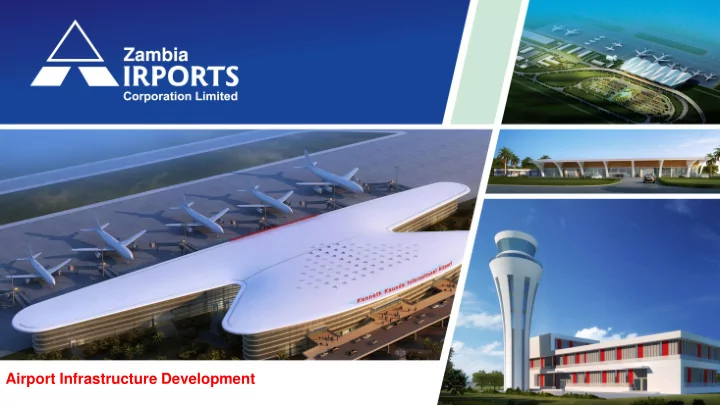
SLIDE 1 Airport Infrastructure Development
SLIDE 2
The Corporation Mandate
Zambia Airports Corporation Limited was established by an
Act of Parliament No. 16 of 1989, it is incorporated as an amendment No.5 of 2016 to the Civil Aviation Act, 2016 of the Laws of Zambia.
ZACL is a Company limited by shares and registered
under the Companies Act, Cap 388.
The Company commenced operation on 11th September,
1989.
The Company’s shares are 100% owned by the
Government of the Republic of Zambia.
SLIDE 3
The Corporation Mandate
The Corporation is responsible for the management of the four (4) designated airports and provision of air navigation services within the Zambian airspace. The designated airports are namely:
Kenneth Kaunda (Lusaka), Harry Mwaanga Nkumbula (Livingstone), Simon Mwansa Kapwepwe (Ndola) and Mfuwe.
SLIDE 4
Functions of ZACL
The functions of the Corporation referred to in Part III of the Civil Aviation Act, 2016:-
To provide air traffic control service throughout the Republic; To provide aircraft services at designated airports; To provide fire and rescue services at designated airports; To provide and maintain navigational and telecommunications aids
throughout the Republic of Zambia;
To provide Security at designated airports; To provide terminal facilities for passengers and cargo at
designated airports;
SLIDE 5
Corporate Plan (2017 – 2021)
The five (5) year Strategic Plan is aimed at transforming the Corporation through:-
infrastructure development; adherence quality management systems; rebranding of the company; improvement of income generating streams and; enhancing operational efficiency.
SLIDE 6 Passenger data 1990 to 2016 in in Zambia
200000 400000 600000 800000 1000000 1200000 1400000 1600000 1800000 1990 1991 1992 1993 1994 1995 1996 1997 1998 1999 2000 2001 2002 2003 2004 2005 2006 2007 2008 2009 2010 2011 2012 2013 2014 2015 2016 Passenger Numbers Years
CONSOLIDATED PASSENGER TRAFFIC TRENDS 1990 - 2016
International Domestic Totals Legal: Closure of National Airline
Economic: Financial Meltdown Social: Ebola outbreak in Africa Politics: Multi Party Elections
SLIDE 7
Im Importance of Air ir Transport In Infrastructure
The aviation industry has a vital role to play in achieving
sustainable development and linking Africa;
Improvements in air transport infrastructure would help to
raise living standards and alleviate poverty in Africa by lowering transport costs, supporting more rapid economic growth and increasing personal mobility;
Africa is the smallest region for air services in the
world, reflecting its low income and lack of air transport infrastructure and connectivity;
Air services are key to facilitating the development of a
more diversified export base and increased tourism in Africa.
SLIDE 8
Border Controls – Health Hazards
Severe Acute Respiratory
Syndrome - SARS (Asia - 2003)
Bird Flu - H5N1 (Asia 1997-2003) Ebola (West Africa – 2014-16) Zika (Latin America - 2015) Ebola (Democratic Republic of
Congo – 2017)
SLIDE 9 Border Controls – Zambia
Scanners installed at all international airports within Zambia.
areas established.
SLIDE 10
Emergency Response – Crash Aid id Win ing
SLIDE 11
a) Who is responsible for the care and medical bills for a passenger offload in transit from a flight due to a suspected illness or disease? b) If an aircraft makes a diversion for a medical emergency to offload a sick passenger, who is responsible for the care and medical bills? c) Upon recovery, whose responsibility is it to get the passenger to their original destination? The Passenger or Airline or the Airport?
Medical Emergencies on Flights
SLIDE 12
Summary ry of Airport In Investments
KKIA - Lusaka
US$360 million
HMNIA - Livingstone
US$60 million
Copperbelt Airport
US$397 million + $15(GRZ)
Mfuwe
US$122 million*
Surveillance System
US$20 million
Equipment US$27.9 million
Total
US$1,001.9 million
SLIDE 13 Proje ject statu tus of KKIA as at t 2nd Ju June
Passenger Terminal
49%
Passenger Terminal Apron
65%
Airport Hotel
38%
Rescue Fire services
99%
RFS Water Reservoir
99%
Presidential Terminal
59%
Presidential Terminal Apron
65%
ATC and Control Tower
50%
Cargo Terminal
30%
Overall Project status 48% Completion Date Oct 2019
SLIDE 14
Kenneth Kaunda International Airport and Expansion Project
SLIDE 15
Passenger Terminal
SLIDE 16
Passenger Terminal – Western view
SLIDE 17
Passenger Terminal – Western view
SLIDE 18
Airport Hotel – 70 Rooms
SLIDE 19
Control Tower and ATM Office
SLIDE 20
Rescue and Fire Services Facility
SLIDE 21
Rescue and Fire Services Facility
SLIDE 22
Airport Mall and Office Park
SLIDE 23
VVIP Terminal
SLIDE 24
Cargo Terminal
SLIDE 25 Other Facilities
Aircraft Hangar Fuel Farm Rehabilitation of Existing Terminal Inflight Catering Extension of Taxiway Upgrade of ZASTI
SLIDE 26 Surveillance - Primary and Secondary Radar
US$20million
Aeronautical Information Management System (AIMS) and Automatic Message
Handling System (AMHS) CAD$1million
Automated Weather Observation Systems
US$1million
Upgrade of CNS and ATM
SLIDE 27
Primary & Secondary RADAR
SLIDE 28 Copperbelt International Airport
Greenfield Airport:
Terminal Capacity one (1) million passengers per Annum Runway - 3 500 m Project Cost – US$ 397 million The works include:-
Terminal building Hotel Office Complex Airfield +Access road Fuel Farm
SLIDE 29
Copperbelt Int. Airport – Layout
SLIDE 30
Copperbelt Int. Airport – Layout
SLIDE 31
Control Tower
SLIDE 32
AIRPORT HOTEL – (50 rooms)
SLIDE 33
Business Complex
SLIDE 34
Aircraft Hangar
SLIDE 35 In conclusion I wish to state that:
a) The main objective of an Airport Operator is to protect the health
and welfare of travellers, staff and the public, and to reduce the
- pportunities for dissemination of communicable diseases by air;
b) The responsibility for management of the risk of communicable
diseases at airports rests primarily with the local/regional/national public health authority and the relevant airport operator;
c) Airport operators should establish a method of testing their
preparedness by means of drills/exercises involving all relevant stakeholders, especially public health authorities, airport operators and airlines.
Conclusion
SLIDE 36