EXAMINING RISK FAILURE MODES EFFECT ANALYSIS (FMEA) LYNNE SLIVOVSKY - - PDF document

examining risk failure modes effect analysis fmea
SMART_READER_LITE
LIVE PREVIEW

EXAMINING RISK FAILURE MODES EFFECT ANALYSIS (FMEA) LYNNE SLIVOVSKY - - PDF document

1/11/16 EXAMINING RISK FAILURE MODES EFFECT ANALYSIS (FMEA) LYNNE SLIVOVSKY CPE 450 W2016 1 Source: http://www.petzl.com/de/en/outdoor/headlamps/batteries RISK IN A NUTSHELL 5 Risk


slide-1
SLIDE 1

1/11/16 ¡ 1 ¡

EXAMINING RISK FAILURE MODES EFFECT ANALYSIS (FMEA)

LYNNE SLIVOVSKY CPE 450 W2016

Source: http://www.petzl.com/de/en/outdoor/headlamps/batteries

1

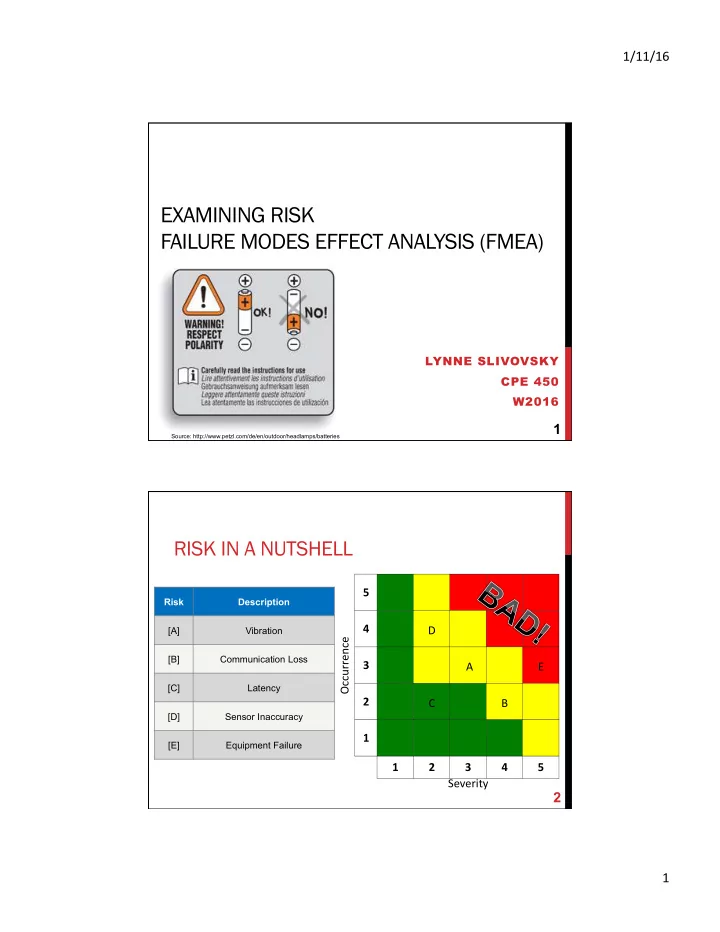
RISK IN A NUTSHELL

Occurrence ¡ 5 ¡ ¡ ¡ ¡ ¡ ¡ ¡ ¡ ¡ ¡ ¡ 4 ¡ ¡ ¡ D ¡ ¡ ¡ ¡ ¡ ¡ ¡ ¡ 3 ¡ ¡ ¡ ¡ ¡ ¡A ¡ E ¡ ¡ 2 ¡ ¡ ¡ C ¡ ¡ ¡ ¡ B ¡ ¡ ¡ ¡ 1 ¡ ¡ ¡ ¡ ¡ ¡ ¡ ¡ ¡ ¡ ¡ 1 ¡ 2 ¡ 3 ¡ 4 ¡ 5 ¡ Severity ¡

Risk Description [A] Vibration [B] Communication Loss [C] Latency [D] Sensor Inaccuracy [E] Equipment Failure

2

slide-2
SLIDE 2

1/11/16 ¡ 2 ¡

RATIONALE

Allows us to identify areas of our process that most impact our customers Helps us identify how our design or process is most likely to fail Points to process failures that are most difficult to detect

3

TYPES

System/Concept: (Driven by system functions) A system is an

  • rganized set of parts or subsystems to accomplish one or more
  • functions. System FMEAs are typically very early, before specific

hardware has been determined. Design: (Driven by part or component functions) A Design/Part is a unit of physical hardware that is considered a single replaceable part with respect to repair. Design FMEAs are typically done later in the development process when specific hardware has been determined. Process: (Driven by process functions & part characteristics) A Process is a sequence of tasks that is organized to produce a product or service. A Process FMEA can involve fabrication, assembly, transactions or services. 4

slide-3
SLIDE 3

1/11/16 ¡ 3 ¡

EXAMPLES

Manufacturing: A manager is responsible for moving a manufacturing operation to a new facility. He/she wants to be sure the move goes as smoothly as possible and that there are no surprises. Design: A design engineer wants to think of all the possible ways a product being designed could fail so that robustness can be built into the product. Software: A software engineer wants to think of possible problems a software product could fail when scaled up to large databases. 5

Failure Mode

the way in which the component, subassembly, product, input, or process could fail to perform its intended function

6

Effects Analysis

studying the consequences of failures

slide-4
SLIDE 4

1/11/16 ¡ 4 ¡

FMEA (FAILURE MODE EFFECTS ANALYSIS)

Why

  • Methodology that facilitates process improvement
  • Identifies and eliminates concerns early in the development of

a process or design

  • Improve internal and external customer satisfaction
  • Focuses on prevention
  • FMEA may be a customer requirement
  • FMEA may be required by an applicable

Quality System Standard 7

FMEA (FAILURE MODE EFFECTS ANALYSIS)

A structured approach to:

  • Identifying the ways in which a product or process can fail
  • Estimating risk associated with specific causes
  • Prioritizing the actions that should be taken to reduce risk
  • Evaluating design validation plan (design FMEA) or current

control plan (process FMEA)

8

slide-5
SLIDE 5

1/11/16 ¡ 5 ¡

TYPES OF FMEAS

Design

  • Analyzes product design before release to production,

with a focus on product function

  • Analyzes systems and subsystems in early concept and

design stages

Process

  • Used to analyze manufacturing and assembly processes

after they are implemented

9

SEVERITY, OCCURRENCE, DETECTION

Severity

  • Importance of the effect on customer requirements

Occurrence

  • Frequency with which a given cause occurs and

creates failure modes

Detection

  • The ability of the current control scheme to detect
  • r prevent a given cause

10

slide-6
SLIDE 6

1/11/16 ¡ 6 ¡

RISK PRIORITY NUMBER (RPN)

— RPN is the product of the severity,

  • ccurrence, and detection scores.

11

Severity Occurrence Detection RPN

X X =

FMEA PROCEDURE

  • 1. For each design component/process input, determine

the ways in which the component/input can go wrong (failure mode)

  • 2. For each failure mode, determine effects
  • Select a severity level for each effect
  • 3. Identify potential causes of each failure mode
  • Select an occurrence level for each cause
  • 4. List current controls for each cause
  • Select a detection level for each cause

12

slide-7
SLIDE 7

1/11/16 ¡ 7 ¡

FMEA PROCEDURE (CONT.)

  • 5. Calculate the Risk Priority Number (RPN)
  • 6. Develop recommended actions, assign responsible

persons, and take actions

  • Give priority to high RPNs
  • MUST look at severities rated a 10
  • 7. Assign the predicted severity, occurrence, and

detection levels and compare RPNs

13

THE FMEA FORM

14

Identify failure modes and their effects Identify causes of the failure modes and controls Prioritize Determine and assess actions

slide-8
SLIDE 8

1/11/16 ¡ 8 ¡

RATING SCALES

There are a wide variety of scoring “anchors”, both quantitative or qualitative Two types of scales are 1-5 or 1-10 The 1-5 scale makes it easier for the teams to decide on scores The 1-10 scale may allow for better precision in estimates and a wide variation in scores (most common)

15

RATING SCALES

Severity

  • 1 = Not Severe, 10 = Very Severe

Occurrence

  • 1 = Not Likely, 10 = Very Likely

Detection

  • 1 = Easy to Detect, 10 = Not easy to Detect

16

slide-9
SLIDE 9

1/11/16 ¡ 9 ¡

FMEA SCORING: SEVERITY

17

Severity of Effect Rating

May endanger machine or operator. Hazardous without warning

10

May endanger machine or operator. Hazardous with warning

9

Major disruption to production line. Loss of primary function, 100% scrap. Possible jig lock and Major loss of Task Time

8

Reduced primary function performance. Product requires repair or Major Variance. Noticeable loss of Task Time

7

Medium disruption of production. Possible scrap. Noticeable loss of takt time. Loss of secondary function performance. Requires repair or Minor Variance

6

Minor disruption to production. Product must be repaired. Reduced secondary function performance.

5

Minor defect, product repaired or "Use-As-Is" disposition.

4

Fit & Finish item. Minor defect, may be reprocessed on-line.

3

Minor Nonconformance, may be reprocessed on-line.

2

None

No effect

1

Extreme High Moderate Low

FMEA SCORING: OCCURRENCE

18

Likelihood of Occurrence Failure Rate Rating

1 in 2

10

1 in 3

9

1 in 8

8

1 in 20

7

1 in 80

6

1 in 400

5

1 in 2000

4

Process is in statistical control. 1 in 15k

3

Low

Process is in statistical control. Only isolated failures associated with almost identical processes. 1 in 150k

2

Remote

Failure is unlikely. No known failures associated with almost identical processes. 1 in 1.5M

1

Failure is almost inevitable Process is not in statistical control. Similar processes have experienced problems.

Process is in statistical control but with isolated failures. Previous processes have experienced occasional failures or out-of-control conditions.

Very High High Moderate
slide-10
SLIDE 10

1/11/16 ¡ 10 ¡

FMEA SCORING: DETECTION

19

Likelihood that control will detect failure Rating Very Low

No known control(s) available to detect failure mode.

10 9 8 7 6 5 4 3 2 1

The process automatically detects failure. Controls will almost certainly detect the existence of a failure. Controls have a good chance of detecting the existence

  • f a failure

Low Moderate High Very High

Controls have a remote chance of detecting the failure. Controls may detect the existence of a failure

DESIGN EXERCISE

Develop an FMEA for your project:

  • Identify the ways in which your product/process can fail
  • Estimate the risks associated with specific causes
  • Prioritizes the actions that should be taken to reduce risk

Complete the FMEA worksheet:

  • Electronic version on PolyLearn
  • Submit a hardcopy at the beginning of class on Tuesday, 1/25
  • One per team

20

slide-11
SLIDE 11

1/11/16 ¡ 11 ¡

SOURCES

American Society for Quality (asq.org) http://www.stat.purdue.edu/~kuczek/stat513/IT/520381_Chap_7.ppt https://oasis.northgrum.com/general/docs/.../AdvancedPFMEA.ppt

21

BONUS SLIDES!

Hey there, how awesome is it that you looked through these slides after class!

22

slide-12
SLIDE 12

1/11/16 ¡ 12 ¡

WHEN TO CONDUCT AN FMEA

Early in the process improvement investigation When new systems, products, and processes are being designed When existing designs or processes are being changed When carry-over designs are used in new applications After system, product, or process functions are defined, but before specific hardware is selected or released to manufacturing 23

HISTORY OF FMEA

First formalized in the 1960’s in the Aerospace industry during the Apollo missions In 1974, the Navy developed MIL-STD-1629 regarding the use of FMEA Required by QS-9000 & Advanced Product Quality Planning Process in 1994 for all automotive suppliers Driven by liability costs, used to reduce risks related to poor quality

24