Evolving Technique Update: How Orthobiologics are Transforming Hip - - PowerPoint PPT Presentation

evolving technique update how orthobiologics are
SMART_READER_LITE
LIVE PREVIEW

Evolving Technique Update: How Orthobiologics are Transforming Hip - - PowerPoint PPT Presentation

Evolving Technique Update: How Orthobiologics are Transforming Hip Preservation Misty Suri M.D. Medical Director, Head Team Physician New Orleans Pelicans (2007-2017) Team Physician New Orleans Saints Team Physician University of New Orleans


slide-1
SLIDE 1

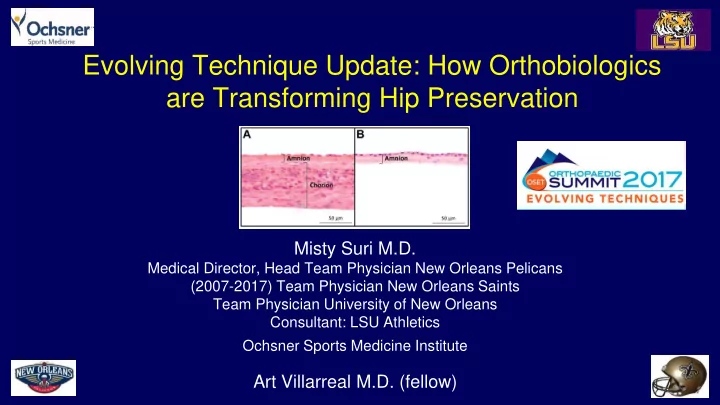
Evolving Technique Update: How Orthobiologics are Transforming Hip Preservation

Misty Suri M.D.

Medical Director, Head Team Physician New Orleans Pelicans (2007-2017) Team Physician New Orleans Saints Team Physician University of New Orleans Consultant: LSU Athletics Ochsner Sports Medicine Institute

Art Villarreal M.D. (fellow)

slide-2
SLIDE 2

Orthobiologics

  • Bone morphogenic proteins
  • Platelet rich plasma
  • Hyaluronic acid
  • Cell therapy
slide-3
SLIDE 3

BMP

  • Member of TGF-β superfamily
  • Osteogenic activities & promote

cartilage formation

slide-4
SLIDE 4
  • 39 hips Ficat & Arlet stage II or III
  • trapdoor technique for removal of necrotic

bone & placement of autologous cancellous bone graft & BMP-7

  • clinical success in 67%

– no THA at mean 36 mo f/u

slide-5
SLIDE 5
  • 72 hips (42 pts)
  • followed 5-8 years (mean 6.1 years)
  • Group 1 – ICBG + Novobone (artificial bone)

& rhBMP-2

  • Group 2 – ICBG + Novobone
  • survival rate

– group 1: 82% – group 2: 72%

slide-6
SLIDE 6

Platelet Rich Plasma

slide-7
SLIDE 7
  • Study group - 91 pts receiving intraarticular PRP
  • Control group - 180 pts receiving intraarticular 0.25%

bupivacaine

  • No difference in pain at 3 months
  • PRP group with higher pain at 2 years

– 3.4 vs 2.5 p=.005

  • PRP group with lower mHHS at 2 years

– 79 vs 83 p=.049

slide-8
SLIDE 8
  • 111 pts receiving weekly IA injection x 3 wks
  • 3 groups

– PRP (44 pts) – PRP+HA (31 pts) – HA (36 pts)

  • 6 mo VAS scores (mm):

– PRP 21 p=.007 – PRP+HA 35 – HA 44

slide-9
SLIDE 9

Hyaluronic Acid

slide-10
SLIDE 10
  • 85 pts; 2.5 ml HA group- 42, 2.5 ml saline-43

– single 2.5 ml injection

  • Main outcome VAS on 100mm scale
  • At 3 months no difference in VAS

– -7.8 +/- 24.9mm with HA vs. – -9.1 +/- 27.4 mm saline p=.98

slide-11
SLIDE 11
  • Meta-analysis of 23 studies

– studies w/ highly variable end points, control groups & f/u – mean decrease in VAS across all studies: 1.97 – in randomized studies decrease was: 0.27

  • ? minimal clinical relevance
slide-12
SLIDE 12

Cell Therapy

slide-13
SLIDE 13
  • 38 pts (48 hips)

– hip arthroscopy & IA BM-MSC infusion

  • BM-MSC from iliac crest, expanded & given as series
  • f 3 injections from 4-6 wks postop
  • Median f/u 30 months

– VAS 4 to 2 p< 0.01 – mHHS 63 to 72 p< 0.01 – 2 failures (THA)

slide-14
SLIDE 14
  • 16 hips in 14 pts with ICRS 3 & 4

– Stem cells from peripheral blood – Microfracture > scaffold placed > stem cells injected into scaffold – Mean f/u 16 months – Hip Outcome Score 67 to 95 p< 0.05

slide-15
SLIDE 15
  • 80 pts w/ ICRS 2-4

– 40 w/ BM-MSC & biodegradable scaffold – 40 microfracture alone – mean f/u 28 months – mHHS, patient satisfaction, Non-arthritic hip score – MSC group

  • mHHS 63 to 87, patient satisfaction 5.2 to 9, NAHS 61 to 82

– control

  • mHHS 62 to 76, patient satisfaction 5.5 to 8.4, NAHS 62 to 76
slide-16
SLIDE 16

inner

  • uter
slide-17
SLIDE 17

Amniotic membranes

  • Anti scarring/wound healing
  • Reduce inflammation
  • Anti microbial
  • Nonimmunogenic
slide-18
SLIDE 18

Amniotic membranes

  • Anti scarring/wound healing

– down regulation of TGF-β reducing activation of fibroblasts – EGF, KGF & HGF – decreased adhesions

  • flexor tendon repair, nerve wrap/conduit (human)
  • rat model of peritoneal adhesions
  • Riboh, JC. Et al. Am J Sports Med. 2016 Sep;44(9):2425-34
  • J Kuckelman, J Smith, K Kniery, J Kay, S Lyon, Z Hoffer, S Steele, V Sohn

Diseases of the Colon & Rectum 60 (6), E98-E98

  • Mamede AC. Et al. Cell Tissue Res. 2012;349(2):447-458.
  • Koizumi NJ. Et al. Curr Eye Res. 2000;20(3):173-177.
  • Fairbairn NG, Randolph MA, Redmond RW. J Plast Reconstr Aesthet Surg.

2014;67(5):662-675.

  • Niknejad, H. et al. Eur Cell Mater. 2008 Apr 29;15:88-99.
slide-19
SLIDE 19

Amniotic membranes

  • Reduce inflammation

– suppression of IL-1α, IL-1β and MMPs

  • Khouw et al. Biomaterials 20:815-1822.
  • Tseng et al. J Cell Physiol 179: 325-335.
  • Lee et al. Curr Eye Res 20: 325-334.
  • Solomon et al. Br J Ophthalmol 85: 444-449.
  • Hao et al. Cornea 19: 348-352.
  • Kim et al. Exp Eye Res 70: 329-337.
  • Higa et al. Cornea 24:206-212.
slide-20
SLIDE 20

Amniotic membranes

  • Anti microbial

– AM cells produce antimicrobial molecules:

  • bactricidin
  • β-lysin, transferrin
  • 7S immunoglobulin
  • β3 defensin
  • cystatin 3
  • Krisanaprakornkit et al. Infect Immun 66: 4222-4228.
  • Harder et al. Am J Respir Cell Mol Biol 22: 714-721.
  • Galask RP, Snyder IS. Am J Obstet Gynecol. 1970;106(1):59-65.
  • Koizumi NJ. Et al. Curr Eye Res. 2000;20(3):173-177.
  • Malhotra C, Jain AK. World J Transplant. 2014;4(2):111-121.
  • Sangwan VS, Basu S. Br J Ophthalmol. 2011;95(1):1-2.
slide-21
SLIDE 21

Amniotic membranes

  • Nonimmunogenic

– lack of HLA-: A, B, & DR – HLA-G induces immune tolerance through inhibition of NK cells & macrophages – reduce activation of T-cells through regulation of multiple cytokines such as IL-2, -4, -7, -15 and IFN-γ

  • Malhotra C, Jain AK. World J Transplant. 2014;4(2):111-121.
  • Insausti CL, et al. Stem Cells Cloning. 2014;7:53-63.
  • Banas R, et al. Cell Transplant. 2014;23(9):1111-1125.
  • Kang JW, et al. J Vet Sci. 2012;13(1):23-31.
  • Magatti M, et al. Cell Transplant. 2009;18(8):899-914.
  • Higa et al. Cornea 24:206-212.
  • Hori et al. Cornea 25: S53-S58.
  • Sargent, IL. Exp Clin Immunogenet 10: 85-102.
  • Szekeres-Bartho, J. Int Rev Immunol 21:471-495.
slide-22
SLIDE 22

Amniotic membranes

  • Nonimmunogenic

– AM-derived stem cells effect on the immune system due to ability to prevent monocyte differentiation into dendritic cells

  • key cell type for antigen presentation
  • Malhotra C, Jain AK. World J Transplant. 2014;4(2):111-121.
  • Insausti CL, et al. Stem Cells Cloning. 2014;7:53-63.
  • Banas R, et al. Cell Transplant. 2014;23(9):1111-1125.
  • Kang JW, et al. J Vet Sci. 2012;13(1):23-31.
  • Magatti M, et al. Cell Transplant. 2009;18(8):899-914.
  • Higa et al. Cornea 24:206-212.
  • Hori et al. Cornea 25: S53-S58.
  • Sargent, IL. Exp Clin Immunogenet 10: 85-102.
  • Szekeres-Bartho, J. Int Rev Immunol 21:471-495.
slide-23
SLIDE 23

Amniotic membranes

  • ?chondrogenic

– cell culture studies

  • AM-derived pluripotent cells can be directed to chondrogenic line

via BMP-2, BMP-7, or chondrogenic medium

  • also can serve as scaffold for

– bone marrrow derived MSC adhesion – chondrogenic differentiation – chondrocyte adhesion & proliferation

  • Malhotra C, Jain AK. World J Transplant. 2014;4(2):111-121.
  • Insausti CL, et al. Stem Cells Cloning. 2014;7:53-63.
  • Banas R, et al. Cell Transplant. 2014;23(9):1111-1125.
  • Kang JW, et al. J Vet Sci. 2012;13(1):23-31.
  • Magatti M, et al. Cell Transplant. 2009;18(8):899-914.
  • Higa et al. Cornea 24:206-212.
  • Hori et al. Cornea 25: S53-S58.
  • Sargent, IL. Exp Clin Immunogenet 10: 85-102.
  • Szekeres-Bartho, J. Int Rev Immunol 21:471-495.