Evolving Adabot: A Mobile Robot with Adjustable Wheel Extensions - - PowerPoint PPT Presentation

evolving adabot a mobile robot with adjustable wheel
SMART_READER_LITE
LIVE PREVIEW

Evolving Adabot: A Mobile Robot with Adjustable Wheel Extensions - - PowerPoint PPT Presentation

Anthony J. Clark Missouri State University Evolving Adabot: A Mobile Robot with Adjustable Wheel Extensions Motivation: Search and Rescue anthonyjclark.com Approach for locating victims of a natural disaster Use a swarm of inexpensive


slide-1
SLIDE 1

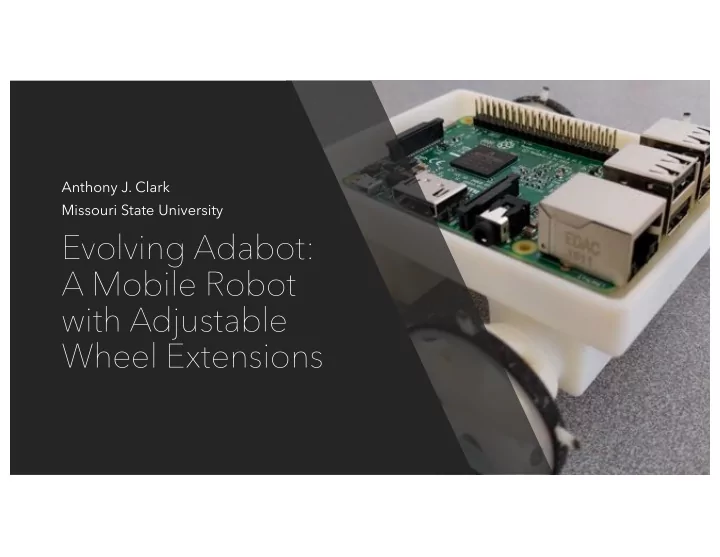
Evolving Adabot: A Mobile Robot with Adjustable Wheel Extensions

Anthony J. Clark Missouri State University
slide-2
SLIDE 2
slide-3
SLIDE 3
slide-4
SLIDE 4
slide-5
SLIDE 5

anthonyjclark.com

Motivation: Search and Rescue

Approach for locating victims of a natural disaster

  • Use a swarm of inexpensive and expendable robots
  • Small and less likely to disturb environment
  • These robots spread out and search an area
  • They are equipped with GPS and two-way radios
  • Victims can grab the robot and ask for help
slide-6
SLIDE 6

anthonyjclark.com

Issues: Search and Rescue

Robots must navigate rough and varied environments

  • smooth and firm (pavement)
  • loose and rocky (gravel)
  • loose and uneven (wooded areas)
  • unexpected failure
  • obstacles of different shapes and sizes
  • dynamic obstacles
  • swarm intelligence
slide-7
SLIDE 7

anthonyjclark.com

Related Work

Active Suspension [Grand 2004] ASGUARD [Eich 2008] RHex [Saranli 2001] Tri-Wheel [Smith 2015]

slide-8
SLIDE 8

anthonyjclark.com

Reconfigurable Wheels

TurboQuad [Chen 2017] Transleg [Wei 2016] [Kim 2014] [She 2015]

slide-9
SLIDE 9

anthonyjclark.com

Adabot (Adaptive Robot)

Simple, extensible design Configure:

  • the wheel radius
  • the number of wegs

Online:

  • adjust wheel extension

amount

slide-10
SLIDE 10

anthonyjclark.com

Weg Mechanism

slide-11
SLIDE 11

anthonyjclark.com

Weg Extension

slide-12
SLIDE 12

anthonyjclark.com

Adabot Hardware

Prototype specifications

  • Raspberry Pi 3 Model B
  • A-Star 32U4 control board
  • 4 drive motors with encoders
  • 4 linear servos for controlling wegs
  • 3 forward IR distance sensors
  • A 9-axis IMU
  • Wireless communication
  • A 2200 mAh NiMH battery pack
slide-13
SLIDE 13

anthonyjclark.com

Physical Parameters

(Top-Down View) Wheel Base Track Width (Wheel Side View) Wheel Radius Weg Count

slide-14
SLIDE 14

anthonyjclark.com

Physical Parameters

(Top-Down View)

slide-15
SLIDE 15

anthonyjclark.com

Constraint Violation

(Top-Down View) (Top-Down View)

slide-16
SLIDE 16

anthonyjclark.com

Control Parameters

start Angular Wheel Rate (Retracted) Mobility Threshold Mobility Duration Angular Wheel Rate (Extended) Weg Extension Percentage Weg Extension Timeout

slide-17
SLIDE 17

anthonyjclark.com

Differential Evolution

  • evolutionary algorithms are

specifically targeted at problems that re not differentiable

  • a standard algorithm for real-

value optimization problems

Evolutionary Optimization

slide-18
SLIDE 18

anthonyjclark.com

Evolutionary Robotics

  • The intersection of robotics and evolutionary computation

called Evolutionary Robotics

  • These algorithms work on a population of candidate solutions,

and require a large number of tests (called fitness evaluations)

  • Most studies use simulation
  • Advantages: faster, safer, less expensive
  • Disadvantages: the simulation will not not match reality
  • For this study we are using ROS and Gazebo
slide-19
SLIDE 19

anthonyjclark.com

ROS and Gazebo

ROS is a set of libraries and middleware that enable the reuse of robotics software (access to a large amount of quality software). For example:

  • One node reads wheel encoder data and emits angular wheel rates
  • Another node reads IMU data and emits localization information
  • A third node uses information from both of these to detect poor mobility

ROS runs on the Linux distribution supported by RPi

  • We can use the same software in simulation as we do on the real device
slide-20
SLIDE 20

anthonyjclark.com

ROS Graph

slide-21
SLIDE 21

anthonyjclark.com

Simulation Environments

Step Environment

  • cannot drive over without wegs
  • provides a baseline

comparison for other environments Rocky Environment

  • cannot drive over without wegs
  • randomly generated rocky

peaks

slide-22
SLIDE 22

anthonyjclark.com

Experiments

Two experiments (40 replicate experiments each): Step Environment

  • 5 repeated trials
  • Up to 2 outliers are removed
  • 20 seconds per trial
  • Fitness is the average maximum speed

Rocky Environment

  • 5 repeated trials
  • Up to 2 outliers are removed
  • 30 seconds per trial
  • Fitness is the average maximum speed
slide-23
SLIDE 23

anthonyjclark.com

Evolutionary Results

slide-24
SLIDE 24

anthonyjclark.com

Evolved Parameters

slide-25
SLIDE 25

anthonyjclark.com

Step Environment

slide-26
SLIDE 26

anthonyjclark.com

Rocky Environment

slide-27
SLIDE 27

anthonyjclark.com

Summary

  • I presented a simple transformable-wheel device
  • The presented mechanism can be scaled up and down quite

easily, and

  • The mechanism can be configured with a range of different

weg counts

  • Variable extension
slide-28
SLIDE 28

anthonyjclark.com

Future Work

  • 1. Validation experiments with the physical device
  • 2. Simulate and fabricate compliant wegs
  • 3. Improve controller using adaptive control techniques
  • 4. Combine with other modes of locomotion
slide-29
SLIDE 29

anthonyjclark.com

Acknowledgements

The authors gratefully acknowledge the contributions and feedback on the work provided by Megan Clark and Professors Philip McKinley and Jared Moore. I would also like to thank Keith Cissell, Dillon Flohr, Dersham Schmidt, and Daniel Warken. Garren Ijames, Michael Brattin, Jesse Stewart, Kyle Finter, Brett Spatz, and Dr. Razib Iqbal. Missouri State University

slide-30
SLIDE 30

anthonyjclark.com

References

  • C. Grand, F. Benamar, F. Plumet, and P. Bidaud, “Stability and traction optimization of a

reconfigurable wheel-legged robot,” The International Journal of Robotics Research, vol. 23, no. 10-11, pp. 1041– 1058, 2004.

  • M. Eich, F. Grimminger, and F. Kirchner, “A versatile stair-climbing robot for search and rescue

applications,” in Proceedings of the 2008 IEEE International Workshop on Safety, Security and Rescue Robotics, Oct. 2008, pp. 35–40.

  • U. Saranli, M. Buehler, and D. E. Koditschek, “RHex: A simple and highly mobile hexapod

robot,” The International Journal of Robotics Research, vol. 20, no. 7, pp. 616–631, 2001.

  • L. M. Smith, R. D. Quinn, K. A. Johnson, and W. R. Tuck, “The Tri-Wheel: A novel wheel-leg

mobility concept,” in Proceedings of the 2015 IEEE/RSJ International Conference on Intel ligent Robots and Systems (IROS), Sep. 2015, pp. 4146–4152. W.H.Chen, H.S.Lin, Y.M.Lin, and P.C.Lin, “Turboquad: A novel leg-wheel transformable robot with smooth and fast behavioral transitions,” IEEE Transactions on Robotics, vol. PP, no. 99,

  • pp. 1–16, 2017.
slide-31
SLIDE 31

anthonyjclark.com

Thank You