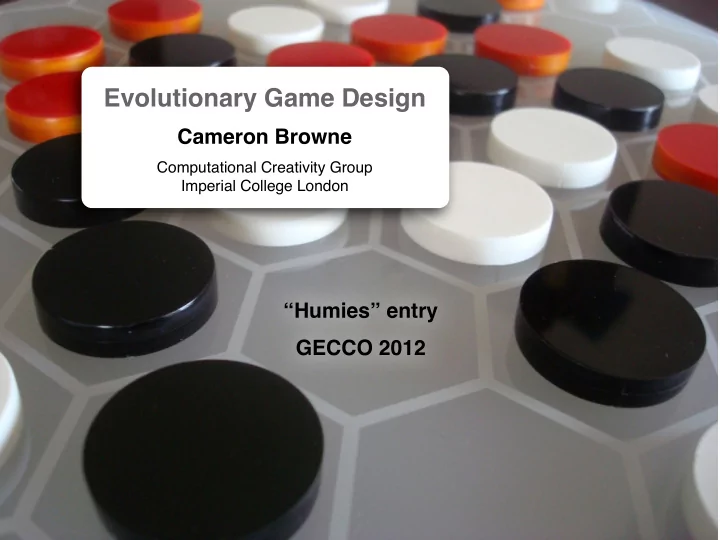
SLIDE 1
“Humies” entry GECCO 2012
Evolutionary Game Design
Cameron Browne
Computational Creativity Group Imperial College London
SLIDE 2 Submission
LUDI system for evolving board games First (and only) fully computer-generated games to be commercially published 2007: Games generated 2009: Games published 2011-12: Full impact seen Publications over last 12 months describe this impact
Evolutionary Game Design Springer, Berlin
SLIDE 3 Representation
Games described as s-expressions Represent rule trees Structured, high-level, human readable Model human understanding of games
Operation
Standard GP operators:
Fitness: Self-play AI trials
(game Tic-Tac-Toe (players White Black) (board (tiling square i-nbors) (shape square) (size 3 3) ) (end (All win (in-a-row 3))) )
game Tic-Tac-Toe players White Black board end tiling square i-nbors shape square size 3 3 All win in-a-row 3
SLIDE 4
Results
79 source games (initial population) 1,389 valid children (final population) 19 playable games (~1.37%) Measured for quality Good correlation with player rankings Two best games published: Ndengrod Yavalath (aka Pentalath)
SLIDE 5
Yavalath
(game Yavalath (players White Black) (board (tiling hex)(shape hex)(size 5)) (end (All win (in-a-row 4)) (All lose (in-a-row 3)) ) )
Win with line of 4 but lose with line of 3 Ranked #2 by players, #4 by LUDI Subverts familiar N-in-a-row genre Forcing moves: planning with certainty
x x
a b c
1 3 5 2 4 6
Puzzle: White to play.
(game Yavalath (players White Black) (board (tiling hex)(shape hex)(size 5)) (end (All win (in-a-row 4)) (All lose (in-a-row 3)) ) )
SLIDE 6
Quality
BoardGameGeek (BGG) database: www.boardgamegeek.com Foremost online community for board game players and designers 400,000+ users (educated voters) 52,000+ games (all known board games) 4,300+ games in “Abstract Games” category Yavalath ranked #99 (August 2011) Top 2.5% of abstract games ever invented (99th out of 4,300) Top 4% of abstract games invented in 2007 (8th out of 200) #3 Go #45 Chess #99 Yavalath #112 Backgammon #267 Othello #539 Mastermind #546 Chinese Checkers
SLIDE 7 nestorgames
Published Yavalath in 2009 First game in catalogue (now 80+) Yavalath still flagship product Favourite exhibition game:
- Easy to learn
- Addictive (“aha!” moment)
Works as a three-player game Deluxe 3rd anniversary edition (~$200)
www.nestorgames.com
SLIDE 8 Impact
Yavalath has directly inspired new games:
- Tritt, Cross, Tailath, Morro, Epsilon, ...
Yavalath has inspired new game types:
- Group of size N but not size N-1
- Connect N sides but not N-1 sides
New sub-genre: N but not sub(N)
Improvement Over Prior Art
Following Yavalath, experienced designer announced similar idea:
- Line of 5 but not 4 on square grid
- Didn’t work, never released, shelved years ago
LUDI found a rule set that worked, where a human designer had failed
SLIDE 9 Game Design Principles (A)
Yavalath implicitly captures the following principles: #1: Familiar but Novel Familiar = Easy to learn Novel = Keeps game interesting to play Hard balance to achieve #2: Rule Tension Conflicting rules (4 = good but 3 = bad) Can’t just extend lines Must weigh up pros and cons of every move
- 1. Familiar but Novel
- 2. Rule Tension
SLIDE 10
Ndengrod
(game Ndengrod (players White Black) (board (tiling hex)(shape trapezium)(size 7)) (pieces (moves // Add piece to empty cell // Go-like surround capture ) ) (end (All win (in-a-row 5))) )
Go-like surround capture, win with 5-in-a-row Ranked #1 by players and LUDI Interesting: deeper than Yavalath but harder to learn Hexagonal Go variant that works (difficult!)
2 4 1 3 5 a
b a b
6 7
(game Ndengrod (players White Black) (board (tiling hex)(shape trapezium)(size 7)) (pieces (Piece All (moves (move (pre (empty to)) (action push) (post (capture surround)) ) ) ) ) (end (All win (in-a-row 5))) )
SLIDE 11 Game Design Principles (B)
Ndengrod implicitly captures the following principles: #1: Fa Designed on trapezoidal board Released on Yavalath board (2009) Re-released on original board (2012) LUDI knew best! #2: Rule Tension Ndengrod works without a ko rule Essential for Go (avoids cycles) Not needed on hexagonal grid! LUDI implicitly (re)discovered this
- 3. Acute Corners Add Variety
- 4. No Ko on Hexagonal Grids
c
SLIDE 12 Result is Human Competitive
Results satisfy the following criteria: Yavalath ranked in top #100 of abstract board games ever invented BoardGameGeek (BGG) database Ranked higher than many famous games:
- Backgammon, Halma, Checkers, Chinese Checkers, etc.
Yavalath and Ndengrod successfully published Ranked higher than many games considered achievements:
- Othello, Mastermind, Abalone, etc.
C) Result >= result placed in an expert database D) Result publishable in its own right F) Result >= result considered achievement when first discovered
SLIDE 13 Result is Best
Game design is an art as much as a science Game design is a very human craft LUDI was able to:
- Evolve new and interesting games
- Inspire a new sub-genre of games
- Find good solutions to problems encountered by human designers
- Implicitly capture several principles of good game design
- Yield insights that have surprised its designer
Thank you!