Evidence-Based Practices for Treating Fear & Anxiety in Children - - PowerPoint PPT Presentation

evidence based practices for treating fear anxiety in
SMART_READER_LITE
LIVE PREVIEW

Evidence-Based Practices for Treating Fear & Anxiety in Children - - PowerPoint PPT Presentation

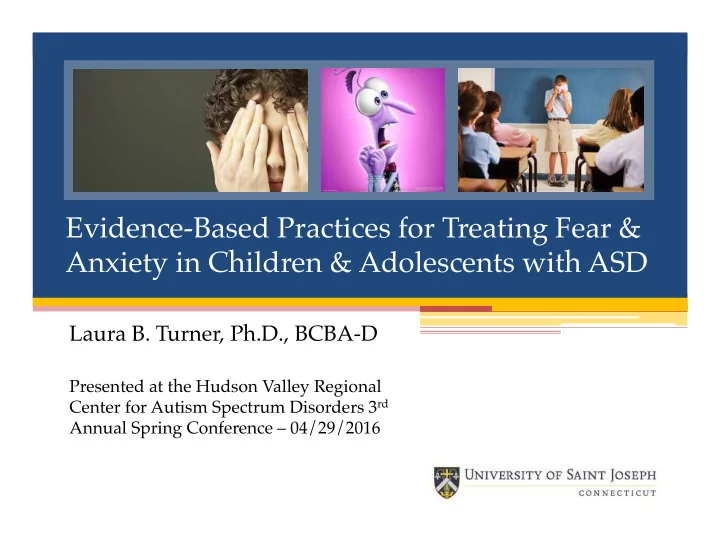
Evidence-Based Practices for Treating Fear & Anxiety in Children & Adolescents with ASD Laura B. Turner, Ph.D., BCBA-D Presented at the Hudson Valley Regional Center for Autism Spectrum Disorders 3 rd Annual Spring


slide-1
SLIDE 1
  • Evidence-Based Practices for Treating Fear &

Anxiety in Children & Adolescents with ASD

Laura B. Turner, Ph.D., BCBA-D

  • Presented at the Hudson Valley Regional

Center for Autism Spectrum Disorders 3rd Annual Spring Conference – 04/29/2016

slide-2
SLIDE 2

The purpose of this presentation is to provide…

1. An overview of the prevalence of fear and anxiety in children and adolescents with ASD 2. An overview of evidence-based approaches for alleviating anxiety in children and adolescents with ASD 3. Additional readings and resources for you to be able to learn more about these techniques

slide-3
SLIDE 3

Starting with Definitions: Fear and Anxiety

slide-4
SLIDE 4
  • It depends on the individual’s cognitive and social-communicative abilities
  • Verbalizations (content) & Vocalizations (volume, tone)
  • Facial expressions
  • Caution: Individuals with ASD can display atypical expression of emotional states, contextually-

incongruous emotional reactions, and unreliable and atypical fearful facial expressions

  • Body tenseness
  • Approach/avoidance behaviors
  • Noncompliance, aggression, self-injury & self-stimulatory behavior
  • How Do we Identify Fear & Anxiety in Individuals with ASD?

Hagopian & Jennett, 2008

  • Issues related to diagnostic overshadowing and symptom overlap
slide-5
SLIDE 5

With those caveats…fears and anxiety disorders are highly prevalent among children & adolescents with ASD

  • Approximately 40% have an anxiety disorder (APA, 2013; Leyfer et al.,

2006; Muris et al., 1998; Simonoff et al., 2008; Sukhodolsky et al., 2008) (<20% in general population)

▫ Specific Phobia: 9% - 64% (5-16% of children/adolescents without ASD) ▫ Social Anxiety Disorder: 8% - 30% (7% of children/adolescents without ASD) ▫ Generalized Anxiety Disorder: 2% - 23% (<1% of children/adolescents without ASD)

  • Children with ASD have more intense fears than children with
  • ther developmental and intellectual disorders (Evans et al., 2005; Rodgers et

al., 2011)

  • Atypical presentation of fear (Evans et al., 2005; Gillis et al., 2009; Turner & Romanczyk, 2012)

▫ More likely to have fears related to medical/dental procedures ▫ Less likely to have fears of dangerous situations and items that could cause harm

slide-6
SLIDE 6

Rank Fear Item “A lot of fear” 1 Getting Blood Drawn 64% 2 Getting a Shot 54% 3 Getting Teeth Cleaned 36% 4 Making Mistakes 29% 5 Insects 29% 6 Finger Prick 28% 7 The Dark 16% 8 Doctor Exam 15% 9 Severe Weather 15% 10 Meeting Peers 14%

Turner & Romanczyk (2012)

Top 10 Fears Rated by Parents of Children with ASD

n = 41

slide-7
SLIDE 7

When to seek help?

  • Does the fear/anxiety interfere with the individual’s

ability to learn or gain independent skills?

  • Is the fear/anxiety abnormally intense?
  • Does the fear/anxiety interfere with everyday activities?
  • Are there associated dangerous behaviors?
slide-8
SLIDE 8

Seeking Help: An Evidence-Based Approach to Overcoming Excessive Fear and Anxiety

  • Cognitive Behavior Therapy (CBT)

▫ Much empirical support for the effectiveness of CBT for children and adolescents without ASD (e.g., Kazdin & Weisz, 2003; Kendall, 2000)

BIACA – Building Confidence

▫ Growing body of support for the effectiveness of CBT for high functioning children and adolescents with ASD (e.g., Reaven et al., 2011; Wood et al., 2015)

– Must match approach to the cognitive, language and social-emotional abilities of the individual

slide-9
SLIDE 9

What is CBT?

  • An approach that merges theory and techniques from behavior

and cognitive therapy

▫ Cognitive: Behavior is a function of faulty thinking and irrational beliefs (Beck, 1972) ▫ Behavioral: Behavior (including verbal behavior) is a function of the environment (e.g., Skinner, 1938)

  • So, the focus of intervention is on the
  • acquisition of new ways of behaving.
  • Underlying assumption is that fear/anxiety

is learned (e.g., Watson & Raynor, 1920)

slide-10
SLIDE 10

Step 1. Psycho-Education: Recognizing Your Anxiety

  • Evaluating & developing

emotional competence

▫ Typically need to spend more time on this step than with individuals without ASD

  • Identification of idiosyncratic

internal cues

▫ How do I know I’m anxious?

  • Identification of idiosyncratic

external triggers

▫ What situations make me anxious?

  • Linking behavior, thoughts

and feelings

▫ Self-monitoring

slide-11
SLIDE 11
slide-12
SLIDE 12

Step 2. Teaching Alternative Skills

  • Attwood & Scarpa, 2013; McNally Keehn et al., 2013; Reaven et al., 2011; White et al., 2015; Wood et al., 2015

▫ Positive self-talk, self-instructions

  • Specific Skills – Coping & Problem Solving

▫ Cognitive Restructuring

– Challenge irrational beliefs & faulty thinking patterns – Increased focus on flexible thinking

▫ “Worry time” ▫ Relaxation techniques, e.g.,

– Diaphragmatic breathing – Progressive muscle relaxation

  • Teaching Considerations

▫ Incorporation of concrete language and examples & visuals ▫ Use prompts and reinforcers ▫ Teach to fluency in a calm state ▫ Program for generalization

slide-13
SLIDE 13

Step 2 Continued. A Relatively New Approach for Individuals with ASD: Acceptance

Eilers & Hayes, 2015; Dixon, 2014; Hayes et al., 2001, 2012; Hoffman et al., 2016; Pahnke et al., 2014; Spek et al., 2013

  • Focus isn’t on changing private events (i.e., thoughts and

feelings); rather, focus is placed on changing the way an individual reacts to those thoughts and feelings.

  • A few components:

▫ Mindfulness – contact with present moment ▫ Defusion of thoughts

  • Acceptance & Commitment Therapy

▫ A form of CBT; based on behavior analytic theory

slide-14
SLIDE 14

Considerations for Conducting Sessions

  • Talking about private events (e.g., thoughts and emotions) can be

non-preferred, unpredictable and difficult…

  • Motivation – Make it fun!

▫ Consider motivation to change and to attend sessions ▫ Incorporate reinforcers for participation ▫ Incorporate idiosyncratic interests

  • Schedule

▫ Inclusion of clear session and activity schedules ▫ Schedules & reminders for CBT homework

Attwood & Scarpa, 2013; McNally Keehn et al., 2013; Reaven et al., 2011; White et al., 2015; Wood et al., 2015

slide-15
SLIDE 15

Step 3. Graduated Exposure*

  • ALL forms of CBT include this component - Considered the most important!
  • Effective for lower-functioning children with ASD

*Considered evidence-based for the treatment of specific phobia in children with ASD (Jennett & Hagopian, 2008)

  • Gradually and systematically place the individual in contact with the feared

stimuli(us)

▫ Respondent Extinction: Shape approach responses to break the association between the conditioned stimulus (e.g., a dog) and the unconditioned stimulus (e.g., loud bark) so the individual can learn a new association ▫ It is important that the feared stimulus not be paired with aversive events (including extreme anxiety responses) and the individual not be able to escape the situation (i.e., operant extinction)

– Consideration: Preventing escape is correlated with more aggression in children with an ASD than typically developing children (Evans et al., 2005)

slide-16
SLIDE 16

Graduated Exposure – Developing a Fear Hierarchy*

*Considered evidence-based for the treatment of specific phobia in children with ASD (Jennett & Hagopian, 2008)

  • Following a multi-component and

individualized assessment, collaboratively develop a fear hierarchy

– Direct observation; interview with individual and caregivers

slide-17
SLIDE 17
  • Start with situation that elicits mild anxiety –

ensure success with approaching!

▫ Importance of clearly defining responses

  • Provide prompts* (e.g., verbal, visual,

model*) to engage in the approach behavior

  • Ensure consistent success before moving on to

next step!

▫ Can have individuals rate their anxiety during contact with stimulus to ensure success

Graduated Exposure – Using a Fear Hierarchy*

*Considered evidence-based for the treatment of specific phobia in children with ASD (Jennett & Hagopian, 2008)

  • Provide contingent reinforcement* for

approach responses and absence of fear responses

▫ Importance of identifying effective reinforcers ▫ Include goal setting

slide-18
SLIDE 18

Making Exposure Collaborative by Incorporating Choice: An Example

“I’m afraid you’re going to cut my pinky toe”

slide-19
SLIDE 19

Important to Include Social Skills Training

  • Particularly important when individual has social phobia

▫ Poor social skills can produce negative outcomes for social exposures

slide-20
SLIDE 20

Involving Parents…Even though this is the last slide, this is one of the most important parts of CBT!

  • Parent training is important – “Co-therapists”

▫ Continue skills learned in sessions at home (e.g., psycho-education, coping skills, exposure exercises, contingency management) ▫ Target parenting behavior and the parent-child relationship

  • Some support for a focus on parent anxiety

▫ Parents of children with ASD have more anxiety (and stress and depression) than parents without a child with ASD ▫ High parental anxiety is associated with negative

  • child outcomes

Creswell et al., (2008); Kuusikko-Gauffun et al., 2013; Reaven & Blakeley-Smith, 2013

slide-21
SLIDE 21

lbturner@usj.edu