EVALUATING FASD PREVENTION & SUPPORT PROGRAMS Tools to Support - - PowerPoint PPT Presentation

evaluating fasd prevention
SMART_READER_LITE
LIVE PREVIEW

EVALUATING FASD PREVENTION & SUPPORT PROGRAMS Tools to Support - - PowerPoint PPT Presentation

EVALUATING FASD PREVENTION & SUPPORT PROGRAMS Tools to Support Planning and Evaluation Nancy Poole Director, BC Centre of Excellence for Womens Health Deborah Rutman, Marilyn Van Bibber, Carol Hubberstey & Sharon Hume Nota Bene


slide-1
SLIDE 1

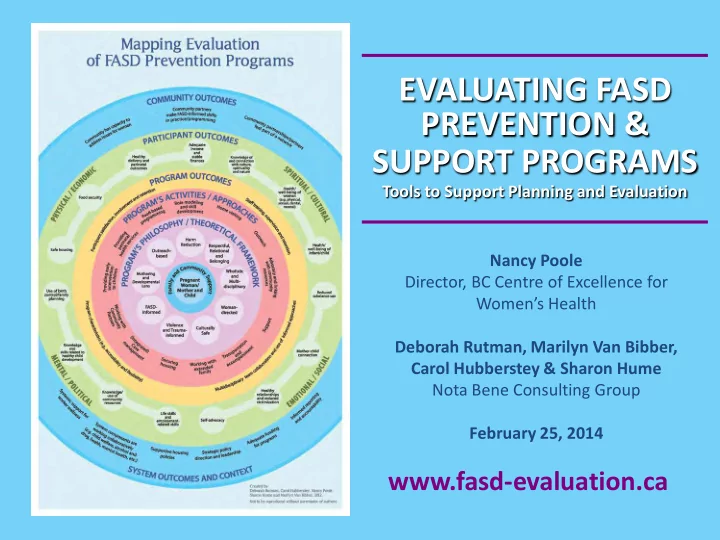
EVALUATING FASD PREVENTION & SUPPORT PROGRAMS

Tools to Support Planning and Evaluation Nancy Poole Director, BC Centre of Excellence for Women’s Health Deborah Rutman, Marilyn Van Bibber, Carol Hubberstey & Sharon Hume Nota Bene Consulting Group February 25, 2014

www.fasd-evaluation.ca

slide-2
SLIDE 2

Project Sponsor: British Columbia Centre of Excellence for Women’s Health Project funder: The Public Health Agency of Canada’s Fetal Alcohol Spectrum Disorder (FASD) National Strategic Project Fund The views expressed do not necessarily represent those of PHAC. For more information, please contact: BC Centre of Excellence for Women’s Health - http://bccewh.bc.ca Nota Bene Consulting Group - notabenegroup@shaw.ca

www.fasd-evaluation.ca

slide-3
SLIDE 3

AGENDA

  • 1. Overview of project
  • 2. Intro to the Evaluation Approach and Maps
  • 3. Intro to the Website

Q&A

  • 4. Program Philosophy & Evaluation
  • 5. Case Example: Participant & Community Outcomes

Q&A and Discussion

slide-4
SLIDE 4

PROJECT OBJECTIVES

This three-year project (ending March 31, 2014) has aimed to:

  • Create common evaluation

frameworks and identify promising methods and tools for FASD programs serving pregnant women and mothers, youth and adults living with FASD, and FASD programs in Aboriginal communities

  • Support the capacity of

community-based organizations to undertake evaluation

slide-5
SLIDE 5

Why focus on evaluation?

What can evaluation do to improve FASD programming?

Implement Evaluate/ Learn/ Decide Plan Implement /Monitor Reflect/ Learn/ Decide/ Adjust Implement /Monitor Reflect/ Learn/Adjust

We believe that evaluation is a means to:

  • Learn about how a particular model

works with the population

  • Learn about how program

improvements can be made each year

  • Learn how new outcomes and
  • utcome measures may be identified
  • Learn what difference the program is

making for participants, providers, communities, and service systems

  • Inform evidenced-based decision-

making (e.g. re: funding, planning)
slide-6
SLIDE 6

We created visual maps that include:

  • Theoretical/philosophical

foundations of programs

  • Program activities and

program/formative

  • utcomes
  • Participant outcomes
  • Community outcomes &

context

  • Systemic outcomes
slide-7
SLIDE 7

FASD Programs in Aboriginal Communities FASD Support Programs

slide-8
SLIDE 8

Website Overview www.fasd-evaluation.ca

slide-9
SLIDE 9

Resource Guides

There are two resource guides available on the website:

  • 1. An Intro to the Visual Maps
  • 2. Using Program Philosophy

as a Foundation to FASD Evaluation

slide-10
SLIDE 10

Introduction to the Visual Maps Includes Organizational Reflection and Assessment Questions and examples of how others are using the maps

slide-11
SLIDE 11

10 Key Philosophy/Theoretical Frameworks

www.fasd-evaluation.ca

slide-12
SLIDE 12

Q&A

slide-13
SLIDE 13

Using Program Philosophy as a Foundation for Evaluation

Describing the philosophy and theoretical framework of your program can increase learning about questions such as:

  • Why are we doing things in a particular

way?

  • Are we doing the right things?
  • Does our approach continue to be

responsive to the needs of our program participants?

slide-14
SLIDE 14

Linking Program Philosophy, Activities/Approaches and Program Outcomes

Which aspects of your program are contributing to positive outcomes - including having participants (continue to) engage? Program Activities/Approaches: Important to uncover and highlight activities that are sometimes ‘invisible’

Examples of Program Outcomes:

  • Participants feel safe;

welcome; safe; respected

  • Participants take part in

decision making

  • Program is accessible
  • Program is flexible
  • Staff have training, support &

supervision

  • Staff employ informed

approaches

  • Team works collaboratively
slide-15
SLIDE 15

Mapping Evaluation: Participant Outcomes

Participant Outcomes organized by:

  • Health and Well-being (of mother &

child)

  • Housing & Income support
  • Knowledge & skills
  • Relational & spiritual development

Each section can be downloaded and includes:

  • Short-term, intermediate and

long-term outcomes

  • Indicators of outcomes
  • Measurement tools and

resources

slide-16
SLIDE 16

Participant Outcome Example: Self-confidence, self-esteem & hope

slide-17
SLIDE 17

Participant Outcome Example: Self-confidence, self-esteem & hope

slide-18
SLIDE 18

Mapping Evaluation: Community & Systems Outcomes

Community Outcomes – Examples

  • Community partners feel part of a

network

  • Community partners have knowledge
  • f FASD
  • Community partners make FASD-

informed shift in practice/programming

  • Community has capacity to address

issues for women

Systems Outcomes – Examples

  • Supportive housing policies
  • Informed reporting and accountability
slide-19
SLIDE 19

Q&A

slide-20
SLIDE 20

Project Sponsor: British Columbia Centre of Excellence for Women’s Health Project funder: The Public Health Agency of Canada’s Fetal Alcohol Spectrum Disorder (FASD) National Strategic Project Fund The views expressed do not necessarily represent those of PHAC. For more information, please contact: BC Centre of Excellence for Women’s Health - http://bccewh.bc.ca Nota Bene Consulting Group - notabenegroup@shaw.ca

www.fasd-evaluation.ca