Ethics for Tax Return Preparers: Meeting Standards for Conduct Under - - PowerPoint PPT Presentation

ethics for tax return preparers meeting standards for
SMART_READER_LITE
LIVE PREVIEW

Ethics for Tax Return Preparers: Meeting Standards for Conduct Under - - PowerPoint PPT Presentation

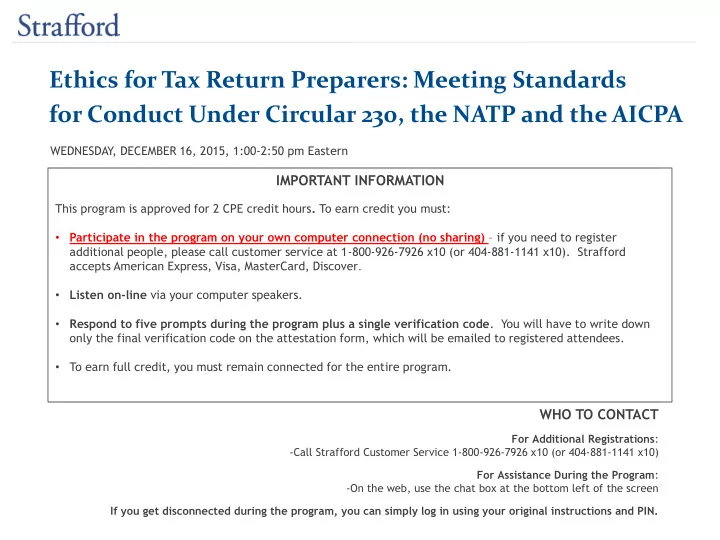
Ethics for Tax Return Preparers: Meeting Standards for Conduct Under Circular 230, the NATP and the AICPA WEDNESDAY , DECEMBER 16, 2015, 1:00-2:50 pm Eastern IMPORTANT INFORMATION This program is approved for 2 CPE credit hours . To earn credit


slide-1
SLIDE 1

WHO TO CONTACT

For Additional Registrations:

  • Call Strafford Customer Service 1-800-926-7926 x10 (or 404-881-1141 x10)

For Assistance During the Program:

  • On the web, use the chat box at the bottom left of the screen

If you get disconnected during the program, you can simply log in using your original instructions and PIN.

IMPORTANT INFORMATION

This program is approved for 2 CPE credit hours. To earn credit you must:

  • Participate in the program on your own computer connection (no sharing) – if you need to register

additional people, please call customer service at 1-800-926-7926 x10 (or 404-881-1141 x10). Strafford accepts American Express, Visa, MasterCard, Discover.

  • Listen on-line via your computer speakers.
  • Respond to five prompts during the program plus a single verification code. You will have to write down
  • nly the final verification code on the attestation form, which will be emailed to registered attendees.
  • To earn full credit, you must remain connected for the entire program.

Ethics for Tax Return Preparers: Meeting Standards for Conduct Under Circular 230, the NATP and the AICPA

WEDNESDAY , DECEMBER 16, 2015, 1:00-2:50 pm Eastern

slide-2
SLIDE 2

Tips for Optimal Quality

Sound Quality When listening via your computer speakers, please note that the quality

  • f your sound will vary depending on the speed and quality of your internet

connection. If the sound quality is not satisfactory, please e-mail sound@straffordpub.com immediately so we can address the problem. Viewing Quality To maximize your screen, press the F11 key on your keyboard. To exit full screen, press the F11 key again.

FOR LIVE EVENT ONLY

slide-3
SLIDE 3
  • Dec. 16, 2015

Ethics for Tax Return Preparers

Joe Marchbein, CPA Rice Sullivan, LLC jmarchbein@rsco.net Gerard Schreiber Schreiber & Schreiber CPAs ghschreiber@bellsouth.net

slide-4
SLIDE 4

Notice

ANY TAX ADVICE IN THIS COMMUNICATION IS NOT INTENDED OR WRITTEN BY THE SPEAKERS’ FIRMS TO BE USED, AND CANNOT BE USED, BY A CLIENT OR ANY OTHER PERSON OR ENTITY FOR THE PURPOSE OF (i) AVOIDING PENALTIES THAT MAY BE IMPOSED ON ANY TAXPAYER OR (ii) PROMOTING, MARKETING OR RECOMMENDING TO ANOTHER PARTY ANY MATTERS ADDRESSED HEREIN.

You (and your employees, representatives, or agents) may disclose to any and all persons, without limitation, the tax treatment or tax structure, or both, of any transaction described in the associated materials we provide to you, including, but not limited to, any tax opinions, memoranda, or other tax analyses contained in those materials. The information contained herein is of a general nature and based on authorities that are subject to change. Applicability of the information to specific situations should be determined through consultation with your tax adviser.

slide-5
SLIDE 5

5 5

Today’s Agenda

  • Introduction
  • Discussion of standards

― Circular 230 ― NATP and NAEA ― Penalties

  • Examples
  • Tips for ensuring compliance with conduct standards
  • Closing remarks
slide-6
SLIDE 6

6 6

Something To Bear In Mind

  • Enrolled agent duties by definition can include preparing tax
  • documents. Thus, a number of slides in this presentation refer

to code sections applying to return preparers, and those sections also cover enrolled agents.

slide-7
SLIDE 7

7 7

Introduction

slide-8
SLIDE 8

8 8

Ethics: Relevance In Practice

  • Avoid loss of your practice or livelihood
  • Avoid penalties and/or some type of censure
  • Avoid malpractice
  • Keep clients from getting penalties
  • Opportunities to build your practice and attract ethical

employees and clients

  • Practice with greater confidence
  • Duties to the tax system and as a professional
slide-9
SLIDE 9

9 9

Rules And Excerpts

slide-10
SLIDE 10

10 10

Rules Relevant To Enrolled Agents

  • Circular 230
  • Rules of conduct of licensing boards
  • Rules of professional organizations

― NAEA and NATP

  • Tax penalties applicable to preparers and clients
slide-11
SLIDE 11

Circular 230

http://www.irs.gov/pub/irs-utl/pcir230.pdf

11

slide-12
SLIDE 12

12 12

What Is Circular 230?

  • Sect. 330 of Title 31 of U.S. Code
  • Treasury has authority to regulate practice before Treasury and

IRS.

  • Allow for effective tax compliance and administration; increase

public confidence in tax professionals

  • §10.53(a): “If an officer or employee of the Internal Revenue

Service has reason to believe a practitioner has violated any provision of this part, the officer or employee will promptly make a written report of the suspected violation. The report will explain the facts and reasons upon which the officer’s or employee’s belief rests and must be submitted to the office(s) of the Internal Revenue Service responsible for administering or enforcing this part.”

  • Sanctions possible; specified and reported in Internal Revenue

Bulletin ― http://www.irs.gov/pub/irs-utl/newly_revised_final_tax- non_compliance_sanction_guidelines_3.pdf

slide-13
SLIDE 13

General Information

  • US Treasury Regulation – 31 CFR Part 10
  • Regulates Practice Before the IRS of CPAs,

Attorneys, Enrolled Agents, Enrolled Actuaries, and Registered Tax Return Preparers

  • Sanctions: Suspension or Disbarment from Practice

Before the IRS; Public Censure; Fines

  • States May have Similar Standards
  • Similarity with AICPA SSTSs and Ethics sections
  • Interaction with some Internal Revenue Code

sections (6694)

slide-14
SLIDE 14

Administration

  • Administered by the IRS Office of

Professional Responsibility (OPR) (Previously Director of Practice)

  • OPR works with Return Preparer Office
  • Some matters handled by Return Preparer

Office and Examination

  • Very Limited Appeal Rights
slide-15
SLIDE 15

Administration-continued

  • Secretary may suspend, disbar, censure
  • For incompetence, is disreputable, or

violates regulations

  • With intent to defraud, willfully, and

knowingly misleads or threatens the person being represented or a prospective person to be represented

  • May impose monetary penalties(done this

year against a valuation firm)

slide-16
SLIDE 16

16 16

Selected Sections of Circular 230

  • § 10.20 Information to be furnished
  • § 10.21 Knowledge of client’s omission
  • § 10.22 Diligence as to accuracy
  • § 10.23 Prompt disposition of pending matters
  • § 10.28 Return of client’s records
  • § 10.29 Conflicting interests
  • § 10.33 Best practices for tax advisors
  • § 10.34 Standards with respect to tax returns and documents, affidavits

and other papers

  • § 10.35 Requirements for covered opinions
  • § 10.50 Sanctions
  • § 10.51 Incompetence and disreputable conduct
  • § 10.52 Violations subject to sanction
  • § 10.53 Receipt of information concerning practitioner
  • § 10.82 Expedited Suspension
slide-17
SLIDE 17

§ 10.20 Information to be furnished

(a) To the Internal Revenue Service. (1) A practitioner must, on a proper and lawful request by a duly authorized officer or employee of the Internal Revenue Service, promptly submit records or information in any matter before the Internal Revenue Service unless the practitioner believes in good faith and on reasonable grounds that the records or information are privileged.

17

slide-18
SLIDE 18

§ 10.21 Knowledge of client’s omission

  • A practitioner who, having been retained by a client with respect to a matter

administered by the Internal Revenue Service, knows that the client has not complied with the revenue laws of the United States or has made an error in

  • r omission from any return, document, affidavit, or other paper which the

client submitted or executed under the revenue laws of the United States, must advise the client promptly of the fact of such noncompliance, error, or

  • mission. The practitioner must advise the client of the consequences as

provided under the Code and regulations of such noncompliance, error, or

  • mission.
slide-19
SLIDE 19

Knowledge of Client’s Omission (§ 10.21)

  • Non-Compliance with Rule or Law
  • Error or Omission
  • Prompt Notification of Problem
  • Notification Must Include Consequences
  • Exercise Professional Judgment
slide-20
SLIDE 20

20 20

Due Diligence - 1

Circular 230 - §10.22 diligence as to accuracy

  • “(a) In general. A practitioner must exercise due diligence —

― (1) In preparing or assisting in the preparation of, approving, and filing tax returns, documents, affidavits, and other papers relating to Internal Revenue Service matters; ― (2) In determining the correctness of oral or written representations made by the practitioner to the Department of the Treasury; and ― (3) In determining the correctness of oral or written representations made by the practitioner to clients with reference to any matter administered by the Internal Revenue Service.”

slide-21
SLIDE 21

Due Diligence Issues

  • Extensions
  • Elections
  • Acceptance of taxpayer provided information
  • Estimates
  • Answers to questions on tax returns
  • Is “same as last year”(SALY) acceptable?
  • Estates and trusts with new 3.8 % NII
  • ACA Matters

21

slide-22
SLIDE 22
  • We note there was a deduction for automobile expenses on your 2014

income tax returns.

  • The IRS requires written records be maintained to document the business

use of your vehicle.

  • Please provide answers to the questions below so we may have the

information to properly complete this part of your income tax return and return to us by fax or mail.

  • Description of Vehicle_____________________
  • Odometer reading at 12/31/15_______________
  • Was the vehicle available for your personal use during off-duty hours? Yes

No

  • Did you have another vehicle available for your personal use (this includes

a vehicle you own personally)? Yes No

  • Please provide the number of miles driven in 2015 for each of the following

categories:

  • Total commuting miles

________________

  • Total other personal (non-commuting) miles ________________
  • Total personal miles _ ______________
  • Total business miles

________________

  • Signed_____________________
slide-23
SLIDE 23
  • We have not received the necessary information from you to timely file your 2015

individual income tax returns.

  • We need your written authorization and the amounts of federal income tax withheld and/or

estimated tax payments made by you in order to timely and accurately file an extension on your behalf. Any tax due must be paid with the extension.

  • This is an extension of time to file and not to pay. Any balances due will incur the failure to

timely pay penalty and interest.

  • Please complete the bottom of this letter with your authorization and the amounts of

federal income tax withheld and/or estimated tax payments made by you and return to us by Monday, April 8, 2016 if you desire us to prepare an extension on your behalf.

  • If you are required to make 2016 estimated tax payments, please note the first payment is

due on April 15, 2016.

  • Please file an extension on my behalf. ___________________________Signature
  • Amount of income tax withheld(Attach W-2 Forms) $
  • Estimated tax payments made:
  • Date

Federal Louisiana

slide-24
SLIDE 24

24 24

Due Diligence - 2

Circular 230, §10.34(d) - Relying on information furnished by clients

  • “A practitioner advising a client to take a position on a tax

return, document, affidavit or other paper submitted to the Internal Revenue Service, or preparing or signing a tax return as a preparer, generally may rely in good faith without verification upon information furnished by the client. The practitioner may not, however, ignore the implications of information furnished to, or actually known by, the practitioner, and must make reasonable inquiries if the information as furnished appears to be incorrect, inconsistent with an important fact or another factual assumption, or incomplete.”

slide-25
SLIDE 25

25 25

Due Diligence - 3

What due diligence requirements apply to enrolled agents and return preparers?

  • In general, tax return preparers should understand the underlying

substantive law affecting an item of income or deduction. Tax return preparers must exercise due diligence in preparing or assisting in the preparation, approval, and filing of returns, documents, affidavits or other papers relating to IRS matters. Tax return preparers also must exercise due diligence in determining: (1) the correctness of oral and written representations made by the tax return preparer to the IRS, and (2) the correctness of representations made by the tax return preparer to the client with reference to any matter administered by the IRS. Tax return preparers who prepare returns for taxpayers who may be eligible for the earned income tax credit have additional due diligence requirements.

slide-26
SLIDE 26

Circular 230 §10.29 Conflicting Interests

slide-27
SLIDE 27

§10.29 Conflicting Interests

  • The representation is not prohibited by law; and each affected

client waives the conflict of interest and gives informed consent, confirmed in writing by each affected client, at the time the existence of the conflict of interest is known by the practitioner. The confirmation may be made within a reasonable period of time after the informed consent, but in no event later than 30 days.

  • Copies of the written consents must be retained by the

practitioner for at least 36 months from the date of the conclusion of the representation of the affected clients, and the written consents must be provided to any officer or employee of the Internal Revenue Service on request.

27

slide-28
SLIDE 28

§ 10.35 Competence

(a) A practitioner must possess the necessary competence to engage in practice before the Internal Revenue Service. Competent practice requires the appropriate level of knowledge, skill, thoroughness, and preparation necessary for the matter for which the practitioner is engaged. A practitioner may become competent for the matter for which the practitioner has been engaged through various methods, such as consulting with experts in the relevant area or studying the relevant law.

28

slide-29
SLIDE 29

29 29

§ 10.36 Procedures to ensure compliance

(a) Any individual subject to the provisions of this part who has (or individuals who have or share) principal authority and responsibility for overseeing a firm’s practice governed by this part, including the provision of advice concerning Federal tax matters and preparation of tax returns, claims for refund, or other documents for submission to the Internal Revenue Service, must take reasonable steps to ensure that the firm has adequate procedures in effect for all members, associates, and employees for purposes of complying with subparts A, B, and C of this part, as applicable. In the absence of a person or persons identified by the firm as having the principal authority and responsibility described in this paragraph, the Internal Revenue Service may identify one or more individuals subject to the provisions of this part responsible for compliance with the requirements of this section.

slide-30
SLIDE 30

30 30

§ 10.36 Procedures to ensure compliance- Continued

(b) Any such individual who has (or such individuals who have or share) principal authority as

described in paragraph (a) of this section will be subject to discipline for failing to comply with the requirements of this section if— (1) The individual through willfulness, recklessness, or gross incompetence does not take reasonable steps to ensure that the firm has adequate procedures to comply with this part, as applicable, and one or more individuals who are members of, associated with, or employed by, the firm are, or have, engaged in a pattern or practice, in connection with their practice with the firm, of failing to comply with this part, as applicable; (2) The individual through willfulness, recklessness, or gross incompetence does not take reasonable steps to ensure that firm procedures in effect are properly followed, and one or more individuals who are members of, associated with, or employed by, the firm are, or have, engaged in a pattern or practice, in connection with their practice with the firm, of failing to comply with this part, as applicable; or (3) The individual knows or should know that one or more individuals who are members of, associated with, or employed by, the firm are, or have, engaged in a pattern or practice, in connection with their practice with the firm, that does not comply with this part, as applicable, and the individual, through willfulness, recklessness, or gross incompetence fails to take prompt action to correct the noncompliance.

slide-31
SLIDE 31

31 31

OPR Director Karen Hawkins On §10.36(b)

  • “10.36(b) essentially is a provision that says that if you have a firm
  • r some kind of business with employees, and you have the

primary responsibility for the tax preparation process and procedures in your office, you may incur personal liability under Circular 230 if you fail to ensure that the people who are preparing the returns and who are advising clients and working with clients— you have to ensure that they are adhering to Circular 230.”

  • She encourages firms to have written procedures.
  • If you become aware someone in your firm unaware or out of

compliance, you must “take steps to ensure that they make corrections to that behavior and that it doesn’t happen in the future.”

  • “So there are some serious liability issues for owners of businesses

in Circular 230 at 10.36. “

slide-32
SLIDE 32

§10.37 Requirements For Written Advice

  • Facts-and-circumstances test
  • Not whether each requirement is address in the advice
  • Advice covered extends not only to income tax but also estate,

gift and payroll taxes.

  • Still heightened standards for tax shelters
  • Practitioners may only rely on other practitioners if the

reliance is reasonable and in good faith, and there is no basis to believe that the other practitioner should not be relied upon, is incompetent or has a conflict of interest.

  • Practitioner must not take into consideration the possibility the

return will be audit.

  • Practitioner may take into account the possibility that, if the

issue is raised by the IRS, the issue will be resolved thru settlement.

  • Maybe abandon the disclaimers being used since 2005

32

slide-33
SLIDE 33

§ 10.50 Sanctions

(a) Authority to censure, suspend, or disbar. The Secretary of the Treasury, or delegate, after notice and an opportunity for a proceeding, may censure, suspend, or disbar any practitioner from practice before the Internal Revenue Service if the practitioner is shown to be incompetent or disreputable (within the meaning of §10.51), fails to comply with any regulation in this part (under the prohibited conduct standards of §10.52), or with intent to defraud, willfully and knowingly misleads or threatens a client or prospective

  • client. Censure is a public reprimand.

33

slide-34
SLIDE 34

§ 10.51 Incompetence and disreputable conduct

(a) Incompetence and disreputable conduct. Incompetence and disreputable conduct for which a practitioner may be sanctioned under §10.50 includes, but is not limited to — (1) Conviction of any criminal offense under the Federal tax laws. (2) Conviction of any criminal offense involving dishonesty or breach of trust. (3) Conviction of any felony under Federal or State law for which the conduct involved renders the practitioner unfit to practice before the Internal Revenue Service. (4) Giving false or misleading information, or participating in any way in the giving of false or misleading information to the Department of the Treasury or any officer or employee thereof, or to any tribunal authorized to pass upon Federal tax matters, in connection with any matter pending or likely to be pending before them, knowing the information to be false or misleading. Facts or other matters contained in testimony, Federal tax returns, financial statements, applications for enrollment, affidavits, declarations, and any other document or statement, written or oral, are included in the term “information.”

34

slide-35
SLIDE 35

§ 10.51 Incompetence and disreputable conduct- Continued

(5) Solicitation of employment as prohibited under §10.30, the use of false or misleading representations with intent to deceive a client or prospective client in order to procure employment, or intimating that the practitioner is able improperly to obtain special consideration or action from the Internal Revenue Service or any officer or employee thereof. (6) Willfully failing to make a Federal tax return in violation of the Federal tax laws, or willfully evading, attempting to evade, or participating in any way in evading or attempting to evade any assessment or payment of any Federal tax. (7) Willfully assisting, counseling, encouraging a client or prospective client in violating,

  • r suggesting to a client or prospective client to violate, any Federal tax law, or

knowingly counseling or suggesting to a client or prospective client an illegal plan to evade Federal taxes or payment thereof. (8) Misappropriation of, or failure properly or promptly to remit, funds received from a client for the purpose of payment of taxes or other obligations due the United States.

35

slide-36
SLIDE 36

§ 10.51 Incompetence and disreputable conduct- Continued

(9) Directly or indirectly attempting to influence, or offering or agreeing to attempt to influence, the official action of any officer or employee of the Internal Revenue Service by the use of threats, false accusations, duress or coercion, by the offer of any special inducement or promise of an advantage or by the bestowing of any gift, favor or thing

  • f value.

(10) Disbarment or suspension from practice as an attorney, certified public accountant, public accountant, or actuary by any duly constituted authority of any State, territory,

  • r possession of the United States, including a Commonwealth, or the District of

Columbia, any Federal court of record or any Federal agency, body or board. (11) Knowingly aiding and abetting another person to practice before the Internal Revenue Service during a period of suspension, disbarment or ineligibility of such other person. (12) Contemptuous conduct in in connection with practice before the Internal Revenue Service, including the use of abusive language, making false accusations or statements, knowing them to be false, or circulating or publishing malicious or libelous matter.

36

slide-37
SLIDE 37

§ 10.51 Incompetence and disreputable conduct- Continued

(13) Giving a false opinion, knowingly, recklessly, or through gross incompetence, including an opinion which is intentionally or recklessly misleading, or engaging in a pattern of providing incompetent opinions on questions arising under the Federal tax laws. (14) Willfully failing to sign a tax return prepared by the practitioner when the practitioner’s signature is required by Federal tax laws unless the failure is due to reasonable cause and not due to willful neglect. (15) Willfully disclosing or otherwise using a tax return or tax return information in a manner not authorized by the Internal Revenue Code, contrary to the order of a court

  • f competent jurisdiction, or contrary to the order of an administrative law judge in a

proceeding instituted under §10.60. (16) Willfully failing to file on magnetic or other electronic media a tax return prepared by the practitioner when the practitioner is required to do so by the Federal tax laws unless the failure is due to reasonable cause and not due to willful neglect.

37

slide-38
SLIDE 38

§ 10.51 Incompetence and disreputable conduct- Continued

(17) Willfully preparing all or substantially all of, or signing, a tax return or claim for refund of, or signing, a tax return or claim for refund when the practitioner does not possess a current or otherwise valid preparer tax identification number or other prescribed identifying number. (18) Willfully representing a taxpayer before an officer or employee of the Internal Revenue Service unless the practitioner is authorized to do so pursuant to this part.

38

slide-39
SLIDE 39

§ 10.52 Violations subject to sanction

(a) A practitioner may be sanctioned under §10.50 if the practitioner — (1) Willfully violates any of the regulations (other than §10.33) contained in this part;

  • r

(2) Recklessly or through gross incompetence (within the meaning of §10.51(a)(13)) violates §§ 10.34, 10.35, 10.36 or 10.37.

39

slide-40
SLIDE 40

§ 10.53 Receipt of information concerning practitioner

(a) Officer or employee of the Internal Revenue Service. If an officer or employee of the Internal Revenue Service has reason to believe a practitioner has violated any provision of this part, the officer or employee will promptly make a written report of the suspected violation. The report will explain the facts and reasons upon which the

  • fficer’s or employee’s belief rests and must be submitted to the office(s) of the

Internal Revenue Service responsible for administering or enforcing this part. (b) Other persons. Any person other than an officer or employee of the Internal Revenue Service having information of a violation of any provision of this part may make an oral or written report of the alleged violation to the office(s) of the Internal Revenue Service responsible for administering or enforcing this part or any officer or employee

  • f the Internal Revenue Service. If the report is made to an officer or employee of the

Internal Revenue Service, the officer or employee will make a written report of the suspected violation and submit the report to the office(s) of the Internal Revenue Service responsible for administering or enforcing this part.

40

slide-41
SLIDE 41

§ 10.53 Receipt of information concerning practitioner-Continued

(c) Destruction of report. No report made under paragraph (a) or (b) of this section shall be maintained unless retention of the report is permissible under the applicable records control schedule as approved by the National Archives and Records Administration and designated in the Internal Revenue Manual. Reports must be destroyed as soon as permissible under the applicable records control schedule. (d) Effect on proceedings under subpart D. The destruction of any report will not bar any proceeding under subpart D of this part, but will preclude the use of a copy of the report in a proceeding under subpart D of this part.

41

slide-42
SLIDE 42

§10.82 Expedited Suspension

42

(a) When applicable. Whenever the Commissioner, or delegate, determines that a practitioner is described in paragraph (b) of this section, the expedited procedures described in this section may be used to suspend the practitioner from practice before the Internal Revenue Service. (b) To whom applicable. This section applies to any practitioner who, within 5 years prior to the date that a show cause order under this section’s expedited suspension procedures is served: (1) Has had a license to practice as an attorney, certified public accountant, or actuary suspended or revoked for cause (not including a failure to pay a professional licensing fee) by any authority or court, agency, body, or board described in §10.51(a)(10). (2) Has, irrespective of whether an appeal has been taken, been convicted of any crime under title 26 of the United States Code, any crime involving dishonesty or breach of trust, or any felony for which the conduct involved renders the practitioner unfit to practice before the Internal Revenue Service.

slide-43
SLIDE 43

§10.82 Expedited Suspension-Continued

43

(3) Has violated conditions imposed on the practitioner pursuant to §10.79(d). (4) Has been sanctioned by a court of competent jurisdiction, whether in a civil

  • r criminal proceeding (including suits for injunctive relief), relating to any

taxpayer’s tax liability or relating to the practitioner’s own tax liability, for — (i) Instituting or maintaining proceedings primarily for delay; (ii) Advancing frivolous or groundless arguments; or (iii) Failing to pursue available administrative remedies. (5) Has demonstrated a pattern of willful disreputable conduct by— (i) Failing to make an annual Federal tax return, in violation of the Federal tax laws, during 4 of the 5 tax years immediately preceding the institution of a proceeding under paragraph (c) of this section and remains noncompliant with any of the practitioner’s Federal tax filing obligations at the time the notice of suspension is issued under paragraph (f) of this section; or (ii) Failing to make a return required more frequently than annually, in violation

  • f the Federal tax laws, during 5 of the 7 tax periods immediately preceding the

institution of a proceeding under paragraph (c) of this section and remains noncompliant with any of the practitioner’s Federal tax filing obligations at the time the no

slide-44
SLIDE 44

§10.82 Expedited Suspension-Continued

44

(3) Has violated conditions imposed on the practitioner pursuant to §10.79(d). (4) Has been sanctioned by a court of competent jurisdiction, whether in a civil

  • r criminal proceeding (including suits for injunctive relief), relating to any

taxpayer’s tax liability or relating to the practitioner’s own tax liability, for — (i) Instituting or maintaining proceedings primarily for delay; (ii) Advancing frivolous or groundless arguments; or (iii) Failing to pursue available administrative remedies. (5) Has demonstrated a pattern of willful disreputable conduct by— (i) Failing to make an annual Federal tax return, in violation of the Federal tax laws, during 4 of the 5 tax years immediately preceding the institution of a proceeding under paragraph (c) of this section and remains noncompliant with any of the practitioner’s Federal tax filing obligations at the time the notice of suspension is issued under paragraph (f) of this section; or (ii) Failing to make a return required more frequently than annually, in violation

  • f the Federal tax laws, during 5 of the 7 tax periods immediately preceding the

institution of a proceeding under paragraph (c) of this section and remains noncompliant with any of the practitioner’s Federal tax filing obligations at the time the notice of suspension is issued under paragraph (f) of this section.

slide-45
SLIDE 45

45

General Rules Of Conduct/Best Practices

  • Know what you are subject to
  • Have ready access to the rules and any interpretations or rulings
  • Common topics

― License renewal terms and requirements (including continuing education requirements) ― Firm name ― Client records ― Confidentiality ― Commissions and contingent fees ― Conflicts ― Due diligence and competence ― Peer review ― Advertising and solicitation and fees ― Acts discreditable

  • Licensing body may have an ethics hotline; find out
slide-46
SLIDE 46

46

NAEA And NATP

  • If a member, be familiar with the rules including enforcement mechanism, and

have ready access ― Be sure colleagues and staff are also familiar

  • NAEA Code of Ethics + Rules of Professional Conduct

― Example No. 19: “If representation is terminated, a Member or Associate will make reasonable steps to protect the former client's interests including providing reasonable notice to allow retention of another practitioner, surrendering papers and property to which the client is entitled, and refunding unearned advance fees.”

  • NATP Code of Ethics + Standards of Professional Conduct 11 standards

― Example – Standard 5: “If the client will not permit enough disclosures to accurately complete the service, then the member should withdraw from the assignment.” ― “Threefold responsibility” ― Clients, the member and the government

slide-47
SLIDE 47

47 47

Civil Tax Penalties Applicable To Enrolled Agents

  • §6694: Understatement of taxpayer’s liability by enrolled agents

and return preparers

  • §6695: Other assessable penalties with respect to preparation of

tax returns for other persons ― (a) Failure to furnish copy to taxpayer ― (b) Failure to sign return ― (c) Failure to furnish identifying number ― (d) Failure to retain copy or list ― (e) Failure to file correct information returns ― (f) Negotiation of check ― (g) Failure to be diligent in determining eligibility for earned income credit [Form 8867]

  • §6695A: Substantial and gross valuation misstatements

attributable to incorrect appraisals

  • §6696: Rules applicable with respect to §§6694, 6695 and 6695A
slide-48
SLIDE 48

48 48

  • Sect. 6694(a)

(a) Understatement due to unreasonable positions

  • (1) In general. If a tax return preparer—

― (A) Prepares any return or claim of refund with respect to which any part of an understatement of liability is due to a position described in paragraph (2), and ― (B) Knew (or reasonably should have known) of the position,

  • Such tax return preparer shall pay a penalty with respect to each such return or claim in

an amount equal to the greater of $1,000 or 50 percent of the income derived (or to be derived) by the tax return preparer with respect to the return or claim.

  • (2) Unreasonable position

― (A) In general. Except as otherwise provided in this paragraph, a position is described in this paragraph unless there is or was substantial authority for the position. ― (B) Disclosed positions. If the position was disclosed as provided in section 6662(d)(2)(B)(ii)(I) and is not a position to which subparagraph (C) applies, the position is described in this paragraph unless there is a reasonable basis for the position. ― (C) Tax shelters and reportable transactions. If the position is with respect to a tax shelter (as defined in section 6662(d)(2)(C)(ii)) or a reportable transaction to which section 6662A applies, the position is described in this paragraph unless it is reasonable to believe that the position would more likely than not be sustained on its merits.

  • (3) Reasonable cause exception. No penalty shall be imposed under this subsection if it is

shown that there is reasonable cause for the understatement and the tax return preparer acted in good faith.

slide-49
SLIDE 49

49 49

Relevant Standards For Tax Research And Transactions

Term Definition Authority

Will 95% or greater probability of success if challenged by IRS Should 70% or greater probability of success if challenged by IRS MLTN Greater than 50% probability of success if challenged by IRS

  • Reg. §1.6664-4(f)(2)(B)

Substantial authority Weight of authorities in support of a position is substantial in relation to the weight of authorities in opposition to the position

  • Reg. §1.6662-4(d)

Realistic possibility of success (RPOS) 1 in 3 possibility of success if challenged by IRS

  • Reg. §1.6694-2(b)

(CPAs – also see SSTS Interpretation 1-1) Reasonable basis Significantly higher than not frivolous, lower than RPOS, or not patently improper

  • Reg. §1.6662-3(b)(3)
slide-50
SLIDE 50

50 50

More IRC Penalties Relevant To Enrolled Agents And Preparers

  • §6700: Promoting abusive tax shelters, etc.
  • §6701: Penalties for aiding and abetting understatement of tax liability
  • §6702: Frivolous tax submissions
  • §6703: Rules applicable to penalties under §§6700, 6701 and 6702
  • §6704: Failure to keep records necessary to meet reporting requirements under §6047(d)

[Reports by employers, plan administrators, etc.]

  • §6707: Failure to furnish information regarding reportable [or listed] transactions

― Minimum penalty is $50K ($200K if it is a listed transaction) ― Ties to §6111 on disclosure of reportable and listed transactions (as defined by §6707A(c))

  • §6707A: Penalty for failure to include reportable [or listed] transaction information with

return

  • §6708: Failure to maintain lists of advisees with respect to reportable transactions
  • §6713: Disclosure or use of information by preparers of returns
  • §7216: Disclosure or use of information by preparers of returns
  • §7206: Fraud and false statements
  • §7210: Failure to obey summons
  • §7407: Action to enjoin tax return preparers
  • §7408: Actions to enjoin specified conduct related to tax shelters and reportable

transactions

slide-51
SLIDE 51

51

Relevant Enrolled Agent And Preparer Definitions

  • Code Sect. 7701(a)(36)
  • Treas. Reg. §301.7701-15(b)
  • Circular 230, §10.3 – Who may practice
  • §7525 Confidentiality privileges relating to taxpayer communications

― “Any federally authorized tax practitioner”

  • Code Sect. 7216 – broader reach for this penalty

51

slide-52
SLIDE 52

52 52

Rules Of Conduct Cautions: Variations

  • Varying definitions of who is subject to Circular 230 vs. PTIN
  • vs. various penalties

― Example: Administrative assistant helps CPA organize files, get data from clients and input data; no analysis ― Not a “tax return preparer,” so no PTIN needed and not subject to §6694, Understatement of taxpayer's liability by tax return preparer ― Not a Circular 230 practitioner ― But, subject to penalties of §6713 and §7216 for improper use or disclosure of tax return information

slide-53
SLIDE 53

53 53

7701(a)(36) Tax Return Preparer

  • 7701(a)(36)(A) In general. The term “tax return preparer” means any person who prepares

for compensation, or who employs one or more persons to prepare for compensation, any return of tax imposed by this title or any claim for refund of tax imposed by this title. For purposes of the preceding sentence, the preparation of a substantial portion of a return or claim for refund shall be treated as if it were the preparation of such return or claim for refund.

  • 7701(a)(36)(B) Exceptions . A person shall not be an [sic] “tax return preparer” merely

because such person:

  • 7701(a)(36)(B)(i) Furnishes typing, reproducing, or other mechanical assistance,
  • 7701(a)(36)(B)(ii) Prepares a return or claim for refund of the employer (or of an officer or

employee of the employer) by whom he is regularly and continuously employed,

  • 7701(a)(36)(B)(iii) Prepares as a fiduciary a return or claim for refund for any person, or
  • 7701(a)(36)(B)(iv) Prepares a claim for refund for a taxpayer in response to any notice of

deficiency issued to such taxpayer or in response to any waiver of restriction after the commencement of an audit of such taxpayer or another taxpayer if a determination in such audit of such other taxpayer directly or indirectly affects the tax liability of such taxpayer.

slide-54
SLIDE 54

54

  • Reg. §301.7701-15(b)(3)
  • “Only a person who prepares all or a substantial portion of a

return or claim for refund shall be considered to be a tax return preparer of the return or claim for refund. A person who renders tax advice on a position that is directly relevant to the determination of the existence, characterization, or amount of an entry on a return or claim for refund will be regarded as having prepared that entry. Whether a schedule, entry, or

  • ther portion of a return or claim for refund is a substantial

portion is determined based upon whether the person knows or reasonably should know that the tax attributable to the schedule, entry, or other portion of a return or claim for refund is a substantial portion of the tax required to be shown

  • n the return or claim for refund. A single tax entry may

constitute a substantial portion of the tax required to be shown on a return. …” [emphasis added]

54

slide-55
SLIDE 55

55 55

Examples

slide-56
SLIDE 56

56 56

For What Is Enrolled Agent/Preparer Responsible?

 Client has donations of $25,000 to a church. In casual conversation with client, he notes that his two children attend a parochial school. Are you required to ask more questions?  Non cash contributions-”door knob receipts” Due diligence - Careful and responsible listening and attention “No willful blindness” – 2010 IRS Nationwide Tax Forum

slide-57
SLIDE 57

57 57

How Many Questions?

  • Is there any exposure to penalties or disciplinary action or

malpractice, if an EA advising a business client today fails to ask about Internet activities that may give rise to tax

  • bligations in others states or cities?
slide-58
SLIDE 58

58 58

FBAR

  • Is a preparer required to determine if an income tax client is

required to file an FBAR(FinCen Report 114)?

  • What if client has vacation home in Toronto?
slide-59
SLIDE 59

59 59

OPR And FBAR

http://www.irs.gov/pub/irs-utl/fbar_document_on_irs_gov_ver_08-04-10.pdf Per OPR:

slide-60
SLIDE 60

60

Charitable Contributions

  • 1. When should you ask taxpayer for verification (receipts and

letters from charity)?

  • 2. Can you accept an amount per week, such as to the

church, indicated from taxpayer?

slide-61
SLIDE 61

61

Extensions And Due Diligence

  • 1. Taxpayer calls preparer and wants extension based on SALY (same as

last year). Generally, this taxpayer is underpaid and usually owes at 10/15 and does not make estimated payments in proper amounts and timely.

  • 2. Taxpayer calls preparer, furnishes all W-2 forms, 1099s, etc. to make

proper estimate.

  • 3. Taxpayer calls preparer. He has no information to give preparer and

wants to file a “zero” extension. Valid extension? What issues if incorrect? See Schreiber and Chambers, “The Need for Increased due Diligence in Filing Extensions,” The Tax Adviser, 4/1/11

slide-62
SLIDE 62

62

Preparer Role In Preparing A Correct Return

  • 1. Auto mileage: Can you accept the amount indicated on tax
  • rganizer or must you obtain additional verification?
  • 2. Estimates: Is client statement of 800 miles per month

sufficient?

  • 3. Must miles verification be in writing?
slide-63
SLIDE 63

63

Taxpayer Elections

Examples: §179 expensing, elect to forego NOL carryback

  • 1. What communication with taxpayer is required to indicate

that this has been discussed?

  • 1. Example: Is it okay to just let the tax prep software

claim the section 179 expensing allowance, or should you discuss with the client the option to not claim it?

  • 2. What level of analysis is required to provide to client, if

any?

  • 2. Should you document any of this?
slide-64
SLIDE 64

64

Conflicts

  • When might a conflict of interest exist?

― Husband and wife? Divorce? ― Corporation and shareholder ― Partnership and partner

  • Circular 230 requirements (§10.29)

― Client agreement ― Maintain documentation

  • Form 2848 power of attorney form requirements

― MFJ: Need separate forms

slide-65
SLIDE 65

65

Knowledge Of Error

  • What is the preparer’s responsibility if he discovers in

preparing 2015 return that some Schedule C income was

  • mitted from a client’s 2014 return?
  • §10.21 Knowledge of client’s omission
slide-66
SLIDE 66

66

Avoiding Penalties

  • 1. Preparer deducts on a return $5000 for gifts the taxpayer

made to 25 customers but it turns out the deduction should have been limited to $25 per customer.

  • 2. Sole proprietor acquired domain name for $20,000. Your

research indicates that not obviously a Sect. 197 intangible, but there some support per legislative history. You depreciate it over 15 years.

  • 3. Client is schoolteacher with $65,000 on W-2, and states in
  • rganizer that she had work-related expenses of $28,000. You

claim them on her return.

slide-67
SLIDE 67

67

Extent Of Duties

  • Is the enrolled agent/return preparer obligated to inform a

client of a change in the law that would allow for filing an amended return for a more favorable result?

  • Review rules of conduct
  • Be clear with client – use an engagement letter
slide-68
SLIDE 68

68

Authority To Practice Before IRS

  • Enrolled agent is asked by a client to help with audit of its

2013 return. Enrolled agent prepared the 2014 return but not the 2013 return. What can they do?

  • Enrolled agent is asked by potential new client for advice on

structuring the disposition of rental property. What can they do?

  • Circular 230, §10.3(f)
slide-69
SLIDE 69

69

Tips For Ensuring Compliance With Rules Of Conduct And Beyond

slide-70
SLIDE 70

70 70

Tips For Avoiding Penalties And Problems

  • Use of organizers (signed and dated by clients)
  • Use of engagement letters
  • Use of checklists
  • Review prior returns when preparing current-year return
  • Thorough research
  • Well-trained and up-to-date personnel
  • Keeping clients informed during the year about new tax laws and

pronouncements

  • Regular office discussions/presentations on penalty provisions and rules of

conduct ― Monthly in-house education on some aspect of rules or new rulings ― Get all employees involved as presenters

  • Ask questions of clients when something seems odd
  • Use common sense
  • Don’t take or keep clients that make you uncomfortable
  • Disclose when don’t have substantial authority, but have reasonable basis

Consistency in all of the above

slide-71
SLIDE 71

71 71

More Tips

  • Have ready access to:

― All rules of conduct you and colleagues are subject to ― Ethics hotline phone numbers

  • Have effective continuing education plans

― Be sure they are relevant (not just what is available before license expires)

  • Infrastructure

― Procedures to ensure all employees properly registered annually (license, PTIN, etc.) ― Interview questions to help gauge ethical behavior when hiring employees ― Employee handbook ― Procedure for employees to report concerns without recourse ― Good client relationships

  • Common sense
slide-72
SLIDE 72

Resources

slide-73
SLIDE 73

73 73

Resources: IRS

  • Circular 230

― http://www.irs.gov/taxpros/content/0,,id=175435,00.html

  • Office of Professional Responsibility (OPR)

― http://www.irs.gov/taxpros/agents/article/0,,id=176297,00.html

― News stories

― http://www.irs.gov/taxpros/agents/article/0,,id=100709,00.html

  • IRS Return Preparer Office

― http://www.facebook.com/IRStaxpros

  • Return Preparer Regulation links

― http://www.irs.gov/taxpros/article/0,,id=221009,00.html

  • IRS Videos

― http://www.irsvideos.gov/Professional

  • IRS FAQ for Tax Return Preparers

― http://www.irs.gov/taxpros/article/0,,id=218611,00.html

  • IRS info on IRC §7216

― http://www.irs.gov/efile/article/0,,id=188390,00.html ― http://www.irs.gov/taxpros/article/0,,id=218344,00.html

slide-74
SLIDE 74

74 74

Resources: AICPA

  • Rules of Professional Responsibility

― http://www.aicpa.org/InterestAreas/ProfessionalEthics/Pages/Pr

  • fessionalEthics.aspx
  • SSTS

― http://www.aicpa.org/InterestAreas/Tax/Resources/StandardsEth ics/StatementsonStandardsforTaxServices/DownloadableDocumen ts/SSTS,%20Effective%20January%201,%202010.pdf

  • SSTS interpretations

― http://www.aicpa.org/InterestAreas/Tax/Resources/StandardsEth ics/StatementsonStandardsforTaxServices/DownloadableDocumen ts/FINAL-Interps-1-1-and-1-2-SSTS-No-1.pdf

  • IRC §7216

― http://www.aicpa.org/InterestAreas/PersonalFinancialPlanning/M embership/Pages/Implementing%20Section%207216.aspx

slide-75
SLIDE 75

75 75

Resources: Other

  • National Association of Enrolled Agents (NAEA)

― http://www.naea.org/about-naea/governance/code-ethics-rules- conduct

  • National Association of Tax Professionals (NATP)

― Code of Ethics ― http://www.natptax.com/ABOUTNATP/WHATISNATP/Pages/Cod eofEthics.aspx ― Standards of Professional Conduct ― http://www.natptax.com/AboutNATP/WhatisNATP/Pages/Stand ardsofProfessionalConduct.aspx

  • Chart comparing types of return preparers

― https://www.irs.gov/Tax-Professionals/Overview-of-Tax-Return- Preparer-Requirements