
SLIDE 1
Et maintenant, les équations du tsunami !
1 1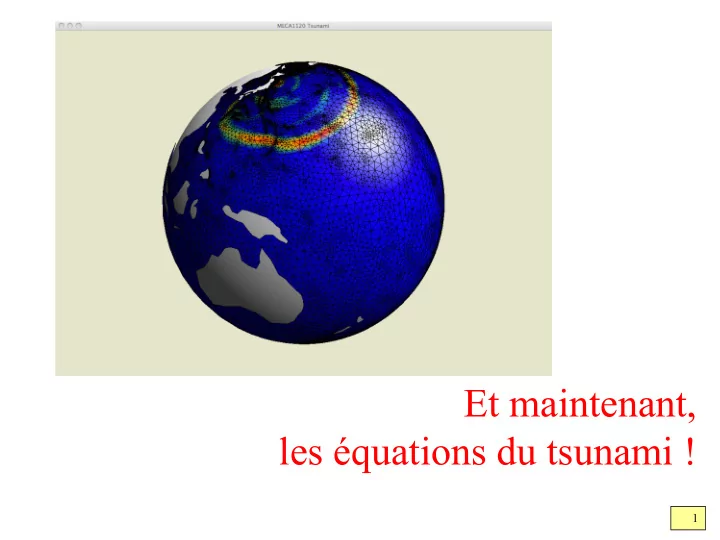
Et maintenant, les quations du tsunami ! 1 1 ( y r ) COMPOSANTES - - PowerPoint PPT Presentation
Et maintenant, les quations du tsunami ! 1 1 ( y r ) COMPOSANTES D E VITESSE RVAMON " ELEVATION MASSE D E | \ L A BILAN QUANTITE D E M N T :-O" The so-called PRESSION HYDROSTATIQUE EEE Shallow Water }
Et maintenant, les équations du tsunami !
1 1 The so-called Shallow Water Equations
2 2Very crude model for geophysical flows, but allows the existence of inertia-gravity waves
( y r )
COMPOSANTES D E VITESSE RVAMON←
ELEVATION D E L A MASSEÏ "
|
\
BILAN QUANTITE D E M N TEEE
}
PROFONDEUR D E L'OCEAN An analytical problem as a numerical validation : Stommel :-)
Dissipation coefficient [s-1] Forcing wind term [N m-2] Gravity [m s-2] Coriolis factor [s-1]
3 Un modèle unidimensionnel le long de l’interface…
Discontinuous Galerkin
Comment calculer les flux de masse et de quantité de mouvement aux interfaces ?
4Ê
+ 4 ¥ = Un solveur de Riemann…
Discontinuous Galerkin
Comment calculer les flux de masse et de quantité de mouvement aux interfaces ?
5 Calculons les valeurs propres de A pour découpler les deux équations…
Deux valeurs propres Deux vecteurs propres
6 C 'EST FACILE A OBTENIR Ë
:L. - 7 ¥
←
¥
dur
VEpÊ ¥.
↳Éploré
|
d e t # - I I ) - O ( ¥ - I I I . e -
x
.↳ = .d . ±Fg
Effectuons un changement de variables…
Matrice des deux vecteurs propres r et s sont appelées les invariants de Riemann :-)
7 Et on obtient… … deux équations de transport découplées !
8E r
+ t g ¥,- - o →¥ - t ¥ "
← Les invariants de Riemann sont constants le long des courbes caractéristiques !
9r t
Et on sait ce qu’il faut faire pour une équation de transport pur !
Le solveur dit de Riemann :-)
10D
Et en termes de vitesses et d’élévation
Le solveur dit de Riemann :-)
11_
A 1D sharp simplified problem in a finite domain
12 What is the solution ?
t = 0 t = 1
Rossby’s radius
13¢
V a u t[
" E A more and more complex and interesting solution…
t = 2 t = 33
14 What are the equations ?
t = 500
Helmholtz’s Equation Forced Wave Equation
15 How does information propagate ?
Riemann’s Invariants
t = 1
16 Two distinct waves…
t = 1
17 An analytical solution exists !
t = 700
Separation of the Classical Equations with the boundary conditions
18 Analytical solution for any initial elevation data
19 A family of initial conditions…
Stiffness factor
R = 10 R = 100 R = 1000
20 The Continuous Galerkin Method
21 The Continuous Galerkin Method
n = 200, t = 2 n = 2000, t = 2
Oscillating solutions that only converge in a mean sense…
22 For smooth solutions, it works !
n = 200, t = 2, R = 100 n = 200, t = 2, R = 10
23 The Optimal Technique : Integrating along characteristics
t = 200 Second-order Runge-Kutta
24 → ×Ent'
O
# ×
E n
Time integration has to be accurately performed…
t = 200 Heun (RK-2) Dt = 0.01 t = 200 Explicit Euler Dt = 0.01 t = 200 Explicit Euler Dt = 0.001
25 The Discontinuous Riemann-Galerkin Method
t = 2
26 Increasing the order
functions…
P1-P1 P2-P2
27¥
RATELIER¢
Maxence! ← . How to estimate the local error ?
The jumps at discontinuities are proportional to the local error The local error are also proportional to hp+1 where p is the order of elements and h the characteristic size.The Discontinuous Galerkin Method provides an efficient and simple error estimator !
28 O R D R E Adaptive strategy
From this new mesh size field, we can create a new adapted mesh. New requested mesh size field from the error estimator Target error 29 ERREUR cocace recenséTION
D E L'ERREUR How to evaluate the error estimator ?
Asymptotic behaviour
The error estimator slightly