Estimation based based on on vectorized vectorized surfaces - - PowerPoint PPT Presentation

estimation based based on on vectorized vectorized
SMART_READER_LITE
LIVE PREVIEW

Estimation based based on on vectorized vectorized surfaces - - PowerPoint PPT Presentation

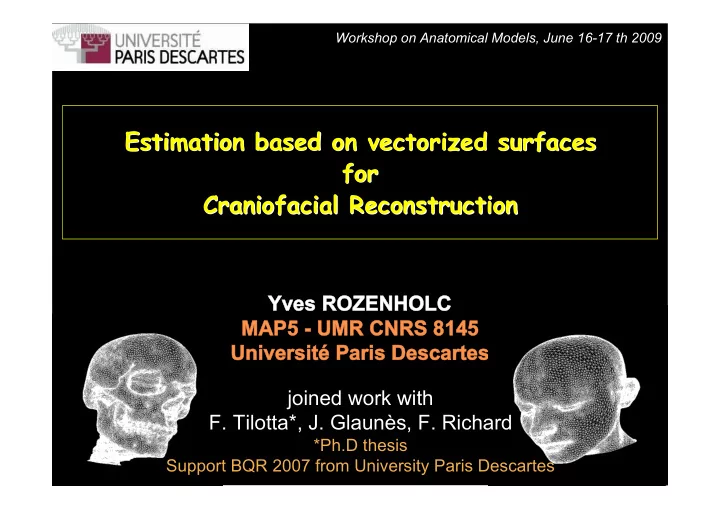
Workshop on Anatomical Models, June 16-17 th 2009 Estimation based based on on vectorized vectorized surfaces surfaces Estimation for for Craniofacial Reconstruction Reconstruction Craniofacial Yves ROZENHOLC Yves ROZENHOLC MAP5 -


slide-1
SLIDE 1

Estimation Estimation based based on

  • n vectorized

vectorized surfaces surfaces for for Craniofacial Craniofacial Reconstruction Reconstruction

Yves ROZENHOLC Yves ROZENHOLC MAP5 - MAP5 - UMR CNRS 8145 MR CNRS 8145 Université Paris Descartes Université Paris Descartes

Workshop on Anatomical Models, June 16-17 th 2009

joined work with

  • F. Tilotta*, J. Glaunès, F. Richard

*Ph.D thesis Support BQR 2007 from University Paris Descartes

slide-2
SLIDE 2

State of State of the the art art

Manual Approach  Localisation of few points on the skull,  Use average tissue thickness,  Manual covering of the skull,  Bad quality of information (dead, surgery, heterogenous data, …) Statistical Global Approach (starts only after 2003 )  Use of Sparse Template or implicit surfaces  Registration of the sparse template or the full surface  kPCA (skull,tissue) with missing data or PLS Statistical technics are global and do not take to local variations

slide-3
SLIDE 3

Outline

  • The data and (sub)-mesh construction
  • Reproductible Kernel Hilbert Spaces for

surfaces (RKHS)

  • Statistical framework for surfaces
  • Registration of surfaces using RKHS
  • Regression of surface using RKHS
  • Results
slide-4
SLIDE 4

Our Our Framework Framework

  • Build and use a large data base
  • more than 80 full head CT-scans.
  • Use a local and conditionnal approach based on
  • individual dense meshes, around 20000 knots
  • « patch »: small sub-surfaces defined on the skull
  • extended surfaces and extended vector fields
  • average of extended surfaces
  • distance between extended surfaces
slide-5
SLIDE 5

Mesh and Localization of the Anatomical Points on the Skull Mesh

Data Data: : mesh and anatomical mesh and anatomical points points

The closest edge on the regularized mesh is associated with the 3D coordinates found by the anatomist

slide-6
SLIDE 6

Geodesics and Patches

Data Data: patch : patch

Patch = ordered sequence of anatomical points Bone Patch = surface defined by the patch associated points of the mesh with border defined as the geodesics between succesive points Geodesic Computation on the dense meshes : Combinaison of existing algorithms

  • Algorithm of Surazhsky et coll. (2005)
  • Fast Matching Algorithm (Sethian, 1999)
slide-7
SLIDE 7

Skin-patches :

Follow « geodesic + patch » idea to extract a skin-patch on the skin mesh:

Data: Data: thickness thickness

 Anatomical points of the bone-patch are projected on the skin surface following the normal rays to the skull surface.  Geodesics on the skin-surface are computed between projected points.  The skin-patch is the skin-surface delimited.

slide-8
SLIDE 8

define Extended Normal Vector Field as

Sσ(x) = ∫S kσ(|y-x|) NS(y) dS(y) ≈ Σ t∈S kσ(|Ot-x|) nt .

and, for a given function f on S define Extended Function as

fσ(x) = ∫S kσ(|y-x|) f(y) NS(y) dS(y) ≈ Σ t∈S f(Ot) kσ(|Ot-x|) nt .

Dealing statistically with Dealing statistically with surfaces surfaces : a : a first first idea idea

Interest : Allow average computations on extended objects. Idea : Transform the surface in a 3D vector field which take into account surface geometry and distances. Given a surface S, its normal vector field NS and a kernel kσ Problem : How to compare objects (distance, norm) ?

slide-9
SLIDE 9

Given surfaces S and T with normal vector fields NS and NT Given kσ a real kernel, consider the Scalar Product between S and T << S , T >>σ :=∫S∫T kσ(|y-x|) < NS(x), NT(y)> dS(x) dT(y) . For triangular meshes, if x=(a,b,c) consider Ox=(a+b+c)/3 and ux=(b-a)(c-a)/2 << S , T >>σ :=∑∑ kσ(|Ox-Oy|) < ux, uy> where the sums are taken on all triangles x for S and y of T. Link with RKHS : Consider the RKHS (Hσ, | . |σ) of fcts from E=R3 into R3 associated to kσ . Define the vectorial distribution generated by S by µS(v) = ∫S < v(x) , NS(x) > dS(x) for every vector field v: R3 R3 . The (dual) RKHS norm of µS is || µS ||σ := sup { µS(v) , | v | σ ≤ 1 }. Its Scalar Product << µS , µT >>σ := (|| µS ||σ

2 + || µT ||σ 2

  • || µS - µT ||σ

2)/2

satifies << µS , µT >>σ = << S , T >>σ .

Surfaces Surfaces Comparison using Comparison using RKHS RKHS

M S

slide-10
SLIDE 10

Let ( H, || . ||H ) be a Hilbert space of functions from a set E into R. H is a RKHS if the linear map f f(x) from H into R is continuous for every x of E . Riesz representation theorem: for every x in E there exists an element Kx of H such that : f(x) = < f , Kx >H for all f in H. K(x,y) = Kx(y) is called the reproducting kernel for the Hilbert space H. Moore-Aronszajn theorem: Given a symmetric positive definite kernel K (x,y) on E there is a unique Hilbert space H of functions on E into R for which K is a RKHS (for H). Example : kσ( |y - x| ) where | . | is a norm on E and kσ is a classical kernel on R,

Reproducing Kernel Reproducing Kernel Hilbert Hilbert Spaces Spaces (RKHS): (RKHS):

M S

slide-11
SLIDE 11

A A Gaussian statistical framework Gaussian statistical framework for « for « surfaces surfaces » »

Given a kernel kσ the RKHS construction defined an Hilbert space (Hσ , || . ||σ ) which contains all the vectorial distributions µS for all surfaces S of R3. In a classical way, we define Gaussian random variables of vectorial distributions X ~ N(µ , Σ) on Hσ by <X, h> ~ N(<µ , h> , <Σ.h,h>) for all h in Hσ E ||X||σ

2 = Tr Σ

It is then possible, given a sample of vectorial distributions, to derive classical theorems for estimation (LLN, TCL, …). Regression : if one observe (Xi, Yi) i=1..n, from a joint Gaussian distribution of vectorial distributions, one can provide estimation of E(Y / X=X0) Remember that for surface S with normal vector fields NS µS(v) = ∫S < v(x) , NS(x) > dS(x) for every vector field vector field v on R3.

slide-12
SLIDE 12

Transport Transport and and registration of surfaces registration of surfaces with with RKHS RKHS

Semi-rigid Registration of the patches :  patch registration uses translation + rotation + dilatation For a given diffeomorphisme φ of the space R3 the transport of µS by φ satisfies φ.µS = µ φ.S . The registration of T on S is then defined as φST = arg φ min || µS - µφ.T ||σ where φ is translation + rotation + dilatation. Because of semi-rigid registration φST = φTS One can define a pseudo-distance between extended surfaces dσ (S, T) = ||S - φST.T||σ = ||φTS.S - T||σ dσ (S, T) = 0 ≠> S = T

slide-13
SLIDE 13

Regression Regression via RKHS for surfaces via RKHS for surfaces with with registration registration

Skin Surface Estimation Let us consider the empirical mean µ = (w01 φ01.µ1 + … + w0n φ0n.µn)/(w01 + … + w0n) and for the closest skin surface P of the learning database ψ = arg min φ || φ.µP - µ ||σ + λ|| φ || defines directly the estimated skin-surface ψ.P . Weights are chosen uniform or for example as w0i = 1 / dσ (S0 , Si) = 1 / || µ0 - φ0i.µi || . Given learning database with n individuals defined by their patch-skull surfaces Si and their skin-surface Pi. Let us denote µ1 … µn the vectorial distributions associated to the skin surfaces P1 … Pn . Call φ0i the « measure » registration of the known but dry patch-skull to dress S0 on the known dressed skulls Si of the « local » learning database.

slide-14
SLIDE 14

Regression Regression via RKHS for surfaces via RKHS for surfaces with with registration registration

Given S1 … Sn n registred surfaces, we consider their associated vectorial distributions denoted µ1 … µn We can define the empirical mean distribution µ = ( µ1 +…+ µn )/n Unfortunately this does not defined a surface. We propose to choose the « closest » surface S in S1 … Sn which minimize || µi - µ ||σ and to find an elastic (or fluid) registration ψ such that ψ = arg min φ || φ.µS - µ ||σ + λ|| φ || where || φ || is a norm on the registration space of interest. As ψ.µS = µψ.S our estimated surface is the transported surface ψ.S Remark : An easiest way could be to consider the median of the chosen surfaces. Remember that for surface S with normal vector fields NS µS(v) = ∫S < v(x) , NS(x) > dS(x) for every vector field vector field v on R3.

slide-15
SLIDE 15

Registration of the bone-patch with nearest neighbors selection

w0i = 1 / dσ (S0 , Si) if dσ (S0 , Si) ≤ c minj dσ (S0 , Si) and 0 if not.

slide-16
SLIDE 16

Associated skin-patch for the selected bone-patch

slide-17
SLIDE 17

Using the closest extended surface to the estimate one, apply a non rigid registration to match the estimated extended surface

slide-18
SLIDE 18

Selected Criterion 1.4 x minimal distance 10 selected individuals

slide-19
SLIDE 19

Average Error = 1.20 mm Selected Criterion 1.4 x minimal distance 10 selected individuals

slide-20
SLIDE 20

Average error = 0.99 mm Selected Criterion 1.3 x minimal distance 7 selected individuals

slide-21
SLIDE 21

Average error = 1.37 mm Selected Criterion 1.2 x minimal distance 5 selected individuals

slide-22
SLIDE 22

Using direct approach on skin-surface

Mathematical Treatment Mathematical Treatment of

  • f the

the Data: Data: Results Results

Estimated Skin-Surface Real Skin-Surface Estimated risk by cross-validation = 0.99 mm range = 0,21 to 2.41 mm* Cross-Validation : Leave one out. The risk is computed on all 48 young women.

* Upper bound due to artefact

slide-23
SLIDE 23

Conclusion Conclusion and and Futures Futures development development

  • Do not need full face knowledge … may use clinical CT-scans !!!
  • Non-rigid post-registration after extended estimation allows direct

surface estimation !!!

  • Need mathematical results to show statistical properties.
  • Need adaptation with respect to choice of bandwith and nearest

neighboors.

  • Possibility of meshes generation improvement.
  • Automatisation of artefact removal and anatomical point localization.
  • Could benefit from a non-rigid registration after the semi-rigid.
slide-24
SLIDE 24

Let ( H, || . ||H ) be a Hilbert space of functions from a set E into Rm and H* its dual Riesz theorem says that for all φ of H*, it exists a unique K*φ in H s.t. φ = < . , K*φ >. Def : H is a RKHS if the linear map δx : f f(x) from H into Rm is continuous for every x of E . Remark : H is a RKHS if δx[α]: = f(x).α belongs to H*. Def : A vectorial kernel is positive if ∑ αi K(xi , xj) αj ≥ 0 for xi in E and αi in Rm. It is definite if ∑ αi K(xi , xj) αj = 0 implies αi=0 when the xi are different. Generalizing M&A th : A vectorial kernel symmetric positive definite defines a unique RKHS on the set of functions from E into Rm. Construction : The application K from ExE into L(Rm) defined by K(x , . ) α = K*δx[α] is the reproducting kernel for the Hilbert space H in the sense that : h(x).α = δx[α](h) = < h , K*δx[α] >H for all h in H . We will consider the special case E = R3 , m = 3 and x.y = kσ( |y - x| ) .

RKHS for RKHS for vector fields vector fields