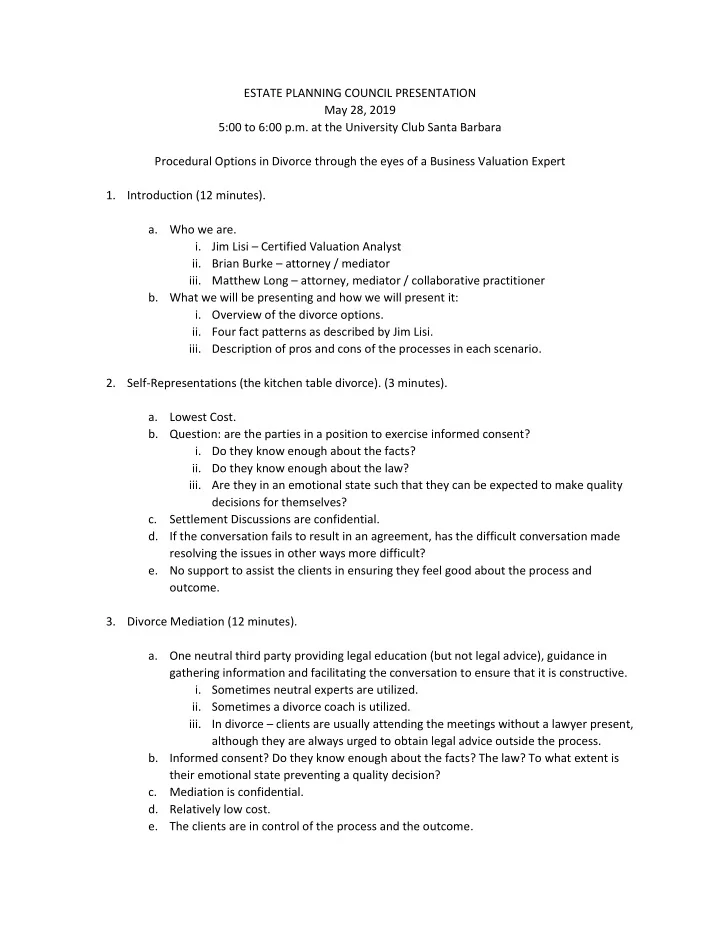
ESTATE PLANNING COUNCIL PRESENTATION May 28, 2019 5:00 to 6:00 p.m. - - PDF document

estate planning council presentation may 28 2019 5 00 to
SMART_READER_LITE
LIVE PREVIEW

ESTATE PLANNING COUNCIL PRESENTATION May 28, 2019 5:00 to 6:00 p.m. - - PDF document

ESTATE PLANNING COUNCIL PRESENTATION May 28, 2019 5:00 to 6:00 p.m. at the University Club Santa Barbara Procedural Options in Divorce through the eyes of a Business Valuation Expert 1. Introduction (12 minutes). a. Who we are. i. Jim Lisi


slide-1
SLIDE 1

ESTATE PLANNING COUNCIL PRESENTATION May 28, 2019 5:00 to 6:00 p.m. at the University Club Santa Barbara Procedural Options in Divorce through the eyes of a Business Valuation Expert

  • 1. Introduction (12 minutes).
  • a. Who we are.
  • i. Jim Lisi – Certified Valuation Analyst
  • ii. Brian Burke – attorney / mediator
  • iii. Matthew Long – attorney, mediator / collaborative practitioner
  • b. What we will be presenting and how we will present it:
  • i. Overview of the divorce options.
  • ii. Four fact patterns as described by Jim Lisi.
  • iii. Description of pros and cons of the processes in each scenario.
  • 2. Self-Representations (the kitchen table divorce). (3 minutes).
  • a. Lowest Cost.
  • b. Question: are the parties in a position to exercise informed consent?
  • i. Do they know enough about the facts?
  • ii. Do they know enough about the law?
  • iii. Are they in an emotional state such that they can be expected to make quality

decisions for themselves?

  • c. Settlement Discussions are confidential.
  • d. If the conversation fails to result in an agreement, has the difficult conversation made

resolving the issues in other ways more difficult?

  • e. No support to assist the clients in ensuring they feel good about the process and
  • utcome.
  • 3. Divorce Mediation (12 minutes).
  • a. One neutral third party providing legal education (but not legal advice), guidance in

gathering information and facilitating the conversation to ensure that it is constructive.

  • i. Sometimes neutral experts are utilized.
  • ii. Sometimes a divorce coach is utilized.
  • iii. In divorce – clients are usually attending the meetings without a lawyer present,

although they are always urged to obtain legal advice outside the process.

  • b. Informed consent? Do they know enough about the facts? The law? To what extent is

their emotional state preventing a quality decision?

  • c. Mediation is confidential.
  • d. Relatively low cost.
  • e. The clients are in control of the process and the outcome.
slide-2
SLIDE 2
  • f. No guarantee of resolution, although the statistics are generally good.
  • g. Trained and skilled mediator can offer support to assist the clients in ensuring they feel

good about the process and outcome.

  • 4. Collaborative Divorce (12 minutes).
  • a. A Team Approach
  • i. Each party has an attorney (trained in mediation) who is prohibited from

representing the clients should the matter go to court.

  • ii. One or two divorce coaches addressing the emotional and communication

challenges (may not be asked to testify).

  • iii. One neutral financial professional addressing the financial fact gathering,

analysis, and development of settlement options (may not be asked to testify).

  • iv. One neutral child specialist if appropriate. (may not be asked to testfy).
  • b. Informed consent? Do they know enough about the facts? The law? To what extent is

their emotional state preventing a quality decision?

  • c. A confidential process.
  • d. Low cost relative to litigation, but not “low cost.”
  • i. Insuring the professional most qualified to address an issue is the one

addressing that issue.

  • ii. Most non-attorney professionals are operating at a lower hourly rate than

attorneys.

  • e. Professionals are the “experts” on process, but the clients ultimately control both the

process and the outcome.

  • f. No guarantee of resolution, although the statistics are generally good.
  • g. Maximum support in assisting the clients in ensuring they feel good about the process

and outcome.

  • 5. The Litigated (court centered) Divorce (13 minutes).
  • a. The court controls the process (with indirect control from attorneys, but the clients have

no control).

  • b. If no agreements are reached pretrial, the court controls the outcome.
  • c. A public, non-confidential, process.
  • d. If there is a settlement, informed consent?
  • i. Up to the attorneys to decide how important it is that the client know the law

before deciding;

  • ii. Maximum encouragement to obtain evidence (sometimes at great expense), up

to the attorneys to decide how important it is that the client know the facts before deciding;

  • iii. Very little patience or skill utilized in the process to address the client’s

emotional state when deciding.

  • e. Very hit or miss if attorneys are skilled enough to assist the clients in ensuring they feel

good about the process and outcome – generally perceived as irrelevant to this process.

slide-3
SLIDE 3
  • f. Resolution is “guaranteed,” there will be a decision (although we’ve all heard the stories

about the cases that go on for years).

  • g. Never “low cost,” but with effort on the part of the attorneys a settlement can be

reached at a reasonable fee. Clients, however, usually don’t have enough information nor emotional “bandwidth” to ensure this. By far the most expensive if the case proceeds to trial.

  • 6. Question and answer period (10 minutes).