Establishing a virtual eating disorders service in a large child - - PDF document

establishing a virtual eating disorders service in a
SMART_READER_LITE
LIVE PREVIEW

Establishing a virtual eating disorders service in a large child - - PDF document

5/03/2015 Establishing a virtual eating disorders service in a large child and youth mental health service Ms Tania Withington CHQ CYMHS Director of Social Work Ms Judi Krause CHQ CYMHS Divisional Director Date: 23.02.2015 Queensland


slide-1
SLIDE 1

5/03/2015 1

Establishing a virtual eating disorders service in a large child and youth mental health service

Ms Tania Withington – CHQ CYMHS Director of Social Work Ms Judi Krause – CHQ CYMHS Divisional Director Date: 23.02.2015

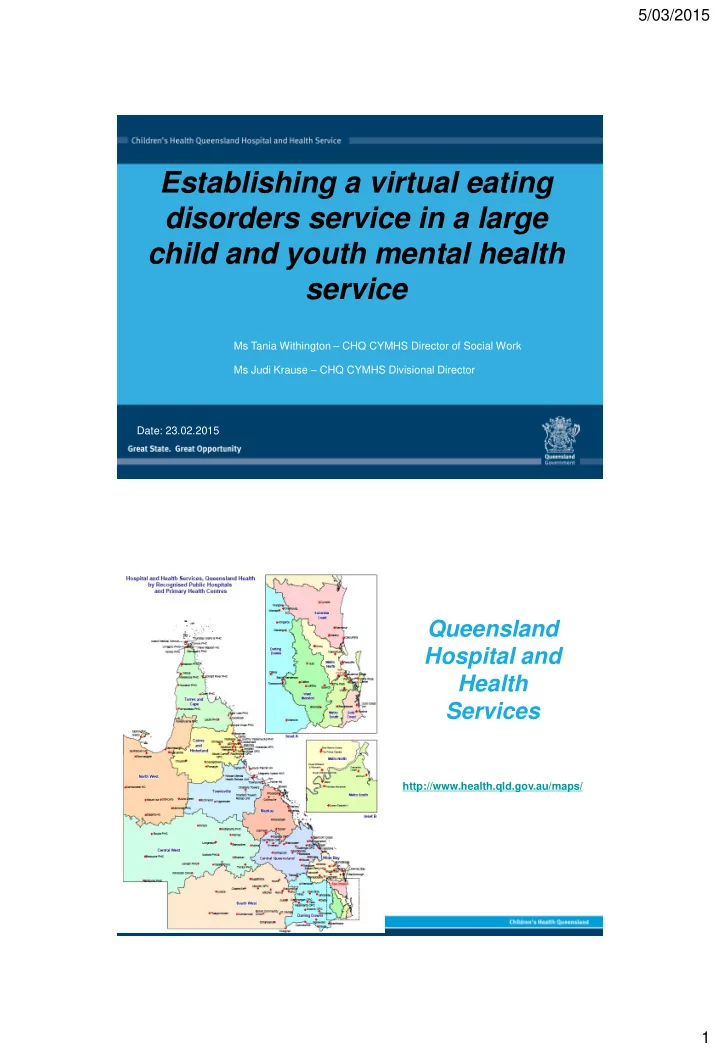
Queensland Hospital and Health Services

http://www.health.qld.gov.au/maps/

slide-2
SLIDE 2

5/03/2015 2

The Lady Cilento Children’s Hospital LCCH opened November 2014

The Lady Cilento Children's Hospital is the largest and most advanced paediatric facility in Australia. Located in South Brisbane, the Lady Cilento Children's Hospital is the public hospital for children in Brisbane and Queensland's tertiary referral facility.

Continuum of Care for Eating Disorders

Referral Community CYMHS CBT-E FBT-AN Inpatient Unit Community CYMHS Discharge Psychiatric Review

slide-3
SLIDE 3

5/03/2015 3

Journey of Family Based Treatment in CYMHS for Eating Disorders

Individual Clinician Interest Clinicians with specialist training Specialist FBT and FT Clinic Clinicians with specialist training Individual Clinician Interest Specialist FBT and FT Clinic

Learnings from the Journey

» Challenges with relying on individual clinician interest » Problems maintaining knowledge and skill in service » Problems maintaining fidelity of EB model » Limited capacity to provide EB Intervention » Perceived isolation of identified clinicians » Loss of momentum in service provision of EB model » Inefficiencies in resource utilisation » Limited accessibility and visibility of service » Challenging accessing physical resources and funding » Challenges bedding research into practice

slide-4
SLIDE 4

5/03/2015 4

Re-establishing a Specialist Clinic

» Review: » Service based data » Training, supervision and mentoring requirements » Clinic structure and practices » Resource requirements and efficiencies » Physical space, staffing, administration, medical equipment » Utilising shared resources and existing systems » Research Agenda » Alignment of Model with HHS Mission, Values, Pillars » Profile, credibility, visibility » Internal and external networks

Challenges and solutions

» No money » No allocated staff » No allocated clinical space » No resources at all So…. » Utilise staff from existing teams to join specialist clinic team one day a week » Negotiated psychiatry input across greater service » Negotiated space in existing CYMHS clinic » CYMHS/QUT Partnership enabled access to live supervision » One-off funding for training and supervision » One-off funding for supervision for Accreditation

slide-5
SLIDE 5

5/03/2015 5

FBT-AN Clinic Description

» Embedded in a community CYMHS clinic » One day a week identified CYMHS clinicians form virtual team » One new intake per week (incorporates Psychiatric review, nursing assessment, family interview) » One new case a week (session one and family meal) » Co-therapy model » Through the mirror live supervision, recorded session supervision, peer supervision, Supervision for Accreditation » Clinic Coordinator » Multiple sessions across day in planned timetable

Unleashing Potential CHQ Australia Day Award 2014: Eating Disorders Team (CYMHS)

slide-6
SLIDE 6

5/03/2015 6

First Annual Review

» Increased referral rates (X5) » Reduced length of inpatient hospital admission » Reductions in re-admission inpatient rates » Length of community treatment shortened (12-18months) » Improved rates of treatment completion and reductions in re- admission to community services » Improved model fidelity » Improved Team cohesion » First Research Grant achieved » Dedicated resources – staffing/equipment » FBT-AN supervision for accreditation with Institute of Eating Disorders Chicago underway

Second Annual Review

Calender Year Accepted Referrals to FBT Percentage of F50.0 in District referred to FBT (excludes EDNOS and BN) Number of Completed Cases Average Length of Stay in Psychiatric Inpatient Unit (bed days CFTU) 2012 11 66% 1 40 2013 31 75% 22 2014 35 80% 21 22

  • Identified need for nursing assessment at intake and across phases

Developed research project to investigate model fidelity

  • Introduced Dietician consultation
  • Established Clinic in CYMHS service structure
  • Established Clinic Budget
  • Established CYMHS Eating Disorder Portfolio
slide-7
SLIDE 7

5/03/2015 7

Critical Components of FBT Clinic Model

» Critical relationships › Inpatient and Community Teams › Consultation Liaison Teams › General Practitioners › Accident and Emergency Services » Role of Nursing in FBT Team › Medical parameters at assessment and across treatment » Role of Dietician in FBT Team › Staff consultation and professional development » Managing FBT Team capacity » Co-therapy model of service delivery » Importance of time and patience » Managing Risk » Importance of top down and bottom up drivers » Portfolio identification across broader service » Role of Research › Projects, grants, service evaluation, service development

What attracts staff to FBT Team

» Recognition of specialist knowledge and skill » Live supervision » Supervision for accreditation » Support for tertiary education » Observable clinical outcomes » Transferable expertise (family therapy) » Professional development » Skill development in supervision and mentoring » Team risk management strategies

slide-8
SLIDE 8

5/03/2015 8

Inpatient Care

» Medical and Psychiatric admission » Consultation Liaison team » Pediatric and adolescent psychiatric units » Structured ED protocols

Inpatient Care

» Diagnostic assessment » Management of medical crisis » Nutritional resuscitation to 85% IBW » Psycho-education » General support for the young person and their family » Clear discharge plan to appropriate follow up community treatment to support recovery

slide-9
SLIDE 9

5/03/2015 9

CBT-E

» Newly introduced evidenced-based intervention model » Works alongside FBT-AN and Community CYMHS » Identified clinicians situated in community clinics » Group training and supervision » Single point of coordination » Shared group training with FBT-AN Clinic Team » Learnings to date: › Engages older adolescents moving to independence › Engages adolescents with established ED > 3years

Inclusion/Exclusion Criteria FBT- AN/CBT-E

CBT-E FBT

Inclusion

Age 14 or above Significant eating disorder psychopathology (BN, EDNOS, BED) but not less than 85% of expected weight) Willing to engage in CBT-E Medically stable Age <18 years Significant eating disorder with restriction (AN EDNOS, BN) Living with family Family commitment Medically stable

Exclusion

Less than 85% of expected body weight Severe clinical depression (should first be managed with medication where appropriate) Persistent substance misuse (if likely to present intoxicated) Significant cognitive impairment Active (non-eating disorder related) psychosis Unwilling to engage in CBT-E

Living independently of family Current DV or abuse in family context Unmanaged parental mental illness or substance misuse Parental significant cognitive impairment Active (non-eating disorder related) psychosis
slide-10
SLIDE 10

5/03/2015 10

Future Challenges and Directions

» Service amalgamation alignment of clinical pathways/ continuum of care » Aligning inpatient care » Shift in culture » Sustainability » Resources » Accreditation – clinician/ supervisor/trainer » Funding Models/Data » Clinical Partnerships » Research Partnerships » Consultation-Liaison » LCCH state-wide role » Specified positions » New EB Interventions:

› ABFT and FBT-AN › MFBT-AN › New Maudsley approach

Tania Withington, Director of Social Work Judi Krause, Divisional Director Richard Litster, Eating Disorder Specialist Salvatore Catania, Consultant Psychiatrist

Child and Youth Mental Health Service Children’s Health Queensland Hospital and Health Service tania.withington@health.qld.gov.au 07 33109444

http://www.health.qld.gov.au/childrenshealth/ http://www.health.qld.gov.au/rch/professionals/cymhs.asp