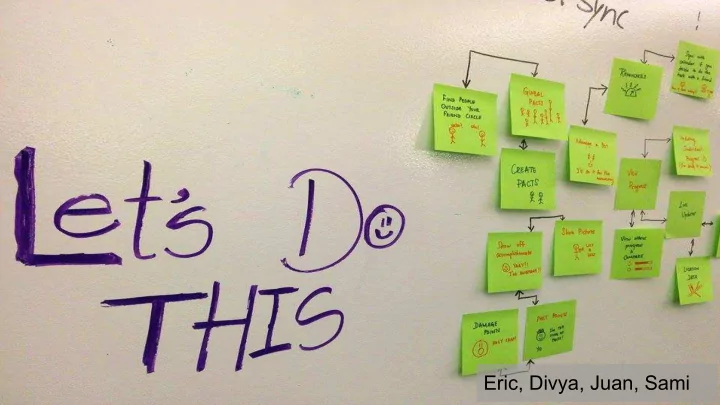
Eric, Divya, Juan, Sami
Eric, Divya, Juan, Sami Overview Overall Problem + Solution - - PowerPoint PPT Presentation
Eric, Divya, Juan, Sami Overview Overall Problem + Solution Contextual Inquiry Description and Results Task Analysis Results Representative Tasks Early Design Sketches Summary Overall Problem + Solution People have a
Overview
- Overall Problem + Solution
- Contextual Inquiry Description and Results
- Task Analysis Results
- Representative Tasks
- Early Design Sketches
- Summary
Overall Problem + Solution
- People have a tough time achieving their long term goals.
- Reminders are not motivating.
- Reminders are easy to ignore.
- It’s hard to find common time to work on a long term goal.
Contextual Inquiry Description
- D.M. - 30-35 years old, Researcher at Stanford University.
Works on a lot of projects, has a messy desktop.
- D.K. - 19 years old, CS undergrad at Stanford University.
Plays League of Legends until deadlines.
- C.L. - 22 years old, CS Masters student at Berkeley.
Uses post-its for reminders, but tends to ignore them.
- D.C. - 21 years old, CS Co-term at Stanford University.
Uses task management systems, but long term tasks slip through.
- K.M. - 26 years old, Fall intern at Electronic Arts.
Works alone on his internship, with no one watching over his work.
How inquired
Stalking, Observing and asking questions in person
Where inquired
At home, workplace, common places
Contextual Inquiry Results
- Buddy system works.
- There are tasks that have short deadlines and then there are tasks that
are resolutions. We want the app to scale for different kinds of tasks.
- Peer pressure works.
- People like reminders and constant updates. So, its more beneficial if
the app is on mobile where the user can be reminded and updated wherever he is.
- Reminders may not work if they are between you and the object.
Task Analysis Results
Who is going to use the system? What tasks do they now perform? What tasks are desired?
Task Analysis Results
How are tasks learned? What tasks are desired? What’s the relationship between the consumer and data?
Task Analysis Results
What other tools does the customer have? How do users communicate with each other? How often are the tasks performed? What are the time constraints on the tasks?
Representative Tasks
Motivating a friend
Scope : Moderate Frequency : Medium Importance : Medium
Representative Tasks
Finding task buddies
Scope : Complex Frequency : High Importance : High
Representative Tasks
View progress
Scope : Simple Frequency : High Importance : High
Application Ideas
Pact Pot
Significance : Fear of losing money motivates people to stay in the pact. Feasibility : Risky, involving money Interest : Moderate
Application Ideas
IMotivateU
Significance : Provides suggestions for users to start and continue towards a goal. Feasibility : High Interest : Low
Application Ideas
Let’s do this
Significance : Using competition and cooperation between friends for motivation Feasibility : High Interest : High
Early Design Sketches
- Friend Centric Design(Left) places
news feed at the forefront so you see what others are up to.
- Google Glass Design(Above) shows
you in real time the difference between what you are doing and what your friend is doing.
Early Design Sketches
- Profile page with a picture,
list of pacts that the user is
- n, achievements, progress.
- Global Pacts screen where
many users in the system are involved in common tasks.
- Friends page showing
friends and their progress
- Pact page showing the
members and chat box.
Early Design Sketches
- “Today” screen shows what
you need to do
- “Friends” screen is
segmented by pacts
- “Calendar” screen shows
schedule and trophies.
Summary
- ‘Let’s Do This’ wants people to remember that they are