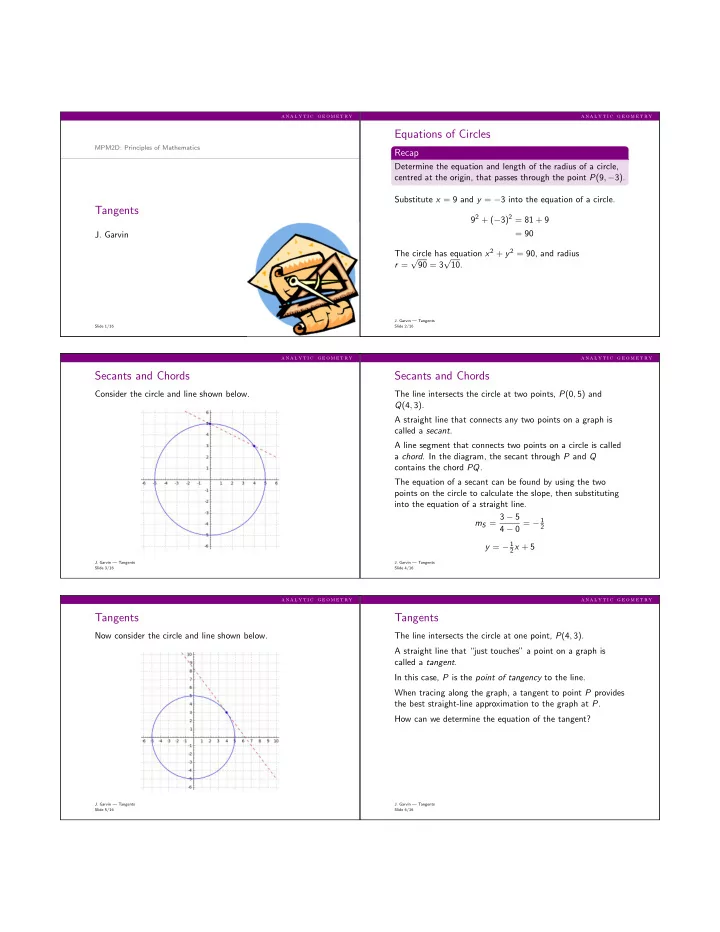
Equations of Circles MPM2D: Principles of Mathematics Recap - - PDF document

equations of circles
SMART_READER_LITE
LIVE PREVIEW

Equations of Circles MPM2D: Principles of Mathematics Recap - - PDF document

a n a l y t i c g e o m e t r y a n a l y t i c g e o m e t r y Equations of Circles MPM2D: Principles of Mathematics Recap Determine the equation and length of the radius of a circle, centred at the origin, that passes through the point P (9 ,


slide-1
SLIDE 1

a n a l y t i c g e o m e t r y

MPM2D: Principles of Mathematics

Tangents

  • J. Garvin

Slide 1/16

a n a l y t i c g e o m e t r y

Equations of Circles

Recap

Determine the equation and length of the radius of a circle, centred at the origin, that passes through the point P(9, −3). Substitute x = 9 and y = −3 into the equation of a circle. 92 + (−3)2 = 81 + 9 = 90 The circle has equation x2 + y2 = 90, and radius r = √ 90 = 3 √ 10.

  • J. Garvin — Tangents

Slide 2/16

a n a l y t i c g e o m e t r y

Secants and Chords

Consider the circle and line shown below.

  • J. Garvin — Tangents

Slide 3/16

a n a l y t i c g e o m e t r y

Secants and Chords

The line intersects the circle at two points, P(0, 5) and Q(4, 3). A straight line that connects any two points on a graph is called a secant. A line segment that connects two points on a circle is called a chord. In the diagram, the secant through P and Q contains the chord PQ. The equation of a secant can be found by using the two points on the circle to calculate the slope, then substituting into the equation of a straight line. mS = 3 − 5 4 − 0 = − 1

2

y = − 1

2x + 5

  • J. Garvin — Tangents

Slide 4/16

a n a l y t i c g e o m e t r y

Tangents

Now consider the circle and line shown below.

  • J. Garvin — Tangents

Slide 5/16

a n a l y t i c g e o m e t r y

Tangents

The line intersects the circle at one point, P(4, 3). A straight line that “just touches” a point on a graph is called a tangent. In this case, P is the point of tangency to the line. When tracing along the graph, a tangent to point P provides the best straight-line approximation to the graph at P. How can we determine the equation of the tangent?

  • J. Garvin — Tangents

Slide 6/16

slide-2
SLIDE 2

a n a l y t i c g e o m e t r y

Tangents

If O is the origin, and the circle is centred at O, then a tangent to a circle at point P has a slope that is perpendicular to the radius OP. In this case, the slope of OP is mOP = 3

4, so the slope of the

tangent must be mT = − 4

3.

Since we know the coordinates of P, we can substitute the values of x and y to determine the equation of the tangent. 3 = − 4

3(4) + b

3 = − 16

3 + b

9 = −16 + 3b b = 25

3

The equation of the tangent is y = − 4

3x + 25 3 .

  • J. Garvin — Tangents

Slide 7/16

a n a l y t i c g e o m e t r y

Tangents

This process leads us to an equation for a tangent to a circle, centred at the origin.

Equation of a Tangent to a Circle Centred at the Origin

The equation of a tangent to a circle, centred at the origin, passing through P(xp, yp), is y = − xp

yp x + xp2+yp2 yp

. Using the previous example, the equation of the tangent at (4, 3) is y = − 4

3x + 42+32 3

= − 4

3x + 25 3 .

Knowing the formula can be a useful shortcut, but it is fairly complex, whereas the process for determining the equation for a tangent may be more intuitive.

  • J. Garvin — Tangents

Slide 8/16

a n a l y t i c g e o m e t r y

Tangents

Example

Determine the equation of the tangent to a circle, centred at the origin, that passes through P(−2, 4).

  • J. Garvin — Tangents

Slide 9/16

a n a l y t i c g e o m e t r y

Tangents

Determine the slope from the origin to P. mOP = − 4

2 = −2

Therefore, the slope of the tangent is mT = 1

  • 2. Use x = −2

and y = 4 in y = mx + b. 4 = 1

2(−2) + b

4 = −1 + b b = 5 The equation of the tangent is y = 1

2x + 5.

This can also be determined using the formula, y = − (−2)

4 x + (−2)2+42 4

= 1

2x + 5.

  • J. Garvin — Tangents

Slide 10/16

a n a l y t i c g e o m e t r y

Tangents

Example

The line y = 3x − 10 is tangent a circle, centred at the origin, when x = 3. Determine the equation and radius of the circle. When x = 3, y = 3(3) − 10 = −1. Therefore, the point of tangency is (3, −1). Determine the equation of the circle passing through (3, −1). 32 + (−1)2 = 9 + 1 = 10 Therefore, the equation of the circle is x2 + y2 = 10, and its radius is √ 10 ≈ 3.2.

  • J. Garvin — Tangents

Slide 11/16

a n a l y t i c g e o m e t r y

Tangents

  • J. Garvin — Tangents

Slide 12/16

slide-3
SLIDE 3

a n a l y t i c g e o m e t r y

Tangents

Example

Determine the equation of the tangent to the circle, centred at the origin with radius 13 units, when x = 5. Since r = 13, r2 = 169, so the equation of the circle is x2 + y2 = 169. Substitute x = 5 into the circle’s equation. 52 + y2 = 169 y2 = 144 y = ±12 There are two possible points of tangency when x = 5: P(5, 12) and Q(5, −12).

  • J. Garvin — Tangents

Slide 13/16

a n a l y t i c g e o m e t r y

Tangents

For the tangent at P(5, 12), the slope of OP is mOP = 12

5 .

Therefore, the tangent has a slope of mT = − 5

12.

Use the slope of the tangent, and point P, to determine its equation. 12 = − 5

12(5) + b

12 = − 25

12 + b

144 = −25 + 12b b = 169

12

The equation of the tangent to P(5, 12) is y = − 5

12x + 169 12 .

Similarly, the tangent to Q(5, −12) is y = 5

12x − 169 12 .

  • J. Garvin — Tangents

Slide 14/16

a n a l y t i c g e o m e t r y

Tangents

  • J. Garvin — Tangents

Slide 15/16

a n a l y t i c g e o m e t r y

Questions?

  • J. Garvin — Tangents

Slide 16/16