
SLIDE 1
Engaging Allies in the Culture of Health Movement
March 12
- Dr. James N. Weinstein
Senior Vice President Microsoft HealthCare Innovation and Health Equity
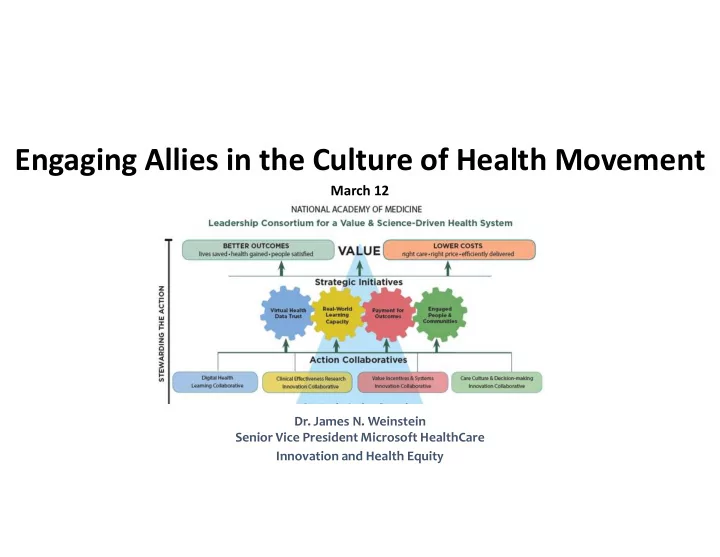
Engaging Allies in the Culture of Health Movement March 12 Dr. - - PowerPoint PPT Presentation
Engaging Allies in the Culture of Health Movement March 12 Dr. James N. Weinstein Senior Vice President Microsoft HealthCare Innovation and Health Equity Preface Our founders wrote, that all people are created equal with the right to life,
March 12
Senior Vice President Microsoft HealthCare Innovation and Health Equity
2
4
5
SOURCE: Mathews et al., 2015.
Race/Ethnicity Infant Mortality Rate (per 1,000 live births) African Americans 11.1 Native Americans 7.61 Puerto Ricans 5.93 Whites* 5.06
*In 2012, IMR was 7.6 per 1,000 for white infants in the Appalachian region. Children’s Defense Fund, 2016 Note: Infant mortality is one of the indicators of overall health
Why America’s Black Mothers and Babies Are in a Life-or-Death Crisis The answer to the disparity in death rates has everything to do with the lived experience of being a black woman in America. By Linda Villarosa NYT April 11, 2018
6
Note: Age adjusted death rates and life expectancy are indicators of overall health
Life expectancy disparities in New Orleans, LA and Kansas City, MO SOURCE: RWJF, 2013.
Conclusion 1-1
7
Racial disparities in health cost approximately $337 billion. Reducing such disparities would save $229 billion.
the Military: due to persistent health problems (drugs, prescription and non prescription, poorly educated, convicted of a felony,
Unmet social needs lead to:
How do we move beyond Regression to the mean? Improving Health and Health Care: The Social Determinants His pain got worse, he went to a doctor, and the pain subsided a little. Therefore the doctor made his pain better. Oops! Regression to the mean.
Key elements of community-based solutions
Desired
Causes of Inequity— Non-Linear
Context— May be equal but not equitable
Name Location Primary Social Determinant(s)
Blueprint for Action
Minneapolis, MN Public safety 2007 -2015 Preventing youth violence: Results = Reductions reported 62% in youth gunshot victims; 36% youth victim crimes; 76% youth arrest with guns
Delta Health Center
Mound Bayou, MS Health systems and services From 2013 -2015 Low birth weight babies decreased from 20.7% to 3.8%
Dudley Street Neighborhood Initiative
Boston, MA Physical environment 2014 -2015 % HS students at or above grade level : Math from 36% to 63% Graduation Rate 51% to 82% Percent enrolled in college 48% to 69%
Eastside Promise Neighborhood
San Antonio, TX Education Child care available 80% to 100% Work with others to improve neighborhood 58% to 83% Safe places for Kids 48% to 67%
11 *Data as reported by the communities
12
Name Location Primary Social Determinant(s)
Indianapolis Congregation Action Network
Indianapolis, IN Employment; Public safety 76% more civic duty than avg. resident Reduction in incarceration and increased jobs
Magnolia Community Initiative
Los Angeles, CA Social environment 2016 57% children 0-5 had access to place vs ER 78% graduated from H.S. ; 45% College 75.7% report feeling safe, to and from school
Mandela Marketplace
Oakland, CA Physical environment 641,000 lbs. of produce; 76% consumption $5.5 M new revenue; 26 + job ownership
People United for Sustainable Housing
Buffalo, NY Housing Regional mapping process: # of employed workers, # housing units for redeveloped, carbon emission reduction; utility bills
WE ACT for Environmental Justice
Harlem, NY Physical environment New policies around air quality, use of harmful chemicals, pesticides, flame retardants
*Data as reported by the communities
https://www.housingfinance.com/news/kaiser-permanente-announces-200-million-affordable-housing-investment_o
https://www.housingfinance.com/news/mayors-ceos-launch-housing-coalition_o
16
March 12