Engage Parents, Form the Family The Engaging and Evangelizing - - PowerPoint PPT Presentation

engage parents form the family
SMART_READER_LITE
LIVE PREVIEW

Engage Parents, Form the Family The Engaging and Evangelizing - - PowerPoint PPT Presentation

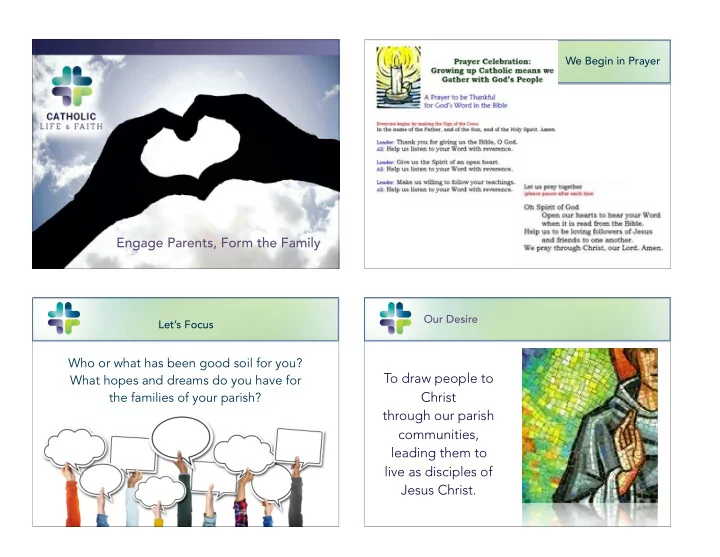
We Begin in Prayer Engage Parents, Form the Family The Engaging and Evangelizing Community Our Desire Lets Focus Who or what has been good soil for you? To draw people to What hopes and dreams do you have for the families of your parish?


slide-1
SLIDE 1

The Engaging and Evangelizing Community

Engage Parents, Form the Family

We Begin in Prayer Let’s Focus

Who or what has been good soil for you? What hopes and dreams do you have for the families of your parish?

To draw people to Christ through our parish communities, leading them to live as disciples of Jesus Christ.

Our Desire

slide-2
SLIDE 2
  • 10% of Americans are

former Catholics

  • 2.6% of Americans have

become Catholic

  • Current young adults

are less likely to affiliate with any denomination, even when compared to other generations when they were young adults.

Pew Reform on Religion and Public Life

26

Over 30% of Americans under age 30 are unaffiliated

Who are the “Nones”?

7

Many who were raised unaffiliated now belong to some religion. Those who join are:

  • Attracted by religious services/styles of worship
  • Have been spiritually unfulfilled
  • Feel called by God

8

“Catholicism has a higher retention rate

than most other religions, (including all Protestant denominations).”

(Center for Applied Research in the Apostolate)

"Most who decided to leave their childhood faith say they did so before reaching age 24.”

Pew Forum on Religion and Public Life: Faith in Flux

slide-3
SLIDE 3
  • 68% of Catholic children are not enrolled in

religious education

  • Most Catholic parents say it is important that their

child receive First Holy Communion and Confirmation

  • Over half of Catholic parents are Hispanic

Painting the Picture Painting the Picture

  • 13% of Catholic parents and single and live

with a partner

  • 9% are single, never married, divorced,

separated or widowed

  • 2/3 are Catholic and married to a Catholic

Painting the Picture

  • 2/3 or more pray often and pray for their family
  • They are most likely to pray during times of

crisis, when they feel anxious, or when they feel blessed

  • They are more likely to pray for their family than

with their family Painting the Picture

  • Catholic families attend Mass more often

than the average Catholic population

  • Over half attend Mass no more than twice a

month; 1/4 rarely attend

slide-4
SLIDE 4

Calling the Questions What is your greatest challenge in engaging families? What is your greatest joy?

The Engaging and Evangelizing Community

Form an Evangelizing Community Encounter God’s love Accompany One Anther, Bridge Distances

The Engaging and Evangelizing Community

Form an Evangelizing Community Bear fruit, be filled with joy! Be sent in mission

The Engaging and Evangelizing Community

Belonging within the community does make a difference!

slide-5
SLIDE 5

41

Engage young people and their families and transform the parish!

Our Shared Hope and Goal

Three Models:

  • Parents form their own children, using materials

designed for this purpose; coaches on hand to help

  • Faith-filled, faithful parent coaching and formation
  • Parents are evangelized through their children and

are drawn in to small group or adult faith formation,

  • ften with teens

Coach and Partner with Parents

www.GrowingUpCatholic.com

3 Explain that at Mass the three readings, plus the Psalm, are chosen by the Church for us. Show them this outline:

1 Reading: Usually from the Old Testament, telling of God’s

1 Pray this with your

child, helping them find their way through it as the leader guides you.

2 When the time comes,

help them identify at least

  • ne way in which they

can do something to help their faith grow. You should also make a commitment and share it with your child. When the time comes, these will be brought forward.

Parent lesson plans for page two of the 2nd lesson.

Follow the numbers.

“The seed

is like God!”

Engage Parents:

  • Be clear about expectations: what does it mean to

be a part of this community? What does it mean to be a Catholic parent?

  • Meet spiritual needs: partner with parents and help

them focus on what is most important — when we put God first, everything else will fall into place

  • Give parents the opportunity to contribute, and to

do so in meaningful ways

Keep in Mind
slide-6
SLIDE 6

Helping Your Child

Grow Up Catholic

What are your hopes and dreams?

When you think of your family, what do you hope or pray for?

Soil, Seeds and Bridges

  • Those who regularly participate in church services:
  • Live Longer (7.6 years on average);
  • Experience less depression, drug use and abuse, and suicide;
  • Experience a greater sense of well-being, hope and optimism, purpose

and meaning, and self-esteem;

Compelling Evidence

slide-7
SLIDE 7
  • Those who regularly participate

in church services:

  • Have a greater sense of satisfaction within their families,

with closer parent-child relationships;

  • Children exhibit higher performance in school and attain

higher levels of education

  • “It may be that religion provides the strongest force

available to reverse the powerful trends that are breaking fathers and children apart.”

Compelling Evidence

Wow!

Those who are rooted in the faith community: Are much more likely to be satisfied with the circumstances of their lives.... In other words, they are happier!

Fall in love with Jesus; Develop a regular rhythm of participation in Mass and in the life of your parish; Learn and appreciate the fullness of our faith; Recognize the holy, Christ-like potential in every day moments

So what is a parent to do?

  • “Contrary to popular misguided

cultural stereotypes and frequent parental misperceptions, we believe that the evidence clearly shows that the single most important social influence on the religious and spiritual lives of adolescents is their parents.”

(Soul Searching: the Religious and Spiritual Lives of American Teenagers,

  • p. 261)

The NSYR

slide-8
SLIDE 8

“Thus whether adults -- particularly parents -- know it or not and like it or not, they are in fact always socializing youth about religion. The question is never whether adults are engaged in religious socialization, but only how and with what effect they are doing so. The two main social entities in religious socialization: “First are individual family households where parents predictably do the primary socializing. Second are individual religious congregations, where other adults can exert socializing influences on youth.”

(Smith with Snell, Souls in Transition, 286)

  • How did you come to faith in Christ, or grow in faith
  • ver time?
  • Did your family pray together? Attend Mass together?
  • Were there family or neighborhood celebrations? Birthdays,

feasts or seasons of the Church year (Advent, Christmas, Epiphany, Lent, Easter, Pentecost, May Crowning, etc.)

  • How did you learn to pray, acquire basic beliefs, or develop

skills in faith-influenced decision-making?

  • Are you still learning and growing in faith?

Build on Your Experience

  • Pray together!
  • Sunday Mass
  • Seasonal Prayer
  • At home
  • Let your children know the importance of prayer in your

life

  • Read the Bible
  • Play together!
  • At home and with your faith community

Let’s Keep it Simple

slide-9
SLIDE 9
  • Have Supper!
  • Recognize the holy in

everyday moments

  • When do you forgive

another?

  • How do you express

love, care, compassion?

Let’s Keep it Simple

  • Talk with each other
  • Share religious

experiences

  • Read sacred scripture
  • Ask your children

what they think, where their challenges are, what they dream of

  • Continue to grow

Let’s Keep it Simple

35

“These little gestures are those we learn at home, in the family; they get lost amid all the other things we do, yet they do make each day different. They are the quiet things done by mothers and grandmothers, by fathers and grandfathers, by children, by brothers. They are little signs of tenderness, affection and compassion. Like the warm supper we look forward to at night, the early lunch awaiting someone who gets up early to go to work. Homely gestures. Like a blessing before we go to bed, or a hug after we return from a hard day’s

  • work. Love is shown by little things,

by attention to small daily signs which make us feel at home. Faith grows when it is lived and shaped by love.” World Meeting of Families, September 27, 2015

slide-10
SLIDE 10

Bring liturgy to life and life to liturgy (Worship) Connect with the community (Connect) Live, learn and teach (Grow) Reach out to others (Serve)

What’s a Parent to Do?

What comes to mind?

Be attentive What is working? Discover

Adapted from Cooperrider and Whitney, Appreciative Inquiry

An Appreciative Process

Dream Discern Do Be intelligent What might be? Be realistic What should be? Be responsible What will be? 22

  • 250+ congregations,

including Catholic parishes

  • Nominated by

denominational leaders

  • 40+ congregation

interviews

  • 12 in-person visits
  • 10,000+ pages of

transcripts The Growing Young Study

slide-11
SLIDE 11

Six Core Commitments

42

Keychain Leadership

43

Keychain Leadership

Keys refer to the capabilities, power, and access

  • f leaders who carry the potential to empower

young people.

44

Have Empathy for Young People Today

slide-12
SLIDE 12

45

Have Empathy for Young People Today

Identity: Who am I? Belonging: Where do I fit? Purpose: What difference do I make?

46

Have Empathy for Young People Today

“Tell me more”

Take Jesus’ Message Seriously Take Jesus’ Message Seriously

Young people are drawn to the person and message of Jesus Christ. Christianity can be awkward, but Jesus is compelling.

slide-13
SLIDE 13

49

Fuel a Warm Community

50

Fuel a Warm Community

  • Welcoming. Accepting. Belonging.
  • Authentic. Hospitable. Caring.

“Like family.”

51

Fuel a Warm Community

5:1 ratio

52

Prioritize Young People and Their Families

slide-14
SLIDE 14

53

Prioritize Young People and Their Families

Everyone rises when we prioritize for young people and their families

54

YOU ARE

ENTERING THE MISSION FIELD

Be Best Neighbors

55

Be Best Neighbors

The best neighbors respect the journey as much as the destination. Dialogue is key.

56

Be Best Neighbors

Courageous neighbors embrace ethnic and socioeconomic diversity

slide-15
SLIDE 15

What comes to mind? CatholicLifeandFaith.net

Live and Virtual workshops and training Leadership development Consulting and Partnering Stewardship, Evangelization, Engagement and Strengths 


Your Partner in Ministry

It is up to us!