Energy (in)efficiency: what low income and vulnerable tenants expect - - PowerPoint PPT Presentation

energy in efficiency what low income and vulnerable
SMART_READER_LITE
LIVE PREVIEW

Energy (in)efficiency: what low income and vulnerable tenants expect - - PowerPoint PPT Presentation

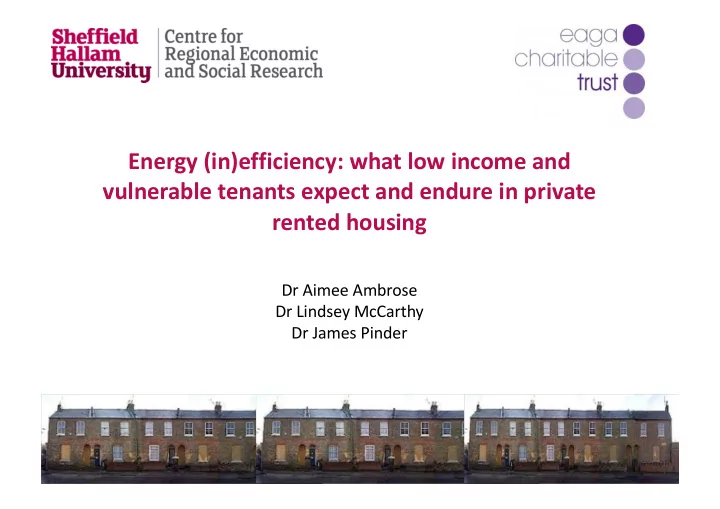
Energy (in)efficiency: what low income and vulnerable tenants expect and endure in private rented housing Dr Aimee Ambrose Dr Lindsey McCarthy Dr James Pinder The problem "The PRS in England exhibits the poorest energy performance of all

slide-1
SLIDE 1

Energy (in)efficiency: what low income and vulnerable tenants expect and endure in private rented housing

Dr Aimee Ambrose Dr Lindsey McCarthy Dr James Pinder

slide-2
SLIDE 2

The problem

"The PRS in England exhibits the poorest energy performance of all tenures whilst growing faster and housing a higher proportion of vulnerable households than any other tenure." (ACE, 2014).

slide-3
SLIDE 3

The missing voice

  • Research into the tenants'

perspective is limited (and not concerned with energy and cold homes)

  • Landlords base decisions

about energy efficiency on assumptions (Ambrose, 2015)

  • Activism amongst PRS tenants

is rare- no formal channels for a collective voice.

  • Tenants face barriers to

speaking out against poor conditions (Shelter, 2014)

  • So, we need to know what

they expect and endure...

slide-4
SLIDE 4

Aims

  • Understand tenants' perspectives on the energy efficiency of

their homes, clarifying needs, expectations and competing priorities

  • Test the assumptions of private landlords about what tenants

want and expect in terms of energy efficiency

  • Contribute to better-informed approaches to driving up

energy performance in the PRS.

slide-5
SLIDE 5

Methods

Literature review + expert interviews Generation of themes Postal survey 48 in-depth interviews in Hackney (25) and Rotherham (23) Observations

slide-6
SLIDE 6

Who did we speak to?

  • 25 low-income renters in

Hackney, via the survey and Crisis

  • 23 low-income renters in

Rotherham accessed, via the survey and the LA

  • All participants claiming LHA
  • All in E,F and G rated

properties

slide-7
SLIDE 7

Findings- overview

  • Finding somewhere to live
  • Is warmth a consideration?
  • Keeping warm and coping with the cold
  • Paying for heating
  • Keeping up with heating costs
  • The tenant-landlord relationship
  • Impacts on health and wellbeing
  • The Energy Act
  • Conclusions and key learning
slide-8
SLIDE 8

Is warmth considered when finding somewhere to live?

The stress of securing a property meant that few respondents considered heating issues when finding somewhere to live. I: When you looked for this property did you take into consideration how easy it would be to keep warm? R: No it didn’t, I just thought I’ll make it work. That’s partly to do with the housing crisis in London. (Gill, Hackney)

slide-9
SLIDE 9

Is warmth considered when finding somewhere to live?

Very few had engaged with EPCs or had been shown them by landlords and letting agents. Many were not even aware that they existed.

"Round here you just don’t get that much choice… if you had three to choose from you could look at the energy efficiency and pick the

  • ne you’d go for first." (Clive, Hackney).
slide-10
SLIDE 10

Keeping warm and coping with the cold

Wearing extra clothing or using blankets to keep warm when at home was common practice.

"It’s [expletive] cold, this is mild now but it is cold, I put the duvet round me and just lie in bed, it’s not productive." (Sonny, Hackney)

slide-11
SLIDE 11

Keeping warm and coping with the cold

Tolerance of cold homes appeared higher in Rotherham than in Hackney. Respondents in Hackney were dissatisfied regarding the warmth of their homes.

"I sleep with a hat on. It's annoying. My parents worry about my health." (Eddie, Hackney)

slide-12
SLIDE 12

Keeping warm and coping with the cold

Whereas in Rotherham, cold homes were seen as something that could be worked around. May perpetuate beliefs amongst landlords' that the energy performance of properties is unimportant to tenants. R: If we’re sat downstairs watching a film or whatever we’ll fetch a blanket down and snuggle under the blanket. I: So you have other ways of keeping warm? R: Yeah you just pop a jacket on. (Sarah, Rotherham). I: Are you comfortable with this kind of temperature? It's cold in here. R: Yes, if it gets a bit cold I just put another cardigan on. (Bill, Rotherham)

slide-13
SLIDE 13

Keeping warm and coping with the cold

It was common to heat the home for short periods to save money and endure the cold thereafter.

"When I turn the heater on…I have to switch it off cos they charge me too much so after 10 or 20 minutes I have to switch it off and I don’t really feel like it’s warm because I’m worried that the money’s going to go over and so I need to switch it off cos I’m like I’ve already put £10 in and tomorrow it’s going to finish, it doesn’t stay [warm for] long." (Adele, Hackney)

slide-14
SLIDE 14

Keeping warm and coping with the cold

No-one had unrealistic expectations regarding indoor temperature, expecting 18 and 20 degrees. It is unlikely that many achieved this.

R: In the morning it takes that long to get the house warmed through. I: We talked earlier about the time the heating comes on, would you have the heating coming on earlier? R: I just think it’s another hour of heating being on and that’s more money and I think for an hour of being cold it’s not going to hurt nobody. (Angela, Rotherham)

slide-15
SLIDE 15

Angela's flat

slide-16
SLIDE 16

Seeking help with high bills and cold homes

Respondents were more likely to seek support with energy bills than cold homes. Fear of rent increases or eviction held them back from complaining about cold homes:

"When I moved in here I got into massive debt and I had to go to Citizen’s Advice and they swapped my bank account and everything and I’m paying off some debts from there, I’m constantly checking my balance now cos it’s a very fine line, sometimes you’re scrabbling around to buy a loaf of bread, it’s bad. So that’s why I don’t want to say anything because I can't allow the rent to go up any more." (Andrea, Rotherham)

slide-17
SLIDE 17

"I went through a phase of thinking I was being poisoned, I thought there was a leak here, I still think there is, where the gas comes into the house and I was refusing to put it on. My landlord wasn’t very helpful with that, they said if we send someone and there’s not a leak we’ll charge you.. Anyway I just use electric heaters instead and they’re not economical: my electricity bill trebled." (Edie, Rotherham) Images from Edie's house

slide-18
SLIDE 18

Impacts on health & wellbeing

Respondents highlighted health issues believed to be associated with their homes: incl. exacerbation of chronic conditions and dangers with faulty equipment.

"I mentioned it to landlord, but nothing happened. This warrant officer came and went down in the cellar cos it was an old house and said ‘I’m surprised you two aren’t dead!' I said ‘is there a gas leak?’ he says ‘worse than a gas leak." (Peter, Rotherham)

slide-19
SLIDE 19

Impacts on health & wellbeing

  • They also highlighted less obvious issues such as:

– the emotional impact of living in a home that makes you unhappy and where you feel insecure; – the stress of balancing the costs of heating the home against

  • ther expenditure;

– the restrictions on how much of the home you can use and afford to keep heated; – and the long term health risks associated with poor diet.

slide-20
SLIDE 20

"As a parent when you’re worrying about bills I know that bleeds out, my kid sees it and it’s not nice, I don’t want to make him pessimistic and anxious about life and what you can afford, I want him to feel confident and secure." (Gill, Hackney) "I spend a little bit on food, I have to eat a little bit less but it doesn’t do me any harm, you also go for cheaper food, you can buy them noodles in a packet for 15p and have a few slices of bread and you can have your dinner on 25p so I’m not starving." (Chris, Rotherham)

slide-21
SLIDE 21

Concluding thoughts

"The picture emerging from the accounts of respondents is

  • ne characterised by limited housing choice that often leads

to the acceptance of poor quality properties that would

  • therwise be unacceptable; to fear of challenging the

landlord in case of retaliatory action; to enduring cold conditions and high bills and eventually to suffering the consequences of all of this for health and wellbeing." Final report.

slide-22
SLIDE 22

Reports and further reading

  • Ambrose, A and McCarthy L (forthcoming), Taming the 'masculine

pioneers'? Changing attitudes towards energy efficiency amongst private landlords and tenants in New Zealand: a case study of Dunedin, Energy Policy

  • Ambrose, A., McCarthy, L. and Pinder, J. (2017) Energy (in)efficiency: what

tenants expect and endure in private rented housing. Sheffield: CRESR, Sheffield Hallam University.

  • McCarthy, L., Ambrose, A., and Pinder, J. (2016) Energy (In)Efficiency:

Exploring what tenants expect and endure in the private rented sector in

  • England. Kendal: Eaga Charitable Trust. (Literature review)
  • Ambrose, A (2015) Energy efficiency in the private rented sector: why

don't landlords' act? Journal of the Indoor and Built Environment, 24 (7)

slide-23
SLIDE 23

This project Lived experiences of fuel poverty Reaching the hardest to reach Understanding energy (in)efficiency in the PRS in UK and NZ Understanding our changing relationship with energy

Housing research at CRESR Energy research at CRESR