
SLIDE 1
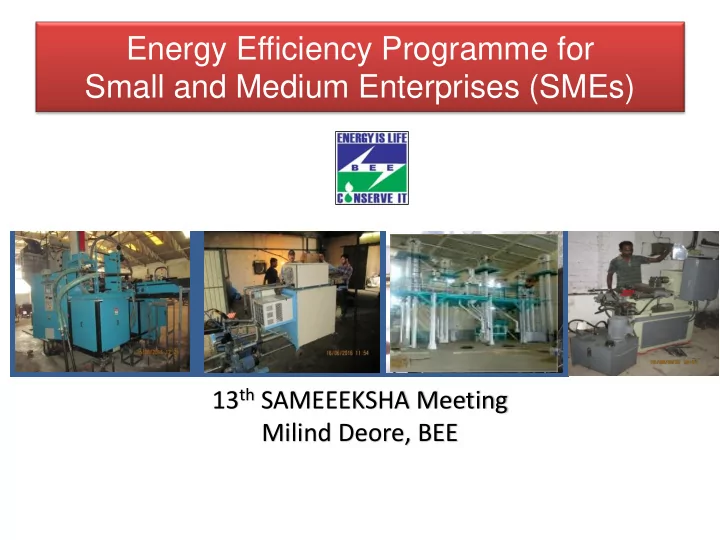
Energy Efficiency Programme for Small and Medium Enterprises (SMEs)
13th SAMEEEKSHA Meeting Milind Deore, BEE
Bureau of Energy Efficiency
Energy Efficiency Programme for Small and Medium Enterprises - - PowerPoint PPT Presentation
Energy Efficiency Programme for Small and Medium Enterprises (SMEs) Bureau of Energy Efficiency 13 th SAMEEEKSHA Meeting Milind Deore, BEE BEEs initiatives in SME sector BEE-SME program GEF-WB BEE GEF-UNIDO-BEE Increase demand
Bureau of Energy Efficiency
BEE-SME program GEF-UNIDO-BEE GEF-WB –BEE
EE Technology Demonstration through direct back ended subsidies to units Capacity Building Workshops
Energy Mapping Performance Banchmarks
Promoting energy efficiency and renewable energy in selected MSME clusters in India
(12 SME Clusters )
Increase capacity & Demand of EE –Product and Services Strengthening policy, institutional and decision making frameworks in the country Increase demand for EE investment in targeted clusters , Build their capacity to access commercial finance. 26 clusters Building Capacity & Awareness Increased Investment in Energy Efficiency Knowledge Management
Demonstration of 10 best identified technologies of selected 5 energy
intensive sectors
100 technology demonstration in 5 sectors.
Sharing of the BoP and BAT Development of case studies , print materials and audio visual of BATs &
BOPs
Capacity building in clusters through SDAs, National level workshops for
stakeholders.
Development of Pan India level Sector specific reports and policy plans . Launch of National Policy Document on Energy Efficiency in SMEs.
aligning the activities of BEE with those of MoMSME in the XII plan under its SME scheme.
TEQUP scheme in its workshops
Synergies of BEE-SME Program MoMSME schemes
assist units with implementation .
clusters .
Demonstration Projects
Capacity Building
Pan India Energy Benchmarking
Step .1
Constitution of cluster level steering committee a) Director, MSME-DI of the cluster, b) BEE is (convener) c) President, cluster Association Shortlisting of units and oversee implementation of EE Demos
Step.2
Open invite for participation to SME units for the implementation
+ Invitation for empanelment of LSP and Technology Providers
Step.3
Physical verification of units by BEE agency to select 20 units on the recommendation of committee
Direct release of subsidy through
e-transfer in the account of unit owner
units and proformas indicating completion of demos from IA .
Step.7 Post Audits steering
committee approves release
satisfaction of completion
Base line audits in the selected 20 units of the cluster by BEE- IA
Step.6
in the 20 units.
and audio visual recordings, Case
Step.4 Signing of MoU with each of
the twenty units of the cluster.
(SME) forging units operating in the various industrial pockets in and around Ludhiana, manufacturing products suitable for automotive, industrial and agricultural sector.
efficiency of forging units in the cluster – Induction Heating Furnace & Special Purpose Machines
forging units
units implemented the suggested technologies – realized energy savings 20 to 40%
region of Moga, Phagwara, Jalandhar and Ludhiana.
Induction heater installed at C-Forge (India) Induction heater installed at Global exports SPM – turning installed at NN Products Induction heater installed at Soga toka Industries SPM – turning installed at Bharat International SPM – turning installed at Khalon International SPM – turning installed at Mehram Industries SPM – drilling installed at Bharat International
More than 200 (Dal + Poha) processing units in Indore and Ujjain industrial area Baseline audits were completed in 14 units Identified Technologies – (average energy saving potential is 25 to 30%) – Replacing old and inefficient motors with EE motors – Installing Oxygen Sensor, fuel control and damper control – Installation of VFDs – Replacement of existing compressor with energy efficient compressor system – Substitution of fuel - saw dust based to gas based burner
technologies – realized energy savings 15 to 30%
Emery Roll Motors at Nanak Overseas Pakka Counter motor at Nanak Overseas Roaster Motor at J P Hansraj Flacker Motor at Hira Industries Poha Machine motor at Dharmesh Industries Dhan Elevator motor at Dharmesh Industries Flacker motor at Bindal Process Poha Machine motor at Abhishek Industries
enhance energy efficiency of brick making units in the cluster
entrepreneurs
cluster
design
More than 350 Textile Dyeing and Finishing units with production capacity of 5.5 million meter per day Local industrial bodies District Industrial Center, Pali Rajasthan Textile and Hand Processors Association (RTHPA), Pali Baseline audits were completed in 11 textile units Post implementation audit completed in 5 units of textile. Identified Technologies – Economizer in Thermic fluid heater, – Air-preheater (APH) in steam boiler, – Waste heat recovery (WHR) with kier boiling unit, – Temperature Monitoring & Control in Jigger Machines Advanced Float Trap systems – Condensate Recovery System (CRS) in Jet Dyeing Machine, – Oxygen based automation and control system in boiler, – Installation of VFD for blowers of thermopac & boiler – New energy efficient boiler
More than 65 units in Kochi sea food cluster Baseline audits were completed in 8 units Identified Technologies – (average energy saving potential is 15 to 20%)
– Replacement of reciprocating compressor with Screw compressor with VFD – Replacement of water cooled condenser with Evaporative condenser – Installation of variable frequency drive for condenser water pumps – Installation of THERMOSHIPON SYSTEM (GAS COOLING) for Compressor. – Automation of refrigeration plant by using PLC controller
and adopt energy efficiency technologies.
units of Food Cluster in Indore, 5 units of Pali Textile Cluster and 2 unit
Savings of about 569 toe per annum, Cost Savings of about INR 1.5 crore per annum and GHG reductions of about 2426 tCO2 per annum.
technology
Textile cluster during 9th-11th January, 2018.
supplies of various identifies EE technologies.
17
(FIs)
investments as “high risk” investments
technologies
requirements for the program.
Proposed Activities and Deliverables – Energy Efficiency and
Technology Upgradation in SMEs (1/3)
8
Year 2017 – 2018 2018 – 2019 2019 – 2020 Planned Activities along with Year wise Measureable Indicators
Upgradation in SMEs through ESCO route
intensive clusters for identification of 20 EE technologies and implementation of demonstration projects
equipments for units implementing EE technologies
demonstration projects
No. of ESCO companies selected for technology identification and implementation No. of EE technologies identified in each cluster No. of local service providers identified for the technology Amount of fund utilized and it’s percent share in total fund allocated No. of demonstration projects in each cluster No. of units with installation
No. of units that have completed M&V of demonstrated technologies Amount of fund utilized and it’s percent share in total fund allocated No. of demonstration projects in each cluster No. of units with installation of M&V equipments No. of units that have completed M&V of demonstrated technologies Amount of fund utilized and it’s percent share in total fund allocated
capacity building sessions for replication of identified technologies
Collaboration with technical institutions and
identification of best practices and opportunities No. of Dissemination workshops completed Amount of fund utilized and it’s percent share in total fund allocated No. of Dissemination workshops completed Amount of fund utilized and it’s percent share in total fund allocated
Proposed Activities and Deliverables – Energy Efficiency and
Technology Upgradation in SMEs (2/3)
9
Year 2017 – 2018 2018 – 2019 2019 – 2020 Planned Activities along with Year wise Measureable Indicators
bidding for design and setting up Technology Specific Forum
disseminate the purpose and objectives of the forum
Hiring of consultant to develop a business model for the technology forum National workshop on dissemination information about the forum Amount of fund utilized and it’s percent share in total fund allocated National workshop on dissemination information about the forum No. of meetings convened by the forum Amount of fund utilized and it’s percent share in total fund allocated No. of meetings convened by the forum Amount of fund utilized and it’s percent share in total fund allocated
institutions from project genesis
energy intensive clusters
studies in the 10 clusters
No. of capacity building workshops conducted for bankers and FIs in clusters No. of risk studies completed in the cluster Amount of fund utilized and it’s percent share in total fund allocated No. of capacity building workshops conducted for bankers and FIs in clusters No. of risk studies completed in the cluster Amount of fund utilized and it’s percent share in total fund allocated
Proposed Activities and Deliverables – Energy Efficiency and
Technology Upgradation in SMEs (3/3)
10
Year 2017 – 2018 2018 – 2019 2019 – 2020 Planned Activities along with Year wise Measureable Indicators
energy intensive sectors
LSPs, technologies, best practices etc. for 10 energy intensive sectors
enabled version of master database
Identification of 10 energy intensive sectors Hiring of agency for development
Hiring of software agency for development of mobile app and web enabled version of database Amount of fund utilized and it’s percent share in total fund allocated Development of master database for all sectors Usage of the mobile app by MSME unit owners Amount of fund utilized and it’s percent share in total fund allocated
basis
sectors/Clusters which have high energy consumption
specific reports and policy plans for development of Sector
energy efficiency in SMEs
Selection of clusters to be covered under the project No. of units covered under the mapping No. of units covered under the mapping Database developed for collating all the data of SMEs Amount of fund utilized and it’s percent share in total fund allocated No. of units covered under the mapping Database developed for collating all the data of SMEs Launch of national level policy document Amount of fund utilized and it’s percent share in total fund allocated