ENE 2XX: Renewable Energy Systems and Control LEC 04 : Distributed - - PowerPoint PPT Presentation

ene 2xx renewable energy systems and control lec 04
SMART_READER_LITE
LIVE PREVIEW

ENE 2XX: Renewable Energy Systems and Control LEC 04 : Distributed - - PowerPoint PPT Presentation

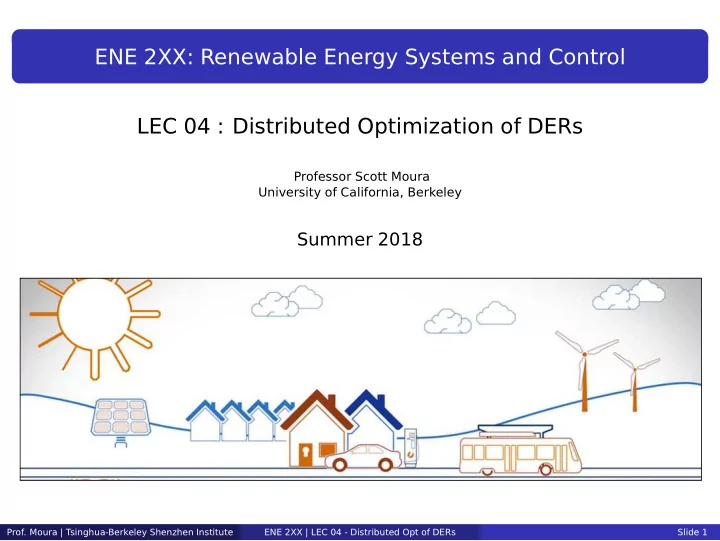
ENE 2XX: Renewable Energy Systems and Control LEC 04 : Distributed Optimization of DERs Professor Scott Moura University of California, Berkeley Summer 2018 Prof. Moura | Tsinghua-Berkeley Shenzhen Institute ENE 2XX | LEC 04 - Distributed Opt


slide-1
SLIDE 1

ENE 2XX: Renewable Energy Systems and Control LEC 04 : Distributed Optimization of DERs

Professor Scott Moura University of California, Berkeley

Summer 2018

  • Prof. Moura | Tsinghua-Berkeley Shenzhen Institute

ENE 2XX | LEC 04 - Distributed Opt of DERs Slide 1

slide-2
SLIDE 2

Distributed vs. Decentralized: What are they?

Distributed Decentralized Decentralized Fully Decentralized Community Optimization/ Control: Power Systems:

  • Prof. Moura | Tsinghua-Berkeley Shenzhen Institute

ENE 2XX | LEC 04 - Distributed Opt of DERs Slide 2

slide-3
SLIDE 3

Distributed vs. Decentralized: What are they?

Distributed Decentralized Decentralized Fully Decentralized Community Optimization/ Control: Power Systems:

  • Prof. Moura | Tsinghua-Berkeley Shenzhen Institute

ENE 2XX | LEC 04 - Distributed Opt of DERs Slide 2

slide-4
SLIDE 4
  • Prof. Moura | Tsinghua-Berkeley Shenzhen Institute

ENE 2XX | LEC 04 - Distributed Opt of DERs Slide 3

slide-5
SLIDE 5
  • Prof. Moura | Tsinghua-Berkeley Shenzhen Institute

ENE 2XX | LEC 04 - Distributed Opt of DERs Slide 3

slide-6
SLIDE 6

Source: C. Vlahoplus, G. Litra, P . Quinlan, C. Becker, “Revising the California Duck Curve: An Exploration of Its Existence, Impact, and Migration Potential,” Scott Madden, Inc., Oct 2016.

  • Prof. Moura | Tsinghua-Berkeley Shenzhen Institute

ENE 2XX | LEC 04 - Distributed Opt of DERs Slide 3

slide-7
SLIDE 7
  • Prof. Moura | Tsinghua-Berkeley Shenzhen Institute

ENE 2XX | LEC 04 - Distributed Opt of DERs Slide 3

slide-8
SLIDE 8
  • Prof. Moura | Tsinghua-Berkeley Shenzhen Institute

ENE 2XX | LEC 04 - Distributed Opt of DERs Slide 4

slide-9
SLIDE 9

PEV Energy Storage: How much, when, and where?

  • A. Langton and N. Crisostomo, “Vehicle-grid integration: A vision for zero-emission transportation interconnected throughout Californias electricity

system,” California Public Utilities Commission, Tech. Rep. R. 13-11-XXX, 2013.

  • Prof. Moura | Tsinghua-Berkeley Shenzhen Institute

ENE 2XX | LEC 04 - Distributed Opt of DERs Slide 5

slide-10
SLIDE 10

Problem Statement

Goal: Schedule DERs (e.g. PEVs, ESS, TCLs) to flatten California duck curve Challenge: N = 103, 106, or 109 DERs to schedule every time slot!!! minimizeP∈RTh×N

Th

  • t=1
  • Dt +

N

  • n=1

Pt

n

2

subject to Pt

n ≤ ut n ≤ P t n,

∀n, ∀t

A Quadratic Program (QP) Th × N optimization variables 2T × N linear inequality constraints

  • Prof. Moura | Tsinghua-Berkeley Shenzhen Institute

ENE 2XX | LEC 04 - Distributed Opt of DERs Slide 6

slide-11
SLIDE 11

Problem Statement

Goal: Schedule DERs (e.g. PEVs, ESS, TCLs) to flatten California duck curve Challenge: N = 103, 106, or 109 DERs to schedule every time slot!!! minimizeP∈RTh×N

Th

  • t=1
  • Dt +

N

  • n=1

Pt

n

2

subject to Pt

n ≤ ut n ≤ P t n,

∀n, ∀t

A Quadratic Program (QP) 100K EVs*, 24 hrs Th × N optimization variables 2.4M 2Th × N linear inequality constraints 4.8M *cumulative PEVs sold in CA by mid-2014

  • Prof. Moura | Tsinghua-Berkeley Shenzhen Institute

ENE 2XX | LEC 04 - Distributed Opt of DERs Slide 6

slide-12
SLIDE 12

Problem Statement

Goal: Schedule DERs (e.g. PEVs, ESS, TCLs) to flatten California duck curve Challenge: N = 103, 106, or 109 DERs to schedule every time slot!!! minimizeP∈RTh×N

Th

  • t=1
  • Dt +

N

  • n=1

Pt

n

2

subject to Pt

n ≤ ut n ≤ P t n,

∀n, ∀t

A Quadratic Program (QP) 1.5M EVs*, 24 hrs T × N optimization variables 32M 2T × N linear inequality constraints 64M *California Gov. Brown 2025 ZEV Goal

  • Prof. Moura | Tsinghua-Berkeley Shenzhen Institute

ENE 2XX | LEC 04 - Distributed Opt of DERs Slide 6

slide-13
SLIDE 13

Problem Statement

Goal: Schedule DERs (e.g. PEVs, ESS, TCLs) to flatten California duck curve Challenge: N = 103, 106, or 109 DERs to schedule every time slot!!! minimizeP∈RTh×N

Th

  • t=1
  • Dt +

N

  • n=1

Pt

n

2

subject to Pt

n ≤ ut n ≤ P t n,

∀n, ∀t

A Quadratic Program (QP) 5M EVs*, 24 hrs T × N optimization variables 120M 2T × N linear inequality constraints 240M *China’s 2025 EV Goal

  • Prof. Moura | Tsinghua-Berkeley Shenzhen Institute

ENE 2XX | LEC 04 - Distributed Opt of DERs Slide 6

slide-14
SLIDE 14

Problem Statement

Goal: Schedule DERs (e.g. PEVs, ESS, TCLs) to flatten California duck curve Challenge: N = 103, 106, or 109 DERs to schedule every time slot!!! minimizeP∈RTh×N

Th

  • t=1
  • Dt +

N

  • n=1

Pt

n

2

subject to Pt

n ≤ ut n ≤ P t n,

∀n, ∀t

A Quadratic Program (QP) 5M EVs*, 24 hrs T × N optimization variables 120M 2T × N linear inequality constraints 240M *China’s 2025 EV Goal Enabling Innovation: Use duality theory!!!

  • Prof. Moura | Tsinghua-Berkeley Shenzhen Institute

ENE 2XX | LEC 04 - Distributed Opt of DERs Slide 6

slide-15
SLIDE 15

Optimal PEV Aggregation

minimizeP∈RTh×N

Th

  • t=1
  • Dt +

N

  • n=1

Pt

n

2 +σ

N

  • n=1

Pn2

subject to: Pt

n ≤ Pt n ≤ P t n,

∀n, ∀t

  • Prof. Moura | Tsinghua-Berkeley Shenzhen Institute

ENE 2XX | LEC 04 - Distributed Opt of DERs Slide 7

slide-16
SLIDE 16

Optimal PEV Aggregation

Define “consensus variable”: zt = Dt + N

n Pt n

minimizeP∈RTh×N,z∈RTh

Th

  • t=1
  • zt2 + σ

N

  • n=1

Pn2

subject to: zt = Dt +

N

  • n

Pt

n,

∀t

Pt

n ≤ Pt n ≤ P t n,

∀n, ∀t

  • Prof. Moura | Tsinghua-Berkeley Shenzhen Institute

ENE 2XX | LEC 04 - Distributed Opt of DERs Slide 7

slide-17
SLIDE 17

Optimal PEV Aggregation

Strong duality holds. Define dual problem: max

λ∈RTh

min

P∈RTh×N,z∈RTh Th

  • t=1
  • zt2 +λt
  • zt − Dt −

N

  • n

Pt

n

  • + σ

N

  • n=1

Pn2

subject to: Pt

n ≤ Pt n ≤ P t n,

∀n, ∀t

  • Prof. Moura | Tsinghua-Berkeley Shenzhen Institute

ENE 2XX | LEC 04 - Distributed Opt of DERs Slide 7

slide-18
SLIDE 18

Optimal PEV Aggregation

Strong duality holds. Define dual problem: max

λ∈RTh

min

P∈RTh×N,z∈RTh Th

  • t=1
  • zt2 +λt
  • zt − Dt −

N

  • n

Pt

n

  • + σ

N

  • n=1

Pn2

subject to: Pt

n ≤ Pt n ≤ P t n,

∀n, ∀t

minimize w.r.t. z f t(zt) = (zt)2 + λtzt, df t dzt = 2zt + λt = 0,

⇒ (zt)⋆ = −1

2λt For convenience, define ρt = −λt. Plug (zt)⋆ = 1

2ρt into dual problem

  • Prof. Moura | Tsinghua-Berkeley Shenzhen Institute

ENE 2XX | LEC 04 - Distributed Opt of DERs Slide 7

slide-19
SLIDE 19

Optimal PEV Aggregation

Plug (zt)⋆ = 1

2ρt into dual problem

max

ρ∈RTh

min

P∈RTh×N Th

  • t=1

1 4

  • ρt2 − ρt
  • 1

2ρt − Dt −

N

  • n

Pt

n

  • + σ

N

  • n=1

Pn2

subject to: Pt

n ≤ Pt n ≤ P t n,

∀n, ∀t

  • Prof. Moura | Tsinghua-Berkeley Shenzhen Institute

ENE 2XX | LEC 04 - Distributed Opt of DERs Slide 7

slide-20
SLIDE 20

Optimal PEV Aggregation

Plug (zt)⋆ = 1

2ρt into dual problem

max

ρ∈RTh

min

P∈RTh×N Th

  • t=1

1 4

  • ρt2 − ρt
  • 1

2ρt − Dt −

N

  • n

Pt

n

  • + σ

N

  • n=1

Pn2

subject to: Pt

n ≤ Pt n ≤ P t n,

∀n, ∀t

The Pn terms decouple along n, yielding N parallel subproblems: max

ρ∈RTh −1

4ρ2 + DTρ

+

N

  • n=1
  • min

P∈RTh×N ρTPn + σPn2

  • subject to: Pt

n ≤ Pt n ≤ P t n,

∀n, ∀t

Each PEV optimizes her own schedule, given ρt from aggregator Parallelized N = 1.5M problems Constraints remain private

  • Prof. Moura | Tsinghua-Berkeley Shenzhen Institute

ENE 2XX | LEC 04 - Distributed Opt of DERs Slide 7

slide-21
SLIDE 21

Provable Convergence w/ Bounds

Define g(ρ) = −1 4ρ2 + DTρ

+

N

  • n=1
  • min

P∈RTh×N ρTPn + σPn2

  • s. to Pt

n ≤ Pt n ≤ P t n,

∀n, ∀t

Theorem: Linear Convergence Rate

The dual problem has a unique solution ρ⋆, and the gradient ascent algorithm with step-size α = −2σ/(N + σ) converges linearly according to g(ρ⋆) − g(ρk) ≤

  • N

N + σ

k (g(ρ⋆) − g(ρ0))

Similar theorems for Incremental stochastic gradient method (constant step-size) Incremental stochastic gradient method (decreasing step-size) Incorporate uncertainty in Dt and PEV availability (SOCP)

  • Prof. Moura | Tsinghua-Berkeley Shenzhen Institute

ENE 2XX | LEC 04 - Distributed Opt of DERs Slide 8

slide-22
SLIDE 22

Optimal DER Aggregation

max

ρ∈RTh −1

4ρ2 + DTρ

+

N

  • n

min

P∈RTh×N ρTPn + σ N

  • n=1

Pn2

  • s. to Pt

n ≤ Pt n ≤ P t n,

∀n, ∀t ρt is time-varying price incentive uniformly provided to each DER.

  • Prof. Moura | Tsinghua-Berkeley Shenzhen Institute

ENE 2XX | LEC 04 - Distributed Opt of DERs Slide 9

slide-23
SLIDE 23

Distributed Algorithm

max

ρ∈RTh −1

4ρ2 + DTρ

+

N

  • n

min

P∈RTh×N ρTPn + σ N

  • n=1

Pn2

  • s. to Pt

n ≤ Pt n ≤ P t n,

∀n, ∀t

Algorithm 1 Gradient Ascent (constant step size) Initialize ρ = ρ0; Choose α = −2σ/(N + σ) for k = 1, · · · , kmax (1) Inner Optimization: Optimize charge schedule for each PEV n for n = 0, 1, · · · , N ...Solve, Pk

n = arg minPt

n≤Pt n≤P t n

(ρk)TPn + σ N

n=1 Pn2

end for (2) Outer Optimization: Update dual variable ρ ...ρk+1 = ρk + α · ∇g(ρk) ...ρk+1 = ρk + α

  • − 1

2ρk + D + N n=1 Pk n

  • end for
  • Prof. Moura | Tsinghua-Berkeley Shenzhen Institute

ENE 2XX | LEC 04 - Distributed Opt of DERs Slide 10

slide-24
SLIDE 24

CENTRALIZED

Central ¡ Controller ¡

PEV ¡ PEV ¡

Personal ¡ Charge ¡ ¡ Schedule ¡ ¡ ¡Mobility ¡Data ¡ ¡Vehicle ¡Data ¡ EVSE ¡Data ¡

+ Global optimality + Complete controllability

  • Communication infrastructure
  • Privacy concerns
  • Scalability
  • Modularity

DISTRIBUTED

Social ¡ Coordinator ¡

PEV ¡ PEV ¡

Uniform ¡ Incen=ve ¡ ¡Charge ¡ Schedule ¡ Self-­‑Op=mize ¡

+ Communication light + Privacy preserving + Modular + Scalable

  • Lacks global optimality
  • Analysis more difficult
  • Prof. Moura | Tsinghua-Berkeley Shenzhen Institute

ENE 2XX | LEC 04 - Distributed Opt of DERs Slide 11

slide-25
SLIDE 25
  • Prof. Moura | Tsinghua-Berkeley Shenzhen Institute

ENE 2XX | LEC 04 - Distributed Opt of DERs Slide 12

slide-26
SLIDE 26
  • C. Le Floch, F

. Belletti, S. J. Moura, “Optimal Charging of Electric Vehicles for Load Shaping: a Dual Splitting Framework with Explicit Convergence Bounds,” IEEE Transactions on Vehicle Electrification, vol. 2, no. 2, pp. 190-199, June 2016. DOI: 10.1109/TTE.2016.2531025.

  • Prof. Moura | Tsinghua-Berkeley Shenzhen Institute

ENE 2XX | LEC 04 - Distributed Opt of DERs Slide 12

slide-27
SLIDE 27

Optimal PEV Aggregation

Goal: Aggregate N PEVs into “Virtual Power Plant,” sell in Day Ahead Market Challenges: (i) N = 106 EVs; (ii) assets stochastic; (iii) privacy

  • Prof. Moura | Tsinghua-Berkeley Shenzhen Institute

ENE 2XX | LEC 04 - Distributed Opt of DERs Slide 13

slide-28
SLIDE 28

Optimal PEV Aggregation

Goal: Aggregate N PEVs into “Virtual Power Plant,” sell in Day Ahead Market Challenges: (i) N = 106 EVs; (ii) assets stochastic; (iii) privacy Local System i = 1, 2, · · · N Gi : Power imported from grid [kW] Si : Power gen. from solar [kW] EVi : Power to charge EV [kW] Li : Power of loads [kW] Day Ahead Market Clearing price p ∈ R24 is stochastic.

ˆ

p = E(p)

ˆ Σ = Cov(p) ∈ R24×24

  • Prof. Moura | Tsinghua-Berkeley Shenzhen Institute

ENE 2XX | LEC 04 - Distributed Opt of DERs Slide 13

slide-29
SLIDE 29

Objective Function

J

= ˆ

pTGΣ

expected cost

+α · GT

Σ ˆ

ΣGΣ

variance

+ δ

2

N

  • i=1
  • EVi2

2 + Gi2 2

  • battery degradation & transformer strain

(1) where GΣ =

N

  • i=1

Gi, EVΣ =

N

  • i=1

EVi (2)

  • Prof. Moura | Tsinghua-Berkeley Shenzhen Institute

ENE 2XX | LEC 04 - Distributed Opt of DERs Slide 14

slide-30
SLIDE 30

Objective Function

J

= ˆ

pTGΣ

expected cost

+α · GT

Σ ˆ

ΣGΣ

variance

+ δ

2

N

  • i=1
  • EVi2

2 + Gi2 2

  • battery degradation & transformer strain

(1) where GΣ =

N

  • i=1

Gi, EVΣ =

N

  • i=1

EVi (2) Case Study: CAISO Day Ahead Market

  • Prof. Moura | Tsinghua-Berkeley Shenzhen Institute

ENE 2XX | LEC 04 - Distributed Opt of DERs Slide 14

slide-31
SLIDE 31

Local Constraints

Local System i = 1, 2, · · · N Supply = Demand Lt

i + EVt i = St i + Gt i,

∀ t

(3) Grid import/export limits Gt

i ≤ Gt i ≤ G t i,

∀ t

(4) EV battery energy & power limits evt

i ≤ t

  • τ=1

EVτ

i ∆t ≤ evt i,

∀ t

(5) EVt

i ≤ EVt i ≤ EV t i,

∀ t

(6)

  • Prof. Moura | Tsinghua-Berkeley Shenzhen Institute

ENE 2XX | LEC 04 - Distributed Opt of DERs Slide 15

slide-32
SLIDE 32

Aggregated EV Energy & Power Limits

  • Prof. Moura | Tsinghua-Berkeley Shenzhen Institute

ENE 2XX | LEC 04 - Distributed Opt of DERs Slide 16

slide-33
SLIDE 33

Aggregated EV Energy & Power Limits

  • Prof. Moura | Tsinghua-Berkeley Shenzhen Institute

ENE 2XX | LEC 04 - Distributed Opt of DERs Slide 16

slide-34
SLIDE 34

Aggregated EV Energy & Power Limits

AGGREGATE individual EV energy & power limits evt

Σ ≤ A · EVΣ ≤ evt Σ,

∀ t

(7) EVt

Σ ≤ EVt Σ ≤ EV

t

Σ,

∀ t

(8) evt

Σ is r.v., e.g. ∼ N( ˆ

ev

t

Σ, (ˆ

σt

ev)2)

evt

Σ is r.v.

EVt

Σ is r.v.

EV

t

Σ is r.v.

  • Prof. Moura | Tsinghua-Berkeley Shenzhen Institute

ENE 2XX | LEC 04 - Distributed Opt of DERs Slide 16

slide-35
SLIDE 35

Aggregated EV Energy & Power Limits

AGGREGATE individual EV energy & power limits evt

Σ ≤ A · EVΣ ≤ evt Σ,

∀ t

(7) EVt

Σ ≤ EVt Σ ≤ EV

t

Σ,

∀ t

(8) evt

Σ is r.v., e.g. ∼ N( ˆ

ev

t

Σ, (ˆ

σt

ev)2)

evt

Σ is r.v.

EVt

Σ is r.v.

EV

t

Σ is r.v.

Relax inequalities into chance con- straints Pr

  • evt

Σ ≤ A · EVΣ

  • ≥ η

(9) Pr

  • A · EVΣ ≤ evt

Σ

  • ≥ η

(10) Pr

  • EVt

Σ ≤ EVt Σ

  • ≥ η

(11) Pr

  • EVt

Σ ≤ EV

t

Σ

  • ≥ η

(12)

  • Prof. Moura | Tsinghua-Berkeley Shenzhen Institute

ENE 2XX | LEC 04 - Distributed Opt of DERs Slide 16

slide-36
SLIDE 36

Problem Summary

minimize J = ˆ pTGΣ + α · GT

Σ ˆ

ΣGΣ + δ

2

N

  • i=1
  • EVi2

2 + Gi2 2

  • (13)

subject to GΣ =

N

  • i=1

Gi, EVΣ =

N

  • i=1

EVi (14) evt

Σ ≤ A · EVΣ ≤ evt Σ,

∀ t

(15) EVt

Σ ≤ EVt Σ ≤ EV

t

Σ,

∀ t

(16)

∀ i = 1, 2, · · · , N; locali :

Lt

i + EVt i = St i + Gt i,

∀ t

(17) Gt

i ≤ Gt i ≤ G t i,

∀ t

(18) evt

i ≤ t

  • τ=1

EVτ

i ∆t ≤ evt i,

∀ t

(19) EVt

i ≤ EVt i ≤ EV t i,

∀ t

(20) A Quadratic Program (QP) 48 · N vars , 144 · N constraints

  • Prof. Moura | Tsinghua-Berkeley Shenzhen Institute

ENE 2XX | LEC 04 - Distributed Opt of DERs Slide 17

slide-37
SLIDE 37

Problem Summary

minimize J = ˆ pTGΣ + α · GT

Σ ˆ

ΣGΣ + δ

2

N

  • i=1
  • EVi2

2 + Gi2 2

  • (13)

subject to GΣ =

N

  • i=1

Gi, EVΣ =

N

  • i=1

EVi (14) evt

Σ ≤ A · EVΣ ≤ evt Σ,

∀ t

(15) EVt

Σ ≤ EVt Σ ≤ EV

t

Σ,

∀ t

(16)

∀ i = 1, 2, · · · , N; locali :

Lt

i + EVt i = St i + Gt i,

∀ t

(17) Gt

i ≤ Gt i ≤ G t i,

∀ t

(18) evt

i ≤ t

  • τ=1

EVτ

i ∆t ≤ evt i,

∀ t

(19) EVt

i ≤ EVt i ≤ EV t i,

∀ t

(20) A Quadratic Program (QP) 100K EVs* 4.8M vars , 14.4M constraints *cumulative PEVs sold in CA by mid-2014

  • Prof. Moura | Tsinghua-Berkeley Shenzhen Institute

ENE 2XX | LEC 04 - Distributed Opt of DERs Slide 17

slide-38
SLIDE 38

Problem Summary

minimize J = ˆ pTGΣ + α · GT

Σ ˆ

ΣGΣ + δ

2

N

  • i=1
  • EVi2

2 + Gi2 2

  • (13)

subject to GΣ =

N

  • i=1

Gi, EVΣ =

N

  • i=1

EVi (14) evt

Σ ≤ A · EVΣ ≤ evt Σ,

∀ t

(15) EVt

Σ ≤ EVt Σ ≤ EV

t

Σ,

∀ t

(16)

∀ i = 1, 2, · · · , N; locali :

Lt

i + EVt i = St i + Gt i,

∀ t

(17) Gt

i ≤ Gt i ≤ G t i,

∀ t

(18) evt

i ≤ t

  • τ=1

EVτ

i ∆t ≤ evt i,

∀ t

(19) EVt

i ≤ EVt i ≤ EV t i,

∀ t

(20) A Quadratic Program (QP) 5M EVs* 240M vars , 720M constraints *China’s 2025 Goal

  • Prof. Moura | Tsinghua-Berkeley Shenzhen Institute

ENE 2XX | LEC 04 - Distributed Opt of DERs Slide 17

slide-39
SLIDE 39

Distributed Algorithm

ν∗ can be regarded as grid power export price

Bµ∗ can be regarded as EV charging price

  • Prof. Moura | Tsinghua-Berkeley Shenzhen Institute

ENE 2XX | LEC 04 - Distributed Opt of DERs Slide 18

slide-40
SLIDE 40

Distributed Algorithm

ν∗ can be regarded as grid power export price

Bµ∗ can be regarded as EV charging price

Convergence Theorem

The distributed algorithm solves the original problem, and it converges sub-linearly w.r.t. the number of iterations between the aggregator and “prosumers”.

  • Prof. Moura | Tsinghua-Berkeley Shenzhen Institute

ENE 2XX | LEC 04 - Distributed Opt of DERs Slide 18

slide-41
SLIDE 41

Simulations

Nesterov’s acceleration method uses the concept of momentum: max

ρ

g(ρ) (21)

ρk+1 = ρk + k − 1

k + 2

  • ρk − ρk−1

+ α · ∇g(ρk)

(22)

  • Prof. Moura | Tsinghua-Berkeley Shenzhen Institute

ENE 2XX | LEC 04 - Distributed Opt of DERs Slide 19

slide-42
SLIDE 42

Resources

  • C. Le Floch, F

. Belletti, SJM, “Optimal Charging of Electric Vehicles for Load Shaping: a Dual Splitting Framework with Explicit Convergence Bounds,” IEEE Transactions on Vehicle Electrification, vol. 2, no. 2, pp. 190-199, June 2016. DOI: 10.1109/TTE.2016.2531025.

  • B. Travacca, S. Bae, J. Wu, SJM, “Stochastic Day Ahead Load Scheduling for Aggregated Distributed

Energy Resources,” IEEE Conference on Control Technology and Applications, Kohala Coast, HI, 2017. DOI: 10.1109/CCTA.2017.8062774.

  • Prof. Moura | Tsinghua-Berkeley Shenzhen Institute

ENE 2XX | LEC 04 - Distributed Opt of DERs Slide 20