Encoding, Fast and Slow: Low-Latency Video Processing Using - - PowerPoint PPT Presentation

encoding fast and slow
SMART_READER_LITE
LIVE PREVIEW

Encoding, Fast and Slow: Low-Latency Video Processing Using - - PowerPoint PPT Presentation

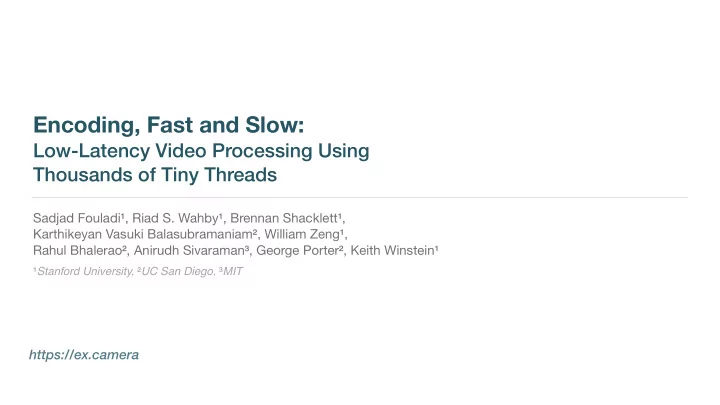
Encoding, Fast and Slow: Low-Latency Video Processing Using Thousands of Tiny Threads Sadjad Fouladi , Riad S. Wahby , Brennan Shacklett , Karthikeyan Vasuki Balasubramaniam , William Zeng , Rahul Bhalerao , Anirudh Sivaraman


slide-1
SLIDE 1

Encoding, Fast and Slow:

Low-Latency Video Processing Using Thousands of Tiny Threads

Sadjad Fouladi¹, Riad S. Wahby¹, Brennan Shacklett¹, Karthikeyan Vasuki Balasubramaniam², William Zeng¹, Rahul Bhalerao², Anirudh Sivaraman³, George Porter², Keith Winstein¹

https://ex.camera

¹Stanford University, ²UC San Diego, ³MIT

slide-2
SLIDE 2

Outline

  • Vision & Goals
  • mu: Supercomputing as a Service
  • Fine-grained Parallel Video Encoding
  • Evaluation
  • Conclusion & Future Work

2

slide-3
SLIDE 3

The challenges

  • Low-latency video processing would need thousands of threads, running in

parallel, with instant startup.

  • However, the finer-grained the parallelism, the worse the compression

efficiency.

9

slide-4
SLIDE 4

Enter ExCamera

  • We made two contributions:
  • Framework to run 5,000-way parallel jobs with IPC on a commercial

“cloud function” service.

  • Purely functional video codec for massive fine-grained parallelism.
  • We call the whole system ExCamera.

10

slide-5
SLIDE 5

Outline

  • Vision & Goals
  • mu: Supercomputing as a Service
  • Fine-grained Parallel Video Encoding
  • Evaluation
  • Conclusion & Future Work

11

slide-6
SLIDE 6

Where to find thousands of threads?

  • IaaS services provide virtual machines (e.g. EC2, Azure, GCE):
  • Thousands of threads
  • Arbitrary Linux executables

! Minute-scale startup time (OS has to boot up, ...) ! High minimum cost


(60 mins EC2, 10 mins GCE)

12

3,600 threads on EC2 for one second → >$20

slide-7
SLIDE 7

Cloud function services have (as yet) unrealized power

  • AWS Lambda, Google Cloud Functions
  • Intended for event handlers and Web microservices, but...
  • Features:

✔ Thousands of threads ✔ Arbitrary Linux executables ✔ Sub-second startup ✔ Sub-second billing

13

3,600 threads for one second → 10¢

slide-8
SLIDE 8

mu, supercomputing as a service

  • We built mu, a library for designing and deploying general-purpose parallel

computations on a commercial “cloud function” service.

  • The system starts up thousands of threads in seconds and manages inter-

thread communication.

  • mu is open-source software: https://github.com/excamera/mu

14

slide-9
SLIDE 9

Outline

  • Vision & Goals
  • mu: Supercomputing as a Service
  • Fine-grained Parallel Video Encoding
  • Evaluation
  • Conclusion & Future Work

17

slide-10
SLIDE 10

Now we have the threads, but...

  • With the existing encoders, the finer-grained the parallelism, the worse the

compression efficiency.

18

slide-11
SLIDE 11

Video Codec

  • A piece of software or hardware that compresses and decompresses digital

video.

19

1011000101101010001 0001111111011001110 0110011101110011001 0010000...001001101 0010011011011011010 1111101001100101000 0010011011011011010

Encoder Decoder

slide-12
SLIDE 12

How video compression works

  • Exploit the temporal redundancy in adjacent images.
  • Store the first image on its entirety: a key frame.
  • For other images, only store a "diff" with the previous images: an interframe.

20

In a 4K video @15Mbps, a key frame is ~1 MB, but an interframe is ~25 KB.

slide-13
SLIDE 13

Existing video codecs only expose a simple interface

encode([!,!,...,!]) → keyframe + interframe[2:n] decode(keyframe + interframe[2:n]) → [!,!,...,!]

21

compressed video

slide-14
SLIDE 14

encode(i[1:200]) → keyframe1 + interframe[2:200] [thread 01] encode(i[1:10]) → kf1 + if[2:10] [thread 02] encode(i[11:20]) → kf11 + if[12:20] [thread 03] encode(i[21:30]) → kf21 + if[22:30]

[thread 20] encode(i[191:200]) → kf191 + if[192:200]

Traditional parallel video encoding is limited

22

finer-grained parallelism ⇒ more key frames ⇒ worse compression efficiency

parallel ↓ serial ↓

+1 MB +1 MB +1 MB

slide-15
SLIDE 15

We need a way to start encoding mid-stream

  • Start encoding mid-stream needs access to intermediate computations.
  • Traditional video codecs do not expose this information.
  • We formulated this internal information and we made it explicit: the “state”.

23

slide-16
SLIDE 16

The decoder is an automaton

24

state

interframe

state state state

key frame interframe interframe

slide-17
SLIDE 17

What we built: a video codec in explicit state-passing style

  • VP8 decoder with no inner state:

decode(state, frame) → (state′, image)

  • VP8 encoder: resume from specified state

encode(state, image) → interframe

  • Adapt a frame to a different source state

rebase(state, image, interframe) → interframe′

25

slide-18
SLIDE 18

Putting it all together: ExCamera

  • Divide the video into tiny chunks:
  • [Parallel] encode tiny independent chunks.
  • [Serial] rebase the chunks together and remove extra keyframes.

26

slide-19
SLIDE 19
  • 1. [Parallel] Download a tiny chunk of raw video

27

1 6 1 1 1 5

thread 1

7 12 1 1 1 11

thread 2

13 18 1 1 1 17

thread 3

19 24 1 1 1 23

thread 4

slide-20
SLIDE 20
  • 2. [Parallel] vpxenc → keyframe, interframe[2:n]

28

1 6 1 1 1 5

thread 1

7 12 1 1 1 11

thread 2

13 18 1 1 1 17

thread 3

19 24 1 1 1 23

thread 4

Google's VP8 encoder


encode(img[1:n]) → keyframe + interframe[2:n]

slide-21
SLIDE 21
  • 3. [Parallel] decode → state ↝ next thread

29

1 6 1 1 1 5

thread 1

7 12 1 1 1 11

thread 2

13 18 1 1 1 17

thread 3

19 24 1 1 1 23

thread 4

Our explicit-state style decoder


decode(state, frame) → (state′, image)

slide-22
SLIDE 22
  • 4. [Parallel] last thread’s state ↝ encode

30

1 6 1 1 1 5

thread 1

7 12 1 1 1 11

thread 2

13 18 1 1 1 17

thread 3

19 24 1 1 1 23

thread 4

Our explicit-state style encoder


encode(state, image) → interframe

slide-23
SLIDE 23
  • 5. [Serial] last thread’s state ↝ rebase → state ↝ next thread

31

1 6 1 1 1 5

thread 1

7 12 1 1 1 11

thread 2

13 18 1 1 1 17

thread 3

19 24 1 1 1 23

thread 4

Adapt a frame to a different source state


rebase(state, image, interframe) → interframe′

slide-24
SLIDE 24
  • 5. [Serial] last thread’s state ↝ rebase → state ↝ next thread

32

1 6 1 1 1 5

thread 1

7 12 1 1 1 11

thread 2

13 18 1 1 1 17

thread 3

19 24 1 1 1 23

thread 4

Adapt a frame to a different source state


rebase(state, image, interframe) → interframe′

slide-25
SLIDE 25
  • 6. [Parallel] Upload finished video

33

1 6 1 1 1 5

thread 1

7 12 1 1 1 11

thread 2

13 18 1 1 1 17

thread 3

19 24 1 1 1 23

thread 4

slide-26
SLIDE 26

ExCamera[6, 16] 2.6 mins 14.8-minute 4K Video @20dB vpxenc Single-Threaded 453 mins vpxenc Multi-Threaded 149 mins YouTube (H.264) 37 mins

slide-27
SLIDE 27

Takeaways

  • Low-latency video processing
  • Two major contributions:
  • Framework to run 5,000-way parallel jobs with IPC on a commercial

“cloud function” service.

  • Purely functional video codec for massive fine-grained parallelism.
  • 56× faster than existing encoder, for <$6.

44

https://ex.camera | excamera@cs.stanford.edu