
SLIDE 1
PCES 2.32
EMPIRICISM & ‘EMPIRICAL PHILOSOPHY’
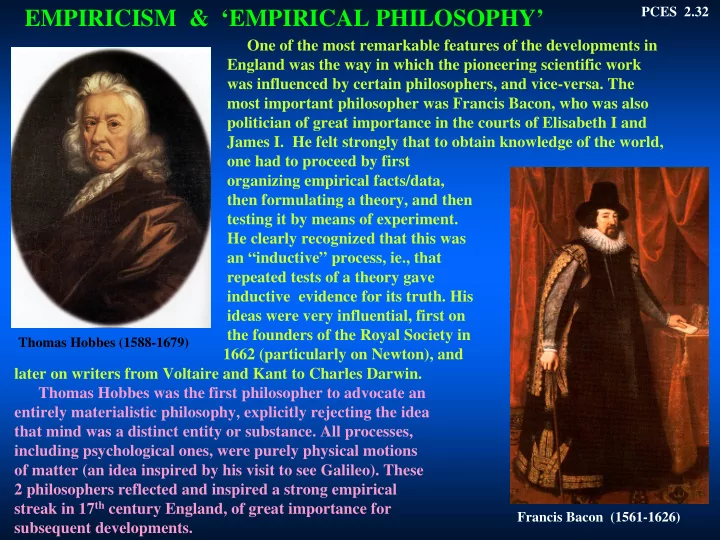
Thomas Hobbes (1588-1679) Francis Bacon (1561-1626)
One of the most remarkable features of the developments in England was the way in which the pioneering scientific work was influenced by certain philosophers, and vice-versa. The most important philosopher was Francis Bacon, who was also politician of great importance in the courts of Elisabeth I and James I. He felt strongly that to obtain knowledge of the world,
- ne had to proceed by first
- rganizing empirical facts/data,
then formulating a theory, and then testing it by means of experiment. He clearly recognized that this was an “inductive” process, ie., that repeated tests of a theory gave inductive evidence for its truth. His ideas were very influential, first on the founders of the Royal Society in 1662 (particularly on Newton), and later on writers from Voltaire and Kant to Charles Darwin. Thomas Hobbes was the first philosopher to advocate an entirely materialistic philosophy, explicitly rejecting the idea that mind was a distinct entity or substance. All processes, including psychological ones, were purely physical motions
- f matter (an idea inspired by his visit to see Galileo). These