eleven factors within the designers control choice of material - - PowerPoint PPT Presentation

eleven
SMART_READER_LITE
LIVE PREVIEW

eleven factors within the designers control choice of material - - PowerPoint PPT Presentation

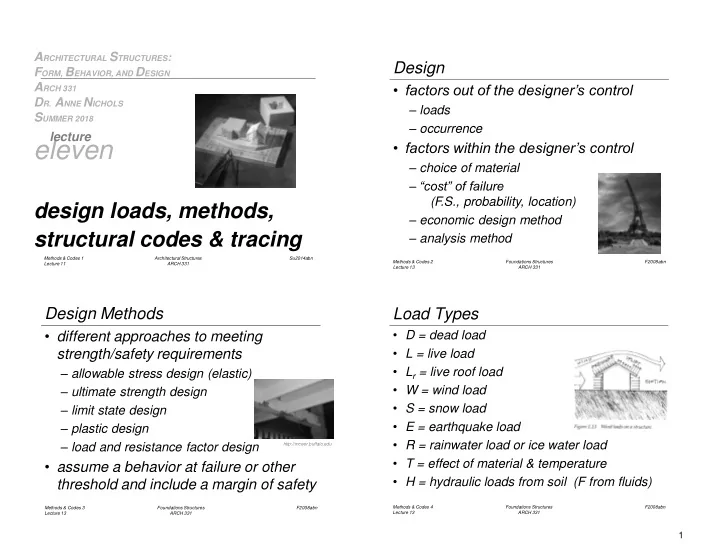
A RCHITECTURAL S TRUCTURES : Design F ORM, B EHAVIOR, AND D ESIGN A RCH 331 factors out of the designers control D R. A NNE N ICHOLS loads S UMMER 2018 occurrence lecture eleven factors within the designers control


slide-1
SLIDE 1

1

Su2014abn

ARCHITECTURAL STRUCTURES: FORM, BEHAVIOR, AND DESIGN ARCH 331

  • DR. ANNE NICHOLS

SUMMER 2018

eleven

design loads, methods, structural codes & tracing

Methods & Codes 1 Lecture 11 Architectural Structures ARCH 331

lecture

F2008abn Methods & Codes 2 Lecture 13 Foundations Structures ARCH 331

Design

  • factors out of the designer’s control

– loads – occurrence

  • factors within the designer’s control

– choice of material – “cost” of failure (F.S., probability, location) – economic design method – analysis method

F2008abn Methods & Codes 3 Lecture 13 Foundations Structures ARCH 331

Design Methods

  • different approaches to meeting

strength/safety requirements

– allowable stress design (elastic) – ultimate strength design – limit state design – plastic design – load and resistance factor design

  • assume a behavior at failure or other

threshold and include a margin of safety

http://mceer.buffalo.edu Methods & Codes 4 Lecture 13 Foundations Structures ARCH 331 F2008abn

Load Types

  • D = dead load
  • L = live load
  • Lr = live roof load
  • W = wind load
  • S = snow load
  • E = earthquake load
  • R = rainwater load or ice water load
  • T = effect of material & temperature
  • H = hydraulic loads from soil (F from fluids)
slide-2
SLIDE 2

2

Methods & Codes 5 Lecture 13 Foundations Structures ARCH 331 F2008abn

Dead Loads

  • fixed elements

– structure itself – internal partitions – hung ceilings – all internal and external finishes – HVAC ductwork and equipment – permanently mounted equipment

  • F = mg (GRAVITY)

F2008abn Methods & Codes 6 Lecture 13 Foundations Structures ARCH 331

Weight of Materials

  • for a volume

– where is weight/volume – for an extruded area with height of t

V W    tA W  

t A

Methods & Codes 7 Lecture 13 Foundations Structures ARCH 331 F2008abn

Concentrated Loads

Methods & Codes 8 Lecture 13 Foundations Structures ARCH 331 F2008abn

Distributed Loads

  • for an area

A w  

slide-3
SLIDE 3

3

Methods & Codes 9 Lecture 13 Foundations Structures ARCH 331 F2008abn

Dynamic Loads

  • time, velocity, acceleration
  • kinetics

– forces causing motion W = m·g – work – conservation of energy

Methods & Codes 10 Lecture 13 Foundations Structures ARCH 331 F2008abn

Load Locations

  • centric
  • eccentric
  • bending of flexural load
  • torsional load
  • combined loading

Methods & Codes 11 Lecture 13 Foundations Structures ARCH 331 F2008abn

Load Paths

  • tributary

areas

  • transfer

Methods & Codes 12 Lecture 13 Foundations Structures ARCH 331 F2008abn

Live Loads

  • occupancy
  • movable furniture

and equipment

  • construction / roof

traffic – Lr

  • minimum values
  • reduction allowed

as area increases

slide-4
SLIDE 4

4

Methods & Codes 13 Lecture 13 Foundations Structures ARCH 331 F2008abn

Wind Load

  • wind speed
  • gusting
  • terrain
  • windward, leeward,

up and down!

  • drag
  • rocking
  • harmonic
  • torsion

F2008abn Methods & Codes 14 Lecture 13 Foundations Structures ARCH 331

Snow Load

  • latitude
  • solar exposure
  • wind speed
  • roof slope

Moscow 2006 (BBC News)

F2008abn Methods & Codes 15 Lecture 13 Foundations Structures ARCH 331

Seismic Load

  • earthquake acceleration

– F = ma – movement of ground (3D) – building mass responds – static models often used, V is static shear – building period, T ≈ 0.1N, determines C – building resistance – RW – Z (zone), I (importance factor)

W

R ZICW V 

Methods & Codes 16 Lecture 13 Foundations Structures ARCH 331 F2008abn

Dynamic Response

slide-5
SLIDE 5

5

F2008abn Methods & Codes 17 Lecture 13 Foundations Structures ARCH 331

Dynamic Response

  • period of vibration or

frequency

– wave – sway/time period

  • damping

– reduction in sway

  • resonance

– amplification of sway

Methods & Codes 18 Lecture 13 Foundations Structures ARCH 331 F2008abn

Frequency and Period

  • natural period of vibration

– avoid resonance – hard to predict seismic period – affected by soil – short period

  • high stiffness

– long period

  • low stiffness

“To ring the bell, the sexton must pull

  • n the downswing of the bell in time

with the natural frequency of the bell.”

F2008abn Methods & Codes 19 Lecture 13 Foundations Structures ARCH 331

Water Load

  • rainwater – clogged drains
  • ponding
  • ice formation

mrfussycontracting.com Methods & Codes 20 Lecture 13 Foundations Structures ARCH 331 F2008abn

Thermal Load

  • stress due to strain
  • restrained expansion or contraction
  • temperature gradients
  • composite construction
slide-6
SLIDE 6

6

Methods & Codes 21 Lecture 13 Foundations Structures ARCH 331 F2008abn

Hydraulic Loads

  • pressure by water in soil, H
  • fluid pressure, F

– normal to surface

  • flood

F2008abn Methods & Codes 22 Lecture 13 Foundations Structures ARCH 331

Building Codes

  • documentation

– laws that deal with planning, design, construction, and use of buildings – regulate building construction for

  • fire, structural and health safety

– cover all aspect of building design – references standards

  • acceptable minimum criteria
  • material & structural codes

F2008abn Methods & Codes 23 Lecture 13 Foundations Structures ARCH 331

Building Codes

  • occupancy
  • construction types
  • structural chapters

– loads, tests, foundations

  • structural materials, assemblies

– roofs – concrete – masonry – steel

Methods & Codes 24 Lecture 13 Foundations Structures ARCH 331 F2008abn

Prescribed Loads

  • ASCE-7

– live load (not roof) reductions allowed

  • International Building Code

– occupancy – wind: pressure to static load – seismic: shear load function of mass and response to acceleration – fire resistance

slide-7
SLIDE 7

7

F2008abn Methods & Codes 25 Lecture 13 Foundations Structures ARCH 331

Structural Codes

  • prescribe loads and combinations
  • prescribe design method
  • prescribe stress and deflection limits
  • backed by the profession
  • may require design to meet

performance standards

  • related to material or function

F2008abn Methods & Codes 26 Lecture 13 Foundations Structures ARCH 331

Structural Codes

  • Design Codes

– Wood

  • NDS

– Steel

  • AISC

– Concrete

  • ACI
  • AASHTO

– Masonry

  • MSJC

Methods & Codes 27 Lecture 13 Foundations Structures ARCH 331 F2008abn

Design Methods

  • probability of loads and resistance
  • material variability
  • overload, fracture, fatigue, failure
  • allowable stress design
  • limit state design

– design loads & capacities

. S . F f f A P f

capacity allowed actual

  

Methods & Codes 28 Lecture 13 Foundations Structures ARCH 331 F2008abn

Allowable Stress Design

  • historical method
  • a.k.a.

working stress, strength design

  • stresses stay in

ELASTIC range

slide-8
SLIDE 8

8

F2008abn Methods & Codes 29 Lecture 13 Foundations Structures ARCH 331

ASD Load Combinations

  • D
  • D + L
  • D + 0.75(Lr or S or R)
  • D + 0.75L + 0.75(Lr or S or R)
  • D + (0.6W or 0.7E)

– D + 0.75L + 0.75(0.6W) + 0.75(Lr or S or R) – D + 0.75L + 0.75(0.7E) + 0.75S

  • 0.6D + 0.6W
  • 0.6D + 0.7E

ASCE-7 (2010)

F2008abn Methods & Codes 30 Lecture 13 Foundations Structures ARCH 331

Limit State Design

  • a.k.a. strength design
  • stresses go to limit (strain outside

elastic range)

  • loads may be factored
  • resistance or capacity reduced by a

factor

  • based on material behavior
  • “state of the art”

F2008abn Methods & Codes 31 Lecture 13 Foundations Structures ARCH 331

Limit State Design

  • load and resistance factor design (LRFD)

– loads:

  • not constant,
  • possibly more influential on failure
  • happen more or less often

– UNCERTAINTY  - Resistance factor  - Load factor for (D)ead & (L)ive load

n L L D D

R R R     

F2008abn Methods & Codes 32 Lecture 13 Foundations Structures ARCH 331

LRFD Load Combinations

  • 1.4D
  • 1.2D + 1.6L + 0.5(Lr or S or R)
  • 1.2D + 1.6(Lr or S or R) + (L or 0.5W)
  • 1.2D + 1.0W + L + 0.5(Lr or S or R)
  • 1.2D + 1.0E + L + 0.2S
  • 0.9D + 1.0W
  • 0.9D + 1.0E
  • F has same factor as D in 1-5 and 7
  • H adds with 1.6 and resists with 0.9 (permanent)

ASCE-7 (2010)

slide-9
SLIDE 9

9

Methods & Codes 33 Lecture 13 Foundations Structures ARCH 331 F2008abn

Deflection Limits

  • based on service condition, severity

L/480 L/240 L/240 L/180 L/120 DL+LL Roof or floor (damageable elements) L/360 Ordinary Usage Floor beams: L/360 no plaster L/240 plaster ceiling Commercial L/180 Industrial Roof beams: LL only Use

Methods & Codes 34 Lecture 13 Foundations Structures ARCH 331 F2008abn

Load Conditions

  • loads, patterns & combinations

– usually uniformly distributed gravity loads – worst case for largest moments... – wind direction can increase moments

Load Tracing 2 Lecture 14 Foundations Structures ARCH 331 F2008abn

Structural Loads

  • gravity acts on mass (F=m*g)
  • force of mass

– acts at a point

  • ie. joist on beam

– acts along a “line”

  • ie. floor on a beam

– acts over an area

  • ie. people, books,

snow on roof or floor

Load Tracing 5 Lecture 14 Foundations Structures ARCH 331 F2008abn

Equivalent Force Systems

  • replace forces by resultant
  • place resultant where M = 0
  • using calculus and area centroids

dx w(x) x L

loading loading L

A dA wdx W   

 

dx y x

el

x

slide-10
SLIDE 10

10

F2008abn Load Tracing 6 Lecture 14 Foundations Structures ARCH 331

Area Centroids

  • Table 6.1 – pg. 304

b h

3 b

right triangle only Load Tracing 7 Lecture 14 Foundations Structures ARCH 331 F2008abn

Equivalent Load Areas

  • area is width x “height” of load
  • w is load per unit length
  • W is total load

x x/2 W x/2 x 2x/3 W/2 x/3 x x/2 W x/6 x/3 W/2 W x w   w w 2 2 W x w   w 2w

Load Tracing 8 Lecture 14 Foundations Structures ARCH 331 F2008abn

Distributed Area Loads

  • w is also load per unit area

w

Load Tracing 9 Lecture 14 Foundations Structures ARCH 331 F2008abn

Load Tracing

  • how loads are

transferred

– usually starts at top – distributed by supports as actions – distributed by tributary areas

slide-11
SLIDE 11

11

Load Tracing 10 Lecture 14 Foundations Structures ARCH 331 F2008abn

Load Tracing

  • areas see distributed

area load

  • beams or trusses

see distributed line loads

  • “collectors” see

forces

– columns – supports

Load Tracing 11 Lecture 14 Foundations Structures ARCH 331 F2008abn

Load Tracing

tributary area

Load Tracing 12 Lecture 14 Foundations Structures ARCH 331 F2008abn

Load Tracing

  • tributary load

– think of water flow – “concentrates” load of area into center

 

width tributary area load w        

width

F2008abn Load Tracing 13 Lecture 14 Foundations Structures ARCH 331

Load Tracing

Patcenter Rogers 1986

www.columbia.edu

slide-12
SLIDE 12

12

F2008abn Load Tracing 14 Lecture 14 Foundations Structures ARCH 331

Load Tracing

Alamillo Bridge Calatrava 1992

http://en.structurae.de Load Tracing 15 Lecture 14 Foundations Structures ARCH 331 F2008abn

Load Paths

  • floors and framing

Load Tracing 16 Lecture 14 Foundations Structures ARCH 331 F2008abn

Load Paths

  • wall systems

Load Tracing 17 Lecture 14 Foundations Structures ARCH 331 F2008abn

Load Paths

  • openings & pilasters
slide-13
SLIDE 13

13

Load Tracing 18 Lecture 14 Foundations Structures ARCH 331 F2008abn

Load Paths

  • foundations

Load Tracing 19 Lecture 14 Foundations Structures ARCH 331 F2008abn

Load Paths

  • deep foundations

Load Tracing 20 Lecture 14 Foundations Structures ARCH 331 F2008abn

Spans

  • direction
  • depth

Load Tracing 21 Lecture 14 Foundations Structures ARCH 331 F2008abn

Levels

  • determine span at top level
  • find half way to next element
  • *include self weight
  • look for “collectors”
  • repeat
  • one:
slide-14
SLIDE 14

14

Load Tracing 22 Lecture 14 Foundations Structures ARCH 331 F2008abn

Levels

  • two:
  • three:

F2012abn

Irregular Configurations

  • tracing still ½ each side

Load Tracing 23 Lecture 14 Architectural Structures ARCH 331 Load Tracing 23 Lecture 14 Foundations Structures ARCH 331 F2008abn

Slabs

  • edge support
  • linear and uniform distribution

Load Tracing 24 Lecture 14 Foundations Structures ARCH 331 F2008abn

Girders and Transfer

  • openings

– no load & no half way

  • girder actions at beam supports

+ + + +

slide-15
SLIDE 15

15

F2008abn Load Tracing 58 Lecture 11 Foundations Structures ARCH 331

Sloped Beams

  • stairs & roofs
  • projected live load
  • dead load over length
  • perpendicular load to beam:
  • equivalent distributed load:



 cos w w  

 cos w . adj w 

F2012abn

Framing Diagrams

  • beam lines and “dots”
  • breaks & ends

Load Tracing 27 Lecture 14 Architectural Structures ARCH 331 S panning direction of decking or reinforcement Load Tracing 25 Lecture 14 Foundations Structures ARCH 331 F2008abn

  • purpose

– retain soil or other material

  • basic parts

– wall & base – additional parts

  • counterfort
  • buttress
  • key

Retaining Walls

Load Tracing 26 Lecture 14 Foundations Structures ARCH 331 F2008abn

Retaining Wall Types

  • “gravity” wall

– usually unreinforced – economical & simple

  • cantilever retaining wall

– common

slide-16
SLIDE 16

16

Load Tracing 27 Lecture 14 Foundations Structures ARCH 331 F2008abn

Retaining Wall Loads

  • gravity

W =   V

  • fluid pressure

p = ’  h P = ½ p h at h/3

  • friction

F =   N

  • soil bearing pressure, q

Load Tracing 28 Lecture 14 Foundations Structures ARCH 331 F2008abn

Retaining Wall Equilibrium

  • sliding - overcome friction?
  • overturning at toe (o) - overcome mass?
  • P

R W

2 5 1

g

  • verturnin

   . M M SF

resist

2 25 1   

. F F SF

sliding resist horizontal

Fresist

Load Tracing 29 Lecture 14 Foundations Structures ARCH 331 F2008abn

  • want resultant of load from pressure inside

the middle third of base (kern)

  • triangular stress block with pmax
  • x = 1/3 x width of stress
  • equivalent force location:

Pressure Distribution

3 2 3 x x p x W

max

   a W x W pmax 2 3 2  

 

when a is fully stressed

Load Tracing 30 Lecture 14 Foundations Structures ARCH 331 F2008abn

Wind Pressure

  • distributed load
  • “collected” into V
  • lateral loads

must be resisted

V

slide-17
SLIDE 17

17

Load Tracing 31 Lecture 14 Foundations Structures ARCH 331 F2008abn

Bracing Configurations