
SLIDE 1
Introduction
If you are a factory owner or manager, you cannot simply look at safety and health problems on an ad hoc basis and hope that the conditions in your workplace comply with national and international
- standards. Any preventive and control measures
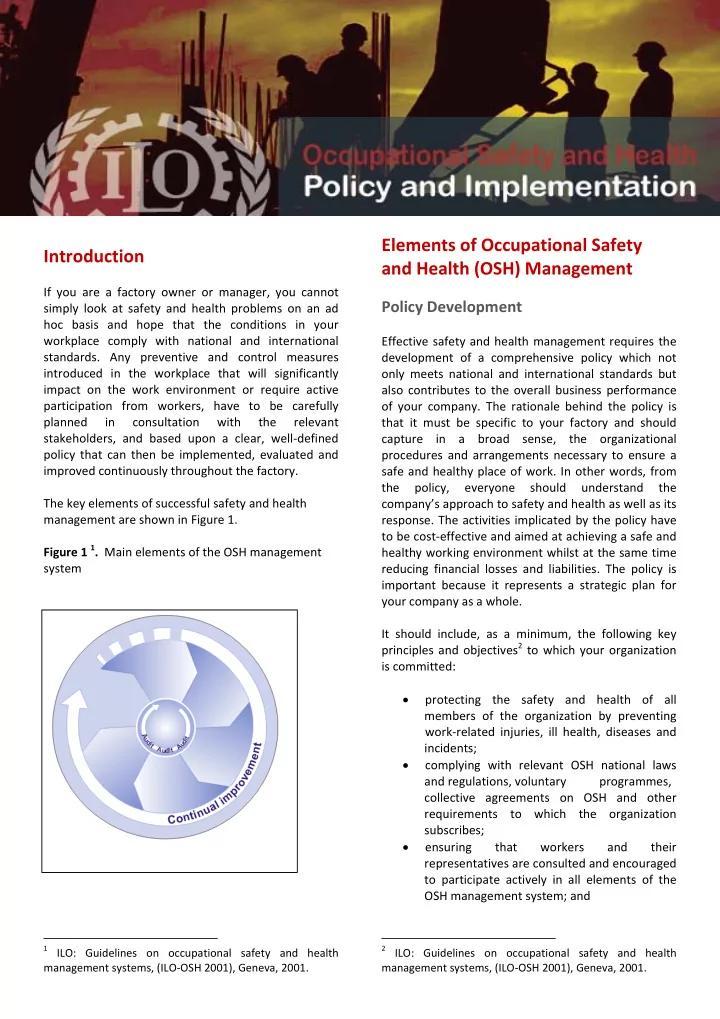
introduced in the workplace that will significantly impact on the work environment or require active participation from workers, have to be carefully planned in consultation with the relevant stakeholders, and based upon a clear, well‐defined policy that can then be implemented, evaluated and improved continuously throughout the factory. The key elements of successful safety and health management are shown in Figure 1. Figure 1 1. Main elements of the OSH management system
1 ILO: Guidelines on occupational safety and health
management systems, (ILO‐OSH 2001), Geneva, 2001.
Elements of Occupational Safety and Health (OSH) Management
Policy Development
Effective safety and health management requires the development of a comprehensive policy which not
- nly meets national and international standards but
also contributes to the overall business performance
- f your company. The rationale behind the policy is
that it must be specific to your factory and should capture in a broad sense, the organizational procedures and arrangements necessary to ensure a safe and healthy place of work. In other words, from the policy, everyone should understand the company’s approach to safety and health as well as its
- response. The activities implicated by the policy have
to be cost‐effective and aimed at achieving a safe and healthy working environment whilst at the same time reducing financial losses and liabilities. The policy is important because it represents a strategic plan for your company as a whole. It should include, as a minimum, the following key principles and objectives2 to which your organization is committed:
- protecting the safety and health of all
members of the organization by preventing work‐related injuries, ill health, diseases and incidents;
- complying with relevant OSH national laws
and regulations, voluntary programmes, collective agreements on OSH and other requirements to which the organization subscribes;
- ensuring
that workers and their representatives are consulted and encouraged to participate actively in all elements of the OSH management system; and
2 ILO: Guidelines on occupational safety and health