Electronics for Large Arrays of Cherenkov Detectors Frank - - PowerPoint PPT Presentation

electronics for large arrays of cherenkov detectors
SMART_READER_LITE
LIVE PREVIEW

Electronics for Large Arrays of Cherenkov Detectors Frank - - PowerPoint PPT Presentation

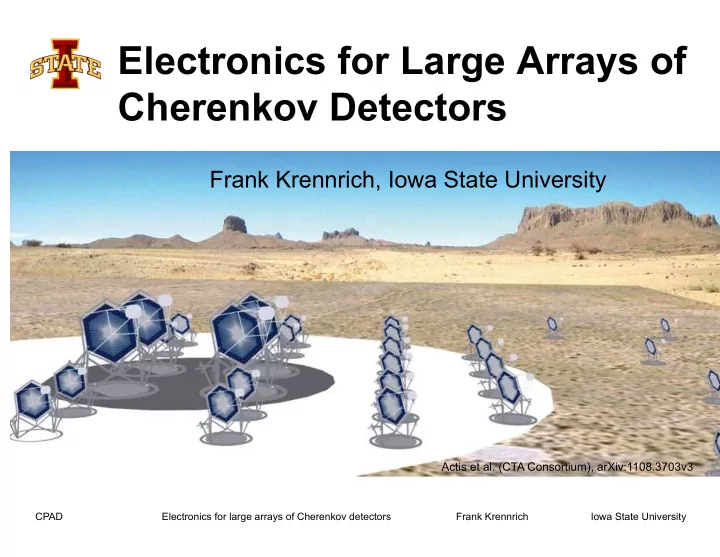
Electronics for Large Arrays of Cherenkov Detectors Frank Krennrich, Iowa State University Actis et al. (CTA Consortium), arXiv:1108.3703v3 CPAD Electronics for large arrays of Cherenkov detectors


slide-1
SLIDE 1

CPAD Electronics for large arrays of Cherenkov detectors Frank Krennrich Iowa State University

Electronics for Large Arrays of Cherenkov Detectors

Frank Krennrich, Iowa State University

Actis et al. (CTA Consortium), arXiv:1108.3703v3

slide-2
SLIDE 2

Cherenkov Telescope Array (CTA)

  • What is CTA?
  • ground-based successor to MAGIC, VERITAS,

HESS & Fermi will revolutionize VHE !-ray science

  • 10 GeV – 100 TeV with ten times better sensitivity
  • 1 km2 array of Cherenkov telescopes
  • 3 different telescope sizes: Small Size Telescopes,

Medium Size Telescopes, Large Size Telescopes

  • What will CTA do?

Particle Physics

  • Dark Matter annihilation
  • Lorentz invariance violation
  • EBL; axion-like pseudoscalar bosons

Astrophysics & Cosmology

  • Galactic/extragalactic particle acceleration
  • Origin of intergalactic/cosmological B-fields
  • Black holes & relativistic jets

“Discovery machine” for particle astrophysics & astronomy at the TeV scale

slide-3
SLIDE 3

Imaging Atmospheric Cherenkov Energy Range

Major Step (flux sensitivity): advance the 100 GeV - 10 TeV regime:

  • 60 element array of 12m tels.
  • wide FOV
  • high resolution camera

Major Step (expand E-range):

  • add 20-24 m tels. (LST)
  • add small size telescopes (SST)

(camera dominates cost)

Telescope design drawings from Actis et al. (CTA Consortium), arXiv:1108.3703v3

4 LST 60 MST 70 SST

slide-4
SLIDE 4

The Road to better sensitivity

0.1-10 TeV mid size telescopes angular resolution # teles. + wide FoV + fine pixels 10 -100 TeV small size telescopes collection area # telescopes !

background dominated count rate limited

# pixels !

slide-5
SLIDE 5

Air Cherenkov Technique: !/hadron separation

300 m proton shower !-ray shower

~ 10 km "C ~ 0.3o – 1o 5o

#t ~ 5 ns

#$/$ ~ 30-40%

slide-6
SLIDE 6

Air Cherenkov Technique: Angular resolution

angular resolution ~ 0.1o

#$/$ < 15%

shower height shower core location

slide-7
SLIDE 7

Step 1: Large array concept

100 m!

Event containment:

  • angular resolution
  • background rejection
  • collection area x 10

CPAD Electronics for large arrays of Cherenkov detectors Frank Krennrich Iowa State University

slide-8
SLIDE 8

Step 2: wide field of view telescope

100 m! Event containment only works for minimum size of array, so that combination of collection area and ang. Resolution are achieved!

Large Field of View:

  • increases # of telescopes

in shower reconstruction

  • better angular resolution
  • improved background

rejection

CPAD Electronics for large arrays of Cherenkov detectors Frank Krennrich Iowa State University

slide-9
SLIDE 9

Optimum # of telescopes for 1 km2 MST array?

x, m

  • 1000 -800
  • 600
  • 400
  • 200

200 400 600 800 1000

y, m

  • 1000
  • 800
  • 600
  • 400
  • 200

200 400 600 800 1000

2 4 6 8 10 12 14 16 18 20 22 x, m

  • 1000 -800
  • 600
  • 400
  • 200

200 400 600 800 1000

y, m

  • 1000
  • 800
  • 600
  • 400
  • 200

200 400 600 800 1000

2 4 6 8 10 12 14 16 18 20 22 Minimal Number Of Triggered Telescopes

5 10 15 20 25

2

Detection Area, km

  • 1

10 1

°

8.0 ! 61 tel

°

8.0 ! 25 tel

°

3.5 ! 4 tel

array with nearly

  • ptimum

angular resolution

4 tels. (3.5° FoV) 61 tels. (8° FoV)

Cherenkov light images - Sky

Bugaev, S. 2011 Funk, S. & Hinton, J. 2009

slide-10
SLIDE 10

Step 3: Novel High resolution wide FoV telescope

SC DC

~ 0.07° ~ 0.2°

Focal plane – very compact

CPAD Electronics for large arrays of Cherenkov detectors Frank Krennrich Iowa State University

slide-11
SLIDE 11

SC DC

~ 0.07° ~ 0.2°

MAPMTs Si-PMs

Biland et al. 2011, Cherenkov light images Recorded under full moon

Step 3: Novel High resolution wide FoV compact camera

CPAD Electronics for large arrays of Cherenkov detectors Frank Krennrich Iowa State University

slide-12
SLIDE 12

SC DC

~ 0.07° ~ 0.2°

MAPMTs

  • reduced plate scale

allows the use of Si-PMs & MAPMTs

  • significant potential

cost savings through high QE, lower cost pixels & compact camera

Step 3: Novel High resolution wide FoV compact camera Si-PMs

CPAD Electronics for large arrays of Cherenkov detectors Frank Krennrich Iowa State University

slide-13
SLIDE 13

# of Pixels

Current generation: MAGIC, HESS, VERITAS CTA southern site 2016 - … Beyond CTA 2020 - … # telescopes 2 - 4 ~ 140 ? # pixels/camera 500 – 1,000 1,300 – 12,000 ? pixel size [°] 0.15 – 0.2 0.07 – 0.25 0.02 – 0.1 field of view [°] 3.5 – 5 5 – 10 ? total # pixels 1,500 – 4,000 ~ 600,000 ~ 107 – 108 ? photo detectors PMTs ($300) MAPMTs/SiPMs/PMTs SiPMs, …? cost per pixel [$] $1,000 – 2,000 $100 - $400 < $10

CPAD Electronics for large arrays of Cherenkov detectors Frank Krennrich Iowa State University

slide-14
SLIDE 14

Signal Recording Cherenkov light flashes from air showers are short: ~ 2-10 ns

CPAD Electronics for large arrays of Cherenkov detectors Frank Krennrich Iowa State University

slide-15
SLIDE 15

Signal Recording Sampling with ~ 1 GHz adequate …

recording pulse shapes with sufficient resolution important:

  • muon/cosmic-ray rejection
  • noise rejection from NSB (night sky background)
  • account for time gradients across C-light images
  • jitter detection and correction (systematics)

CPAD Electronics for large arrays of Cherenkov detectors Frank Krennrich Iowa State University

slide-16
SLIDE 16

Signal Recording Sampling with ~ 1 GHz adequate …

recording pulse shapes with sufficient resolution important:

  • muon/cosmic-ray rejection
  • noise rejection from NSB (night sky background)
  • account for time gradients across C-light images
  • jitter detection and correction (systematics)

CPAD Electronics for large arrays of Cherenkov detectors Frank Krennrich Iowa State University

slide-17
SLIDE 17

Analogue sampling memories

recording pulse shapes with analog sampling memories:

  • highly integrated into a single multi-channel ASIC (16 TARGET, 8 DRS4)
  • low cost per channel of a few $10
  • TARGET for high pixelation cameras
  • separate circuitry for trigger (buffer 16 µs)
  • low power 10 – 50 mW/channel

Actis et al. (CTA Consortium), arXiv:1108.3703v3

CPAD Electronics for large arrays of Cherenkov detectors Frank Krennrich Iowa State University

slide-18
SLIDE 18

Alternative Signal Recording Sampling with ~ 200 MHz marginal …

CPAD Electronics for large arrays of Cherenkov detectors Frank Krennrich Iowa State University

slide-19
SLIDE 19

Flash ADCs

~ 1 GHz

recording pulse shapes with FADCs:

  • continuously digitizes photo-sensor signals
  • no separate camera trigger circuitry needed (fully digital trigger)
  • high power usage & cost " not suitable for compact/high res. cameras
  • available inexpensive FADCs limited to ~ 200 MSamples/s

Actis et al. (CTA Consortium), arXiv:1108.3703v3

CPAD Electronics for large arrays of Cherenkov detectors Frank Krennrich Iowa State University

slide-20
SLIDE 20

Triggering & clock distribution

*single telescope: 10 kHz, 103 – 104 pixels, 2 bytes/pixel caveat: bursts/rate fluctuations up to 1 MHz possible due to NSB

CPAD Electronics for large arrays of Cherenkov detectors Frank Krennrich Iowa State University

slide-21
SLIDE 21

Array Trigger Scenarios

  • exchange of time stamps

" n-tel time coincidences (reduce rates from NSB, reduces CR background by factor of 2)

  • exchange of imaging info

" basic stereoscopic analysis (reduces background from CRs by factor of 10)

3 different approaches: a) no real-time array trigger: perform event building in

  • ff-line analysis (rate spikes ! paralyze DACQ!)

b) write data into camera buffer (FPGA) continuously, distrib. time stamps (coincidences), determine if data be kept (1 ms) c) distribute image & timing info from FPGA-based camera trigger to neighbor telescopes, form array coincidences based on time stamps & simple stereo analysis (<10 µs)

CPAD Electronics for large arrays of Cherenkov detectors Frank Krennrich Iowa State University
slide-22
SLIDE 22

Array Trigger ! FPGAs

Timing + Stereo Imaging in real-time (< 3 µs) Fast FPGA, ATCA

CPAD Electronics for large arrays of Cherenkov detectors Frank Krennrich Iowa State University

slide-23
SLIDE 23

Array Trigger ! FPGAs

CPAD Electronics for large arrays of Cherenkov detectors Frank Krennrich Iowa State University

Hadron rejection by stereo trigger: # ``!-rays’’ are compact and provide consistent point of origin when viewed in stereo # ``hadrons’’ often are spread out and translates into a spread in points of origin

36 tels. 8 deg. FoV

Krennrich, F. & Lamb, R.C., Experimental Astronomy, 6, 285 (1995)

!-ray proton

di!

slide-24
SLIDE 24

Integration & Connectivity ‘‘no cable principle’’

!""#$%&'()#*+%,%,-*) # .+/00)+#1'234)(& # 5%&'(6+#76$)+6#7%87)*,#

25 x

‘‘wireless provider?’’

e.g., array trigger

CPAD Electronics for large arrays of Cherenkov detectors Frank Krennrich Iowa State University

slide-25
SLIDE 25

Water Cherenkov Technique: HAWC

Altitude ~ 4,100 m Aeff ~ 22,000 m2 15 x more sensitive than Milagro under construction (Puebla Mexico) General detector technology

  • Large-area, fast, low noise, cheap photosensors.
  • PMTs: a major cost driver for any future array.
  • water based scintillators:

to build compact muon detectors (relying on water requires a rather thick layer of water to generate sufficient photons to detect)

Electronics

  • any future array would be located in a harsh environment
  • we would need to have distributed DACQ systems with

communication over radio

  • maintaining relative timing between the disparate detectors

to better than 1 ns

  • CPAD Electronics for large arrays of Cherenkov detectors Frank Krennrich Iowa State University
slide-26
SLIDE 26

Wish List

# Photo detectors:

  • increased QE (300 – 500 nm) to reduce size/cost of telescopes
  • cheap SiPMs, MAPMTs, LAPDs for high pixelation detectors

# Signal recording: highly integrated compact devices

  • develop inexpensive GHz FADCs (fully digital)
  • continue ASIC based front-end electronics development (dead-time)
  • cost reduction paramount where camera cost dominates

# Trigger & clock distribution: highly versatile & reliable

  • continue FPGA development
  • develop ATCA integration of FPGA boards
  • develop universal clock distribution systems: < 1 ns (White Rabbit)
  • develop deterministic wireless technology/protocols for triggering

# Other technologies (mirror fabrication, coating techniques & alignment) are not covered here, but are important!

CPAD Electronics for large arrays of Cherenkov detectors Frank Krennrich Iowa State University