Electromagnetic Induction Practice Problems Slide 2 / 47 Multiple - - PDF document

electromagnetic induction practice problems
SMART_READER_LITE
LIVE PREVIEW

Electromagnetic Induction Practice Problems Slide 2 / 47 Multiple - - PDF document

Slide 1 / 47 Electromagnetic Induction Practice Problems Slide 2 / 47 Multiple Choice Slide 3 / 47 1 A square loop of wire is placed in a uniform magnetic field perpendicular to the magnetic lines. The strength of the magnetic field is 0.5


slide-1
SLIDE 1

Electromagnetic Induction Practice Problems

Slide 1 / 47

Multiple Choice

Slide 2 / 47

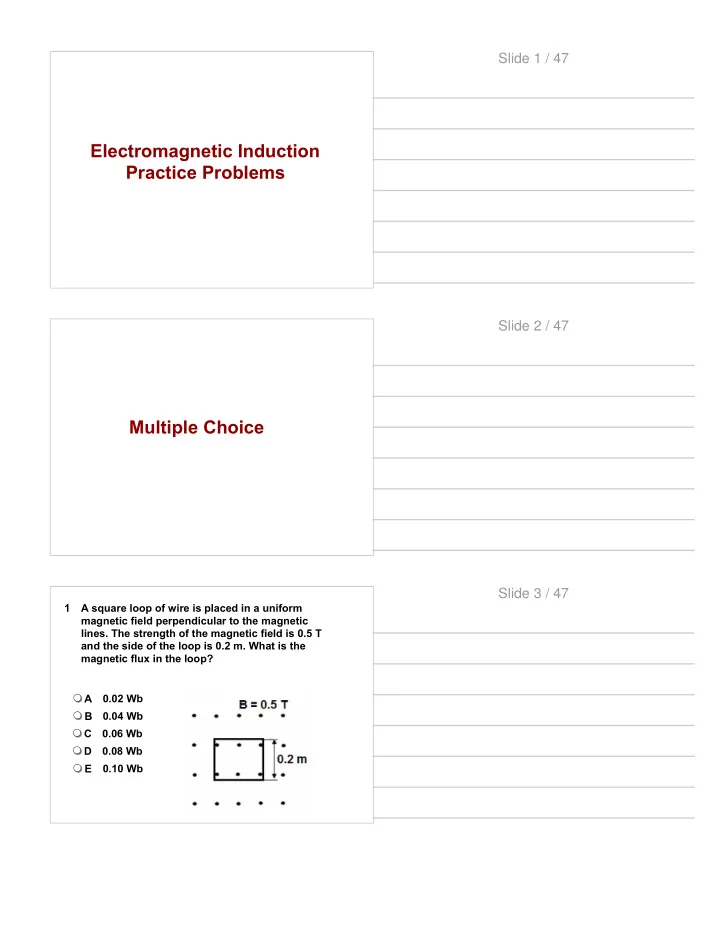
1 A square loop of wire is placed in a uniform magnetic field perpendicular to the magnetic

  • lines. The strength of the magnetic field is 0.5 T

and the side of the loop is 0.2 m. What is the magnetic flux in the loop? A 0.02 Wb B 0.04 Wb C 0.06 Wb D 0.08 Wb E 0.10 Wb

Slide 3 / 47

slide-2
SLIDE 2

2 A circular loop of wire is placed in a uniform magnetic field perpendicular to the magnetic

  • lines. The strength of the magnetic field is B and

the radius of the loop is R. What is the magnetic flux in the loop? A π B/R2 B π BR2 C π B/R D π BR E B/R2

Slide 4 / 47

3 A square loop of wire with one side of 0.4 m is placed in a uniform magnetic field B = 2 T. The normal line to the loop makes 60º with the magnetic field lines. What is the magnetic flux in the loop? A 0.12 Wb B 0.14 Wb C 0.16 Wb D 0.18 Wb E 0.20 Wb

Slide 5 / 47

4 A circular loop is initially placed in a uniform magnetic field perpendicular to the field lines and then removed quickly from the field. The induced emf causes the electric charge flow in the loop. Which of the following explains the force on the induced current due to the original field? A Force causes the loop to turn around its axis B Force causes the loop to turn around its diameter C Force causes the loop to accelerate in the field direction D Force causes the loop to accelerate perpendicular to the field direction E Force opposes to any motion of the loop

Slide 6 / 47

slide-3
SLIDE 3

5 A magnet bar with the north pole down is held above a horizontal aluminum ring. Which of the following is true about the induced current in the ring? (View from above) A There is no current in the ring B There is a clockwise current in the ring C There is a counterclockwise current in the ring D There is an AC current in the ring E More information is required

Slide 7 / 47

6 A magnet bar with the north pole down is held above a horizontal aluminum ring. Which of the following is true about the induced current in the ring? (View from above) A There is no current in the ring B There is a clockwise current in the ring C There is a counterclockwise current in the ring D There is an AC current in the ring E More information is required

Slide 8 / 47

7 A circular loop of wire is placed in a uniform magnetic field directed out of the page. Suddenly the magnetic field disappears. What is the direction of the induced current in the loop? A Clockwise B Counterclockwise C No current in the coil D Into the page E Out of the page

Slide 9 / 47

slide-4
SLIDE 4

8 A square loop of wire is placed in a uniform magnetic field directed into the page. Suddenly the magnetic field grows stronger. What is the direction of the induced current in the loop? A Clockwise B Counterclockwise C No current in the coil D Into the page E Out of the page

Slide 10 / 47

9 A copper rod ML moves at a constant speed in a uniform magnetic field perpendicular to the magnetic lines. Which statement is true about the electric potential in the rod? A Point M is at higher potential B Point L is at higher potential C Potential is higher at the surface of the rod D Potential is higher at the center of the rod E More information is required

Slide 11 / 47

10 A copper rod ML moves at a constant speed in a uniform magnetic field perpendicular to the magnetic lines. Which statement is true about the electric potential in the rod? A Point M is at higher potential B Point L is at higher potential C Potential is higher at the surface of the rod D Potential is higher at the center

  • f the rod

E More information is required

Slide 12 / 47

slide-5
SLIDE 5

11 A square loop of wire with one side of a and resistance R is pulled out the field with a constant speed of v. The strength of the field is B. Which statement is true about the magnitude and direction of the induced current? A Bav/R Counterclockwise B Bav/R Clockwise C BavR Counterclockwise D BavR Clockwise E Ba/vR Counterclockwise Magnitude Direction

Slide 13 / 47

12 A square loop of wire with one side of a and resistance R is pulled out the field with a constant speed of v. The strength of the field is B. Which statement is true about the magnitude and direction of the magnetic force on the loop? A Bav/R In the direction of the loop’s motion B Bav/R In opposite direction to the loop’s motion C B2a2v/R In the direction of the loop’s motion D B2a2v/R In opposite direction to the loop’s motion E B2a2vR In the direction of the loop’s motion

Slide 14 / 47

13 A square loop of aluminum wire is initially placed perpendicular to the lines of a constant magnetic field of 0.5 T. The area enclosed by the loop is 0.2

  • m2. The loop is then turned through an angle of

90° so that the plane of the loop is parallel to the field lines. The turn takes 0.1 s. What is the induced emf in the loop? A 0.5 V B 1.0 V C 1.5 V D 1.2 V E 0.8 V

Slide 15 / 47

slide-6
SLIDE 6

14 A square loop of wire with one side of a and resistance R is placed in a uniform magnetic field

  • f strength B. The field vanishes and results an

induced current I in the loop. What is the rate of change of magnetic field? A IR/a B IR/a2 C IRa2 D IRa E Ia/R

Slide 16 / 47

15 A metallic bar with ends lying on two parallel conducting rails moves at a constant speed v in the direction of the uniform magnetic field B. The induced emf in the bar is: A Directed to the left side of the page B Directed to the right side of the page C Directed to the top of the page D Directed to the bottom of the page E Zero

Slide 17 / 47

16 A loop of wire is pulled with constant velocity v to the right through a region

  • f space where there is a uniform magnetic field B directed into the page, as

shown above. The magnetic force on the loop is A Directed to the left both as it enters and as it leaves the region B Directed to the right both as it enters and as it leaves the region C Directed to the left as it enters the region and to the right as it leaves D Directed to the right as it enters the region and to the left as it leaves E zero at all times

Slide 18 / 47

slide-7
SLIDE 7

17 A vertical length of copper wire moves to the right with a constant speed v in the perpendicular direction of a constant horizontal magnetic field B. Which of the following describes the induced charges on the ends of the wire? A Positive Negative B Negative Positive C Negative Zero D Zero Negative E Zero Zero Point M Point L

Slide 19 / 47

18 When the switch is closed the direction of the electric current is: A Clockwise Counterclockwise B Counterclockwise Clockwise C Clockwise Clockwise D Counterclockwise Counterclockwise E Zero Zero Loop 1 Loop 2

Slide 20 / 47

19 Which of the following procedures will not produce an induced current in the loop 2: A Closing the switch B Opening the switch C Rotating loop 2 with respect to its axis when switch is close for a long time D Rotating loop 2 with respect to its diameter when switch is close for a long time E Removing loop 2 from loop 1 when the switch is closed for a long time

Slide 21 / 47

slide-8
SLIDE 8

20 A magnet bar with a north pole down is dropped from a certain height and on the way down passes through a closed coil of wire. Which statement is true about the magnet's acceleration? A Greater than g B Less than g C g D Zero acceleration E More information is required

Slide 22 / 47

Free Response

Slide 23 / 47

  • a. What is the magnetic flux in the loop at 0.4 s?
  • b. What is the induced emf for the following time?
  • i. ____ 0.1 s ii. ____0.3 s iii. ____ 0.5 s
  • c. What is the induced current for the following

time?

  • i. ____ 0.1 s ii. ____0.3 s iii. _____ 0.5 s
  • d. On the diagram below graph the induced current as a function of time.

1. A 0.2 Ω rectangular loop of wire has an area of 0.5 m2 and placed in a region where magnetic field changes as shown on the diagram.

Slide 24 / 47

slide-9
SLIDE 9
  • a. What is the magnetic flux in the loop at 0.4 s?

F = B^A F = (0.4 T)(0.5 m2) F = 0.2 Wb

1. A 0.2 Ω rectangular loop of wire has an area of 0.5 m2 and placed in a region where magnetic field changes as shown on the diagram.

Slide 25 / 47

  • b. What is the induced emf for the following time?
  • i. ____ 0.1 s ii. ____0.3 s iii. ____ 0.5 s
  • i. E = - AΔB/Δt = -(0.5 m2)(0.4 T)/(0.2 s) = -1V
  • ii. E = 0
  • iii. E = - AΔB/Δt = -(0.5 m2)(-0.4 T)/(0.1 s) = -1V

1. A 0.2 Ω rectangular loop of wire has an area of 0.5 m2 and placed in a region where magnetic field changes as shown on the diagram.

Slide 26 / 47

  • c. What is the induced current for the following

time?

  • i. ____ 0.1 s ii. ____0.3 s iii. _____ 0.5 s
  • i. I = V/R = (1 V)/(0.2 Ω) = 5 A
  • ii. I = 0
  • iii. I = V/R = (2 V)/(0.2 Ω) = 10 A

1. A 0.2 Ω rectangular loop of wire has an area of 0.5 m2 and placed in a region where magnetic field changes as shown on the diagram.

Slide 27 / 47

slide-10
SLIDE 10

10 A

  • 10 A

5 A

  • 5 A
  • d. On the diagram below graph the induced current as a function of time.

1. A 0.2 Ω rectangular loop of wire has an area of 0.5 m2 and placed in a region where magnetic field changes as shown on the diagram.

Slide 28 / 47

  • 2. A rectangular loop of wire 0.5 m wide and 1.5

m long is moving out of a uniform magnetic field B = 2 T at a constant speed of 2m/s. The left side

  • f the loop stays inside the field when the right

side is out. The resistance of the loop is 0.5 Ω.

  • a. What is the direction of the induced current in the loop?
  • b. Calculate the induced emf in the loop.
  • c. Calculate the induced current in the loop.
  • d. Calculate the applied force required to move the loop at the constant

speed.

  • e. Calculate the power developed by the force.

Slide 29 / 47

  • 2. A rectangular loop of wire 0.5 m wide and 1.5

m long is moving out of a uniform magnetic field B = 2 T at a constant speed of 2m/s. The left side

  • f the loop stays inside the field when the right

side is out. The resistance of the loop is 0.5 Ω.

  • a. What is the direction of the induced current in the loop?

Counter clockwise

Slide 30 / 47

slide-11
SLIDE 11
  • 2. A rectangular loop of wire 0.5 m wide and 1.5

m long is moving out of a uniform magnetic field B = 2 T at a constant speed of 2m/s. The left side

  • f the loop stays inside the field when the right

side is out. The resistance of the loop is 0.5 Ω.

  • b. Calculate the induced emf in the loop.

E = Blv E = (2 T)(0.5 m)(2 m/s) E = 2 V

Slide 31 / 47

  • 2. A rectangular loop of wire 0.5 m wide and 1.5

m long is moving out of a uniform magnetic field B = 2 T at a constant speed of 2m/s. The left side

  • f the loop stays inside the field when the right

side is out. The resistance of the loop is 0.5 Ω.

  • c. Calculate the induced current in the loop.

I = V/R I = (2 V)/(0.5 Ω) I = 4 A

Slide 32 / 47

  • 2. A rectangular loop of wire 0.5 m wide and 1.5

m long is moving out of a uniform magnetic field B = 2 T at a constant speed of 2m/s. The left side

  • f the loop stays inside the field when the right

side is out. The resistance of the loop is 0.5 Ω.

  • d. Calculate the applied force required to move the loop at the constant

speed. F = BIL F = (2 T)(4 A)(0.5 m) F = 4 N

Slide 33 / 47

slide-12
SLIDE 12
  • 2. A rectangular loop of wire 0.5 m wide and 1.5

m long is moving out of a uniform magnetic field B = 2 T at a constant speed of 2m/s. The left side

  • f the loop stays inside the field when the right

side is out. The resistance of the loop is 0.5 Ω.

  • e. Calculate the power developed by the force.

P = Fv P = (4 N)(2 m/s) P = 8 W

Slide 34 / 47

  • 3. A metallic rod has a length L and slides at

a constant speed v on the top of two conducting parallel rails. The rails are connected to a resistor R. The apparatus is placed in a uniform magnetic field B which is perpendicular to the plane where rod is moving.

  • a. What is the direction of the induced current?
  • b. Determine the induced emf.
  • c. Determine the induced current in the circuit.
  • d. Determine the electric field E induced in the rod.
  • e. Determine the force required to move the rod at the constant speed.
  • f. Determine the power dissipated in the resistor when the rod crosses the

magnetic field.

Slide 35 / 47

  • 3. A metallic rod has a length L and slides at

a constant speed v on the top of two conducting parallel rails. The rails are connected to a resistor R. The apparatus is placed in a uniform magnetic field B which is perpendicular to the plane where rod is moving.

  • a. What is the direction of the induced current?

Counter clockwise

Slide 36 / 47

slide-13
SLIDE 13
  • 3. A metallic rod has a length L and slides at

a constant speed v on the top of two conducting parallel rails. The rails are connected to a resistor R. The apparatus is placed in a uniform magnetic field B which is perpendicular to the plane where rod is moving.

  • b. Determine the induced emf.

E = Blv = BLv

Slide 37 / 47

  • 3. A metallic rod has a length L and slides at

a constant speed v on the top of two conducting parallel rails. The rails are connected to a resistor R. The apparatus is placed in a uniform magnetic field B which is perpendicular to the plane where rod is moving.

  • c. Determine the induced current in the circuit.

I = E/R = BLv/R

Slide 38 / 47

  • 3. A metallic rod has a length L and slides at

a constant speed v on the top of two conducting parallel rails. The rails are connected to a resistor R. The apparatus is placed in a uniform magnetic field B which is perpendicular to the plane where rod is moving.

  • d. Determine the electric field E induced in the rod.

E = V/d E = BLv/L E = Bv

Slide 39 / 47

slide-14
SLIDE 14
  • 3. A metallic rod has a length L and slides at

a constant speed v on the top of two conducting parallel rails. The rails are connected to a resistor R. The apparatus is placed in a uniform magnetic field B which is perpendicular to the plane where rod is moving.

  • e. Determine the force required to move the rod at the constant speed.

F = BIL F = B(BLv/R)(L) F = B2L2v/R

Slide 40 / 47

  • 3. A metallic rod has a length L and slides at

a constant speed v on the top of two conducting parallel rails. The rails are connected to a resistor R. The apparatus is placed in a uniform magnetic field B which is perpendicular to the plane where rod is moving.

  • f. Determine the power dissipated in the resistor when the rod crosses the

magnetic field. P = Fv P = (B2L2v/R)v P = B2L2v2/R

Slide 41 / 47

  • 4. A coil 30 cm in diameter consist of 20 turns of

circular copper wire 2 mm in diameter. The coil is connected to a low resistance galvanometer. Initially coil is placed in a uniform magnetic field perpendicular to its plane. During the experiment the magnetic field changes from 0.5 T to 2.5 T in 0.4

  • s. Ignore the resistance of the connecting wires.

(copper resistivity 1.68x10⁻⁸Ω·m)

  • a. Calculate the initial flux in the coil.
  • b. Calculate the induced emf in the galvanometer.
  • c. Calculate the induced current in the coil.
  • d. Calculate the power dissipated in the coil as the field changes.

Slide 42 / 47

slide-15
SLIDE 15
  • 4. A coil 30 cm in diameter consist of 20 turns of

circular copper wire 2 mm in diameter. The coil is connected to a low resistance galvanometer. Initially coil is placed in a uniform magnetic field perpendicular to its plane. During the experiment the magnetic field changes from 0.5 T to 2.5 T in 0.4

  • s. Ignore the resistance of the connecting wires.

(copper resistivity 1.68x10⁻⁸Ω·m)

  • a. Calculate the initial flux in the coil.

F = nB^A F = (20)(0.5 T)(À)(0.15 m)2 F = 0.71 Wb

Slide 43 / 47

  • 4. A coil 30 cm in diameter consist of 20 turns of

circular copper wire 2 mm in diameter. The coil is connected to a low resistance galvanometer. Initially coil is placed in a uniform magnetic field perpendicular to its plane. During the experiment the magnetic field changes from 0.5 T to 2.5 T in 0.4

  • s. Ignore the resistance of the connecting wires.

(copper resistivity 1.68x10⁻⁸Ω·m)

  • b. Calculate the induced emf in the galvanometer.

E = -ΔF/Δt E = (0.36 Wb)/(0.4 s) E = 0.9 V

Slide 44 / 47

  • 4. A coil 30 cm in diameter consist of 20 turns of

circular copper wire 2 mm in diameter. The coil is connected to a low resistance galvanometer. Initially coil is placed in a uniform magnetic field perpendicular to its plane. During the experiment the magnetic field changes from 0.5 T to 2.5 T in 0.4

  • s. Ignore the resistance of the connecting wires.

(copper resistivity 1.68x10⁻⁸Ω·m)

  • c. Calculate the induced current in the coil.

I = V/R I = (0.9 V)/(10.7 Ω) I = 0.0841 A R = pL/A R = p(2πr)(20 m)/(#r2) R = (1.68x10⁻⁸ # m)(20 m)/(π)(0.001 m)2 R = 10.7 #

Slide 45 / 47
slide-16
SLIDE 16
  • 4. A coil 30 cm in diameter consist of 20 turns of

circular copper wire 2 mm in diameter. The coil is connected to a low resistance galvanometer. Initially coil is placed in a uniform magnetic field perpendicular to its plane. During the experiment the magnetic field changes from 0.5 T to 2.5 T in 0.4

  • s. Ignore the resistance of the connecting wires.

(copper resistivity 1.68x10⁻⁸Ω·m)

  • d. Calculate the power dissipated in the coil as the field changes.

P = IV P = (0.09 A)(0.0841 V) P = 0.0757 W

Slide 46 / 47 Slide 47 / 47