Elected Member Briefing 31 January 2019 Commencing at 1.30pm in - - PowerPoint PPT Presentation

elected member briefing 31 january 2019
SMART_READER_LITE
LIVE PREVIEW

Elected Member Briefing 31 January 2019 Commencing at 1.30pm in - - PowerPoint PPT Presentation

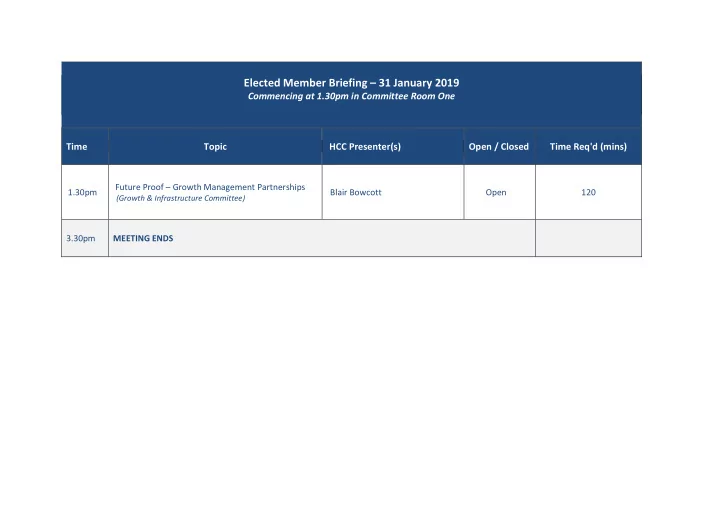
Elected Member Briefing 31 January 2019 Commencing at 1.30pm in Committee Room One Time Topic HCC Presenter(s) Open / Closed Time Req'd (mins) Future Proof Growth Management Partnerships 1.30pm Blair Bowcott Open 120 (Growth &


slide-1
SLIDE 1

Elected Member Briefing – 31 January 2019

Commencing at 1.30pm in Committee Room One Time Topic HCC Presenter(s) Open / Closed Time Req'd (mins)

1.30pm Future Proof – Growth Management Partnerships

(Growth & Infrastructure Committee)

Blair Bowcott Open 120 3.30pm MEETING ENDS

slide-2
SLIDE 2

Growth Management Partnerships

31 January 2019

slide-3
SLIDE 3
  • Hamilton to Auckland Corridor Plan
  • Hamilton‐Waikato Metro Spatial Plan
  • Partnership Arrangements to deliver Plans

Agenda

slide-4
SLIDE 4
slide-5
SLIDE 5
  • Recap:

– H2A Corridor Plan presents New Zealand’s best growth

  • pportunity & the Plan aims to realise this

– Developed in partnership between Central Government, Local Government and Iwi – It is a key focus of Central Government to deliver on their Urban Growth Agenda – Links to interim rail case and rapid rail case – Links to infrastructure funding and financing work

H2A Corridor Plan

slide-6
SLIDE 6
  • Deliverables:

– A spatial plan for future urban growth along the corridor – A draft programme of possible key transformative projects – Key project relevant to HCC is the ‘Hamilton‐Waikato Metro Spatial Plan’ and associated projects – An enduring plan will require a partnership arrangement to deliver

  • Next Milestone:

– Governance Group meeting on 15th February 2019 to sign off draft Plan, proposed partnership arrangement and emerging work programme

H2A Corridor Plan

slide-7
SLIDE 7

Metro Spatial Plan

slide-8
SLIDE 8
  • What it is?

– Joint long‐term growth planning in partnership with Central Government and Iwi – Will identify a 100 year framework for wider metro area – Will identify key opportunities and potential pilots for new Government planning, funding and financing tools – Our ‘”Greater Hamilton/GHUGS” project – Covers area surrounding Hamilton from Taupiri/Ngaruawahia to Cambridge/Te Awamutu

  • It has significant political visibility at a Central Government level
  • It will be used as the model for joint spatial planning for other areas
  • f the country

Metro Spatial Plan

slide-9
SLIDE 9
  • Within the overall Metro Plan are 9 sub‐projects:

– Sub‐regional Waters Investigation – Mass Transit Plan – Intercity Rail between Auckland and Hamilton – Open Space and recreational networks programme – Biodiversity offsetting – North opportunities: Horotiu, Rotokauri, Te Rapa North, Te Kowhai – East opportunities: Ruakura and east of WEX – South opportunities: Hautapu, Cambridge, Te Awamutu, Peacocke and Airport – Central Opportunities: Hamilton CBD

Metro Spatial Plan

slide-10
SLIDE 10

How will it progress?

– HCC will be taking a lead role and will provide programme/project management resources and technical staff – MHUD and NZTA will provide technical staff – Other partners will also contribute resourcing – Will require a Partnership arrangement to deliver

Metro Spatial Plan

slide-11
SLIDE 11
  • What is needed to deliver on H2A and Metro

Spatial Plan?

– A Partnership between the relevant councils, central government and Iwi – Potential to repurpose existing arrangements to deliver on this new work programme

  • Getting H2A right and the governance

arrangements are a priority for government in growth management partnerships (a model for NZ)

Partnerships for delivery

slide-12
SLIDE 12
  • Need for long term growth management
  • Agree partnership is needed

– Need active joint conversations and the right conversations – Relies on relationships – Must have ministerial representation

  • Strong endorsement for long term spatial plan for

greater Hamilton (Metro Spatial Plan)

  • Future Proof has delivered value/outcomes but is not

delivering HCC needs at present

Summary of Feedback from Last Briefing

slide-13
SLIDE 13
  • Current perceptions:

– Future Proof – planning focus, too slow to react – H2A Governance – execution focus, progressive, nimble

  • Future Proof needs:

– To change to conversation to be more strategic – Focus reviewed so it is clear what it does – Name change – Deliver economic and wellbeing outcomes in growth context – Keep the H2A plan moving at pace

Summary of Feedback from Last Briefing cont’d

slide-14
SLIDE 14
  • Use Future Proof governance, management and technical

model but repurpose:

– Invite Government and Auckland Council to join – Name change – Focus/Purpose reviewed (wider purpose then planning) – Memorandum of Understanding/Terms of Reference reviewed – Identified strategic stakeholders (e.g. MPDC in context of Morrinsville)

  • Reflects Minister and government preferred partnership

model

  • New primary focus is to respond to Hamilton to Auckland

Corridor Plan in context of Government Urban Growth Agenda and growth planning for the sub‐region

Proposal

slide-15
SLIDE 15
  • Gives effect to Future Development Strategy (NPS on

Urban Development Capacity), Government Urban Growth Agenda, Regional Policy Statement, Growth Strategies and other planning processes (e.g. UDA)

  • Retain independent chair (noting contract finishes at

election)

– Focus on successful transition, review scope in light of new governance

  • Review resourcing/independent advice needed for the

future(noting contract finishes June 2019)

Proposal cont’d

slide-16
SLIDE 16
  • The H2A Corridor Plan and Metro Spatial Plan have high levels of

visibility and support (Government and other councils)

  • HCC needs to update its Urban Growth Strategy (GHUGS) and this is

the recommended process to do it

  • A Partnership arrangement is needed to deliver these projects
  • Repurposing and refocusing Future Proof recommended by staff

and supported by all other partners – existing key players at the table plus government and Auckland Council BUT with a new mandate

  • A transition period will be required (by June 2019)
  • Metro Spatial Plan is where rubber hits the road for HCC

Key messages for HCC

slide-17
SLIDE 17
  • Council Report 7 February 2019
  • CEO meeting 11 February 2019
  • H2A Governance Group 15 February 2019
  • Future Proof implementation Committee

20 February 2019

Next Steps