Ele lectio ions approach are you ready? Fact-checking for ed - - PowerPoint PPT Presentation

ele lectio ions approach
SMART_READER_LITE
LIVE PREVIEW

Ele lectio ions approach are you ready? Fact-checking for ed - - PowerPoint PPT Presentation

Ele lectio ions approach are you ready? Fact-checking for ed educators and fu future voters Mikko Salo, Kari Kivinen, Pirjo Sallinen & Valentina Uitto Brussels, 13.11.2018 Fight disinformation with media literacy event organized


slide-1
SLIDE 1

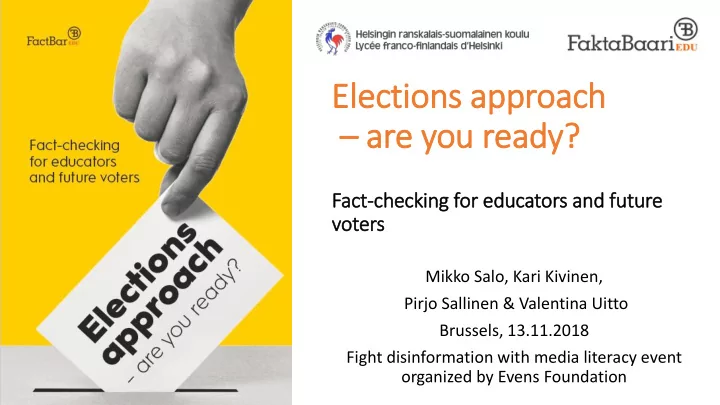
Ele lectio ions approach – are you ready?

Fact-checking for ed educators and fu future voters

Mikko Salo, Kari Kivinen, Pirjo Sallinen & Valentina Uitto Brussels, 13.11.2018 Fight disinformation with media literacy event

  • rganized by Evens Foundation
slide-2
SLIDE 2

Fact-checking for educators and fu future voters

  • 1. Introduction
  • 2. Description of mis-, dis- and mal-information;
  • 3. Information about the key principles of journalism and fact-checking;
  • 4. How to use fact checking approaches in learning contexts;
  • 5. Workshop: sharing good practice and tools for educators on how to

activate young and future voters to become active and voter literate citizens, who are taking part in discussions about elections with critical thinking, argumentation, and media and information literacy skills.

slide-3
SLIDE 3

Welcome to the FactBar EDU for "voter literacy" and participation

  • From 2014 Faktabaari European Elections Fact-checking campaign to FactBar

EDU voter literacy project for critical thinking and participation with HRSK teachers and community

  • HLEG: fact-checking, medialiteracy and elections (win –win)
  • Transparency, non-participation, shared concern and co-operation
  • From misinformation to information disorders to replace ”F*ke news”
  • Primary- and secondary school students with extensions to life –long learning via

educators and materials

  • The event present a first occasion to evaluate and further develop this new

media literacy stream within an open source FactBar EDU community with you.

slide-4
SLIDE 4

Mis-information - false information is shared, but no harm is meant. Dis-information - false information is knowingly shared to cause harm. Mal-information - genuine information is shared to cause harm, often by moving information designed to stay private into the public sphere.

Description of mis-, dis- and mal-information

slide-5
SLIDE 5

MISLEADING INFORMATION

The misleading information which emerges in fact-checking can be divided into three different categories:

  • defective information or ‘mistakes’ (misinformation),
  • deceptive information or ‘hoaxes’ (disinformation) and
  • damaging information or ‘gossip’ (malinformation).
slide-6
SLIDE 6

Information about the key principles

  • f journalism and fact-checking
  • Fact-checking denotes a process of research which strives

to gain a thorough understanding of the truthfulness or likelihood of, for instance, a claim made in public.

  • Fact-checking has branched out beyond journalism,

however, and plenty of civic activism has developed globally in conjunction with it.

  • Specific codes of principles have been developed for fact-

checking (e.g. IFCN) which seek to distinguish between proper fact-checking (which aims for objectivity) and other investigative journalism dealing with facts.

slide-7
SLIDE 7

True, untrue or ‘50/50

The fact-checking processes of Faktabaari yield three kinds of conclusions in relation to the checked claims: true, untrue or ‘50/50’. Faktabaari uses a so-called traffic light scale.

  • A true claim holds true in the context and there are sources to support it. But since fact-

checking deals with very specific contexts, the claim can still be untrue in another context.

  • An untrue claim is clearly false, i.e. the source material and the expert statements are at
  • dds with it. The claim can be either a deliberate lie or simply a careless slip: fact-checking

may not be able to pinpoint the motivation behind the claim.

  • A 50/50 claim includes factual information but it cannot be regarded as completely
  • accurate. This is especially common in the case of over-simplified views. For example, if an

expert states that the claim cannot be either verified or refuted or that it is considered ambiguous or the source material is conflicting, the verdict is usually 50/50. So it is not a matter of being ‘half true’, but rather about not being entirely verifiable or certain.

  • There are also claims that simply cannot be checked or the verification wouldn’t be

meaningful from the point of view of public debate.
slide-8
SLIDE 8

Elections approach – are you ready? Fact-checking for educators and fu future voters

Download voter literacy tool-kit from www.faktabaari.fi/edu

slide-9
SLIDE 9
  • The aim is to
  • provide students with voter literacy skills, so that they would be able to make

their decisions based on facts - not on disinformation or mal-information.

  • to create a new educative and inspiring voter literacy materials and teacher

training kits for educators.

  • The scope is to activate students – the future voters – to take part into the

European Parliament 2019 election discussion and follow-up empowered with critical thinking, argumentation, and media and information literacy skills to resist mis- and disinformation.

slide-10
SLIDE 10

In Information & & knowledge

Students should have basic knowledge on

  • how the political system and democracy

work.

  • political parties of the country.
  • the role and prerogatives of the EU and

the Parliament.

  • what political campaigning is like in

practice.

  • ethical principles of journalism and fact-

checking

slide-11
SLIDE 11

Skills

Students learn argumentation and debating skills and they learn

  • to use analytical and critical thinking in practice.
  • to search data and evaluate media sources

independently

  • to recognise and evaluate arguments
  • to clarify unclear information and paraphrase

arguments

  • to compare mutually opposed claims about

reality and defer to their own judgment when evaluating contradictions

slide-12
SLIDE 12

Attitudes and and experiences

The objective is to enhance the pupil’s identity as an intelligent and critical individual who is capable of independent thinking and students will

  • establish a sense of participation and belonging in democracy.
  • demonstrate different ways of personal involvement.
slide-13
SLIDE 13

True or

  • r false check-list?
  • Who is the author ?
  • Can you find a name or reliable web address ?
  • To whom it is made for?
  • Where has it been published first and to which target

audience?

  • What does it really say?
  • Is it advertisement, piece of news or opinion of

someone?

  • Why is it made?
  • On what information it is based?
  • Can you find references?

????

slide-14
SLIDE 14

Fact-checking process in in a school

  • 1. Select a claim that you want to check
  • 2. Examine the claim using different sources

and check the facts

  • Who, where, when and what said?
  • 3. Write a fact-checking report based on the

discoveries

  • 4. Present your findings to the rest of the

class for the final verdict (“True, “False”

  • r “50/50”)
  • 5. Publish and share the results, e.g. as a

blog text or a presentation paper

slide-15
SLIDE 15

What does Source A say about the claim: In favour Against Both What does Source B say about the claim: In favour Against Both

Listing and evaluating the evidence in a simple way as an exercise to teach

  • bjective and argumentative thinking and how to bypass one’s own

biases

slide-16
SLIDE 16

Online check-list

Check headline & pictures

  • Very emotive, powerful or provocative
  • “Too easy” black-and-white simplifications

 If yes, stay alert and continue Check the content

  • Anonymous? No Sources ?
  • One-sided views on topic? No alternative viewpoints?

 If yes, leave it. If no, continue Towards your own judgement

  • Why author seeks your attention or action?
  • Check the main claim with source you trust?

 You feel not cheated? So, go ahead, share good content!

slide-17
SLIDE 17

Election panels at schools

  • Student candidates present their own

campaign videos.

  • Public participates in the debate with red

and green signs.

slide-18
SLIDE 18

Workshop: Role game – Party presentation wit ith a tw twist

  • 1. Meet and greet your fellow party members
  • 2. Create a program for your party
  • Short and compact: 5 points: promises

/claims/proposals

  • One of the five points should be mis-

information, one should be dis-information

  • 3. Your party needs a catchy slogan!
  • 4. Prepare to introduce your winning party

programme to the other teams you recognize the mis- or disinformation the

  • ther teams are feeding you?
  • 5. Discussion about the excercise.
  • RED –

Anti-EU party

  • BLUE – PRO-EU party
  • Green – Nature party
slide-19
SLIDE 19

Welcome to build a FactBar EDU voter literacy approach from our bottom-up pilot

  • Towards a European project (building on mind over media and #femfacts)
  • Mikko Salo mikko@faktabaari.fi
  • Kari Kivinen kari@kivinen.net
  • More: www.faktabaari.fi/edu @FactBar
  • desk@factbar.eu

IFCN Fact-Checking Network’s code of principles

  • https://ifcncodeofprinciples.poynter.org/