Eight determinants of early childhood development The home Parental - - PowerPoint PPT Presentation

eight determinants of early childhood development
SMART_READER_LITE
LIVE PREVIEW

Eight determinants of early childhood development The home Parental - - PowerPoint PPT Presentation

Eight determinants of early childhood development The home Parental mental The parent-child Early Education learning and physical relationship and childcare environment health Families Environmental Family Child nutrition financial


slide-1
SLIDE 1

Eight determinants of early childhood development

1

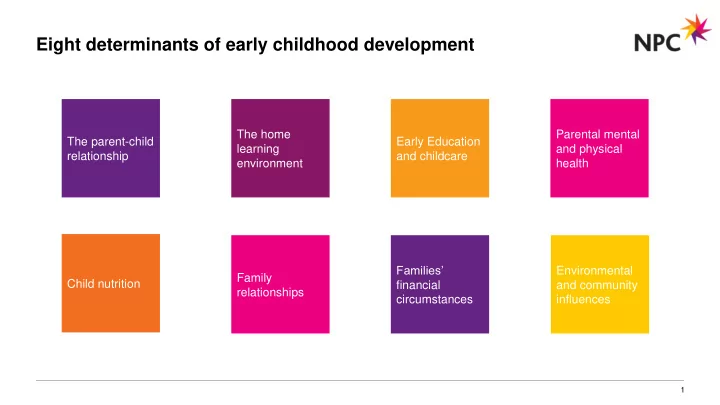
The parent-child relationship The home learning environment Early Education and childcare Parental mental and physical health Child nutrition Family relationships Families’ financial circumstances Environmental and community influences

slide-2
SLIDE 2

The parent-child relationship: Why it is important

  • How parents interact with their child in the early years has a

direct influence on children’s learning, cognitive and non- cognitive skills, and social and emotional development.

  • A ‘secure’ attachment between parent and child is

fundamental to children’s outcomes.

  • Evidence suggests that a ‘disorganised’ attachment between

parent and child is more likely in disadvantaged families.

  • However, the evidence shows, that the quality of parenting

behaviours and parent–child interactions has a greater effect

  • n children’s outcomes than parental education level and

family income

  • The parent-child relationship is considered a central site for

intervention

2

slide-3
SLIDE 3

The home learning environment: Why it is important

  • The home learning environment is:
  • The range of learning activities that children are exposed to at

home, such as playing with letters and numbers, painting and drawing, and learning nursery rhymes and songs

  • Activities outside the home, such as going to parks, museums

and libraries.

  • Verbal exchanges between parent and child and shared

reading activities between parent and child

  • From very early on the quality of the HLE and verbal interaction

with parents can have impact on children’s language skills, vocabulary, and cognitive and memory skills

  • Evidence suggests that the quality of the home learning

environment can have more impact on children’s wellbeing and achievement than any other factor, including parental education and family income.

3

slide-4
SLIDE 4

The parent-child relationship and home learning environment: Sites for early intervention

  • Both the parent-child relationship and HLE are considered a central sites for

intervention

  • There is merit in intervening early to support the parent–child relationship,

and HLE and evidence suggests that some disadvantaged parents may be particularly likely to benefit from support

  • For parenting interventions, some evidence that group-based and universal

programmes can work. But interventions should focus on supporting parents to understand the importance of the quality of their interactions with their children

  • For home learning support there is stronger evidence about the effectiveness
  • f targeted and intensive programmes that help parents to support their

children’s learning

  • ‘Light touch’ literacy programmes are popular but there is little evidence to

show they support language development

  • Improving a mother’s education level can have an impact on children’s home

learning environment and language outcomes even after her child is born

4

slide-5
SLIDE 5

Early education and childcare: Why it is important

  • The evidence highlights the importance of good-quality EEC in

supporting a range of children’s early cognitive outcomes including language and literacy and numeracy

  • Attending a quality setting can also boost children’s confidence and

social, emotional and physical outcomes

  • When a child attends an early education or childcare setting it can

also play an important role in motivating and supporting parents to engage in shared reading activities with their children

5

slide-6
SLIDE 6

Early education and childcare: A site for early intervention

  • The evidence shows that participation in EEC is particularly beneficial

for disadvantaged children however, take-up among these children is lower than it is among other children

  • Removing barriers to EEC for more disadvantaged families to

encourage them to access their free entitlement is therefore a key focus for early intervention

  • Evidence suggests that the quality of EEC is also important but

definitions of quality vary

  • Therefore local exploration between the ABS team and EEC providers

and parents of what good quality should look like and how childcare can meet families’ needs may be worthwhile

6

slide-7
SLIDE 7

Parental physical and mental health: Why it is important

  • The evidence is largely focused on maternal mental and physical

health

  • There are clear links between a mother’s mental health and

children’s outcomes both during pregnancy and postnatally.

  • During pregnancy poor mental health can negatively affect the

development of the foetus.

  • In the early years, more severe mental health issues may affect a

mother’s ability to parent their child

  • The three ways in which maternal physical health can most affect

children are:

– Foetal exposure to drugs and alcohol – Pre-term birth – Maternal age at birth

7

slide-8
SLIDE 8

Parental physical and mental health: A site for early intervention

  • Evidence suggests that maternal mental and physical health is less
  • f an influence on child outcomes than the parent-child relationship
  • r a family’s economic situation
  • However, it is also the case that poor maternal mental health is

likely to be a significant problem among the population that ABS areas serve

  • Support for women from the ante-natal period in mitigating the

impact of poor mental health (e.g. depression) and physical health (e.g. smoking and substance abuse) may have therefore considerable benefits for women and children

  • Screening is recommended for two of the most common maternal

health problems, depression and smoking in pregnancy, as identification is key to effectively tackling these problems. There is then a good evidence base of what works to help mothers deal with these health issues.

8

slide-9
SLIDE 9

Child nutrition: Why it is important

  • Nutritional deficiencies in early childhood can result in a range of

health issues, including poor oral health, anaemia and vitamin D deficiency

  • Poor nutrition in the early years can also result in challenges for

children at school. These include poor cognitive outcomes and behavioural issues, as well as the child’s general ability to concentrate, engage and take part in activities .

  • The evidence also identifies multiple benefits to breastfeeding for

both the child and mother

  • Evidence shows links between low income and poorer levels of

nutrition

  • Evidence around what works in relation to nutrition is largely

centred around breastfeeding

9

slide-10
SLIDE 10

Family relationships: Why it is important

  • Evidence suggests two key ways in which family relationships can impact on child
  • utcomes:

The interparental relationship

  • The nature and quality of the relationship between parents has a direct impact on child
  • utcomes
  • Children of all ages exhibit signs of stress when parents engage in hostile exchanges
  • There is also evidence of a link between the quality of the interparental relationship and

the nature of parenting practices: when the relationship between parents results in persistent, hostile and unresolved conflict, this can lead to more negative parenting

Domestic violence & child abuse and neglect

  • Exposure to domestic abuse in infancy and toddlerhood can result in delays in children

not reaching developmental milestones

  • Domestic abuse can have a negative impact on children’s relationships and social and

emotional skills, self-esteem and mental health

  • The negative impacts of an infant being maltreated in their first year of life include later

issues with physical, cognitive and emotional development

10
slide-11
SLIDE 11

Family relationships: A site for early intervention

11

  • There is evidence to suggest that supporting the quality of the interparental

relationship in the early years can be as important as supporting the parent–child relationship, since one can influence the other and have considerable benefits for children.

  • Therefore worth considering as part of whole-system approach
  • Programmes that target conflict management and communication showed

improvements in parenting and child outcomes.

  • Screening for domestic violence at routine interactions with families ( e.g.

ante natal care and in primary health settings) can result in considerable increases in detection rates when combined with training to increase practitioners’ awareness of domestic violence.

slide-12
SLIDE 12

Environment and community influences: Why it is important

  • There is less available evidence on the influence of environmental factors on

children’s outcomes

  • Available evidence shows that inadequate housing can lead to a range of

child health issues which can then have a knock-on effect on academic attainment

  • How much access children have to parks, playgrounds and healthy foods in

the area they live is also important

  • There are large inequalities in relation to environmental and community

influences

  • Children from poorer families are more likely to be exposed to toxins and to

live in overcrowded or temporary accommodation

  • Families with poorer economic circumstances are more likely to live in the

crowded, damp or otherwise unhealthy conditions that can negatively affect children’s mental and physical health.

  • Environment is considered to be more of a distal factor in relation to

children’s outcomes

12

slide-13
SLIDE 13

Families’ economic situation: A site for early intervention

13

  • There is a clear socio-economic gradient to all the factors raised by the

review and evidence suggests it cuts across all areas but particularly: 1) Health and wellbeing 2) Cognitive and language development and school readiness 3) Social and emotional development

  • Very hard for a local programme to improve the financial circumstances of

low-income families with young children

  • However, as part of whole system approach it’s worth considering:
  • Collaboration with financial advice services, employment agencies and

educational institutions to help parents to increase their income.

  • Supporting low income families to access (subsidised) childcare and

ensuring that childcare services meet the needs of parents who work

  • r study
slide-14
SLIDE 14

Poll: Relative importance of the various influences

In your view, is it possible to identify which factors have the most influence

  • n child outcomes from those that have been discussed?

➢ Yes, some of the factors in the review definitely have more influence than

  • thers

➢ No, it’s not possible to identify which factors have the most influence ➢ I’m not sure

14

slide-15
SLIDE 15

Relative importance of the various influences

  • There is limited evidence about the relative importance of the influences highlighted by

the review

  • However, it’s clear that although economic circumstances increase the risk of poor

child outcomes, they do not determine them

  • Supporting parents’ relationships and interaction with children can make a

difference regardless of economic position

  • The review therefore concludes that LEAP’s core focus should be on influences on:

– The parent child relationship – The interparental relationship – The home learning environment

  • EEC, child nutrition and maternal mental and physical health are also important,

environmental issues have less evidence but should definitely be in the mix

  • The complex relationship between the various influences on children’s early development

make it all the more necessary to have a place-based initiative, such as LEAP, that can identify families’ needs at different stages and draw on support from a range of sources.

15

slide-16
SLIDE 16

What’s missing?

What other influences not surfaced by the review have you seen to be important?

16