
SLIDE 1
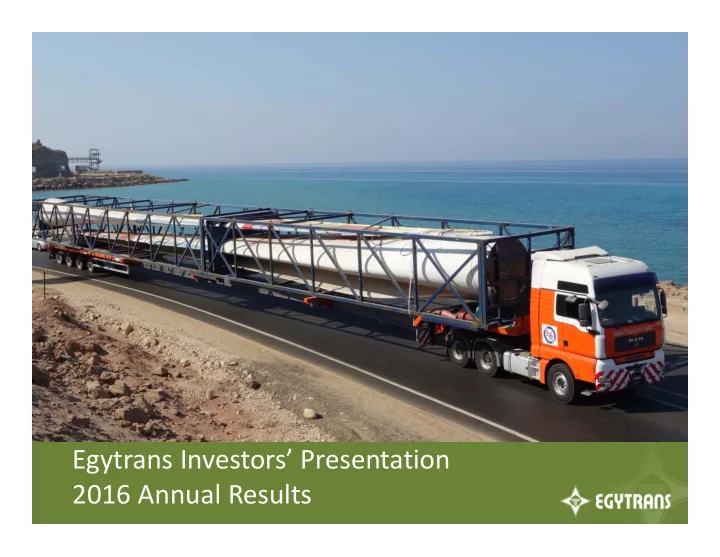
Egytrans Investors Presentation 2016 Annual Results Disclaimer Click - - PowerPoint PPT Presentation
Egytrans Investors Presentation 2016 Annual Results Disclaimer Click to edit Master title style Statements contained in this document that are not historical facts are based on current expectations, estimates, projections, opinions and beliefs
Statements contained in this document that are not historical facts are based on current expectations, estimates, projections, opinions and beliefs of Egytrans. Such statements involve known and unknown risks, uncertainties and other factors; undue reliance should not be placed
statements,” which can be identified by the use of forward‐looking terminology such as “may,” “will,” “seek,” “should,” “expect,” “anticipate,” “project,” “estimate,” “intend,” “continue” or “believe” or the negatives thereof or other variations thereon or comparable terminology. Actual events or results or the actual performance of Egytrans may differ materially from those reflected
subject to risks and uncertainties. Various factors could cause actual results to differ materially from those expressed or implied by the forward‐looking statements in this document including worldwide economic trends, the economic and political climate of Egypt, the Middle East and changes in business strategy and various other factors.
1. Company Overview 2. Why Egytrans? 3. Global Transport & Logistics Industry 4. Transport & Logistics Overview Egypt 5. Financial Statements 6. Strategic Direction 7. Industry Outlook 8. Egytrans Outlook
Source: Egytrans Shareholders’ Structure as of 31‐Dec‐2017
Leheta Family, 11.67% National Investment Bank, 25.25% Free Float, 30.42% Financial Institutions, 8.81% Mohamed Ashraf Omar Group, 18.00% Mostafa Eissa, 5.85% Other, 32.66%
value‐based, transparent management of the company, reinforcing the long‐term confidence
company.
efforts in this area.
environment, our assets and reputation.
impacts, maintaining a robust environmental management system and effective emergency management plans in compliance with laws, regulations, and good industry practice.
amongst other measures mandatory procedures, employee training, due diligence of third parties, and recording of gifts and hospitality.
environments for all employees. We treat all employees with respect and dignity and we will not tolerate discrimination or harassment of any kind.
business processes in accordance with the United Nations Guiding Principles on Business and Human Rights, with a focus on human rights due diligence and establishing operational grievance mechanisms.
economic development through our core business activities, by seeking out opportunities to leverage our capabilities and working in partnership with reputable business partners, charities and
Egytrans is committed to conducting business in a responsible, ethical and sustainable manner. Our business is underpinned by our Core Values and Policies, our commitment to the United Nations Global Compact and seven core principles we integrate into our business:
Egytrans has the right leadership, the right strategy and the financial strength to drive superior shareholder returns Market Strength
Brand with diverse long term customers
position
Strategy and Resources
Sheet
People
leadership with proven track record
driven employees
improvement culture
We are on track in our strategic direction and in a good position to achieve 2017 targets
We use our highly integrated network of people, technology and physical assets to help customers manage their goods more efficiently throughout their supply chains
2016 Revenue
mn
Freight Forwarding 47.4% of Revenue
Transport 42.6% of Revenue
Storage 10% of Revenue
Source: Egytrans Separate financials
Key Metrics:
in 3 locations Gross Revenue Profile
Project Logistics
EGYPROJECT Bonded Storage
cargo, including oversized and heavy lift equipment or packages
health, quality & environmental regulations.
ISO Tanks
year.
Siemens, with a total production capacity of 4.8 gigawatts each, representing the largest power stations in Egypt, as well as the largest ever in the history of Siemens.
capacity of 1.95 gigawatts
comprises the installation of 130 wind towers.
and Logistics continues to decrease
to 2.6 percent in 2016 down from 3% in 2015
not offset decline in earnings
infrastructure have benefitted most from declining fuel prices and have weathered difficult environment positively
worst performers within the sector, as they faced their eighth consecutive year of crisis.
Long term downside pressures weigh on lackluster economy
Shipping Industry due to oversupply of capacity coupled with declining demand
2015 which added to the persisting
declined by 30 –40 percent even as scrapping of capacities continued.
percent in 2016, the lowest ever recorded growth of the global containership fleet
across the globe .
major shipping lines in the world, may balance the supply demand market and improve outlook for 2017 .
expanded by 2.2 percent in 2015, which was lower than in 2014 according to IATA..
persistent overcapacities (due to the expansion of belly capacity over the last years) caused a further deterioration
monthly decline of air freight rates in 2015 was ‐9 percent.
mid‐term modal re‐shift of cargo from sea to air freight. Air freight is still largely dependent
economy and world trade.
infrastructure across all governorates
global markets
encourage investments
GDP Growth vs. Inflation (2011/12‐2015/16)
Source: CBE
0% 2% 4% 6% 8% 10% 12% 14% 16% 0% 1% 2% 3% 4% 5% Real GDP @ Factor Cost Headline CPI Inflation
in FY2014/15 (fiscal year running from July‐June), Egypt’s logistics and transportation sector encompasses more than 108,000 kilometers of paved roads, 9570 kilometers of railways, globally ranked airports in all major urban centers, including an air cargo airport of five terminals in Cairo, six seaports on the Mediterranean and nine on the Red Sea, six dry ports and an extensive network of Nile river transport facilities.
Share of GDP remains constant growing from 4.3 % in 2015 to 4.4% in 2016.
2014/2015 2015/2016
Source: CBE Source: CBE
11.2% 12.5% 15.8% 2.4% 5.1% 9.5% 3.2% 1.7% 4.4% 13.4% 3.9% 0.7% 1.6% 9.7% 4.8% Agriculture, Forests & Fishing Extraction (Oil & Gas) Manufacturing Utilities Construction & Building Real Estate Communication & IT Suez Canal Transportation & Storage Wholesale & Retail Trade Finance Insurance & Social Insurance Tourism General Government Health & Education 11.1% 13.5% 16.0% 2.3% 4.7% 9.3% 3.1% 1.7% 4.3% 13.0% 3.9% 0.7% 2.3% 9.5% 4.7% Agriculture, Forests & Fishing Extraction (Oil & Gas) Manufacturing Utilities Construction & Building Real Estate Communication & IT Suez Canal Transportation & Storage Wholesale & Retail Trade Finance Insurance & Social Insurance Tourism General Government Health & Education
Weight/Implemented Investments increases to 11.4% in 2016 vs 10.3% in 2015
2014/2015 2015/2016
Source: CBE Source: CBE
4.0% 20.9% 12.6% 8.5% 1.2% 11.5% 5.7% 8.2% 10.3% 4.1% 0.2% 0.6% 12.1% Agri, Irrigation & Reclamation Extraction (Oil & Gas ‐ Others) Other Manufacturing Utilities Construction & Building Real Estate Communication & IT Suez Canal Transportation & Storage Wholesale & Retail Trade Finance Tourism Health & Education & Others 4.3% 15.9% 12.5% 5.7% 3.0% 10.1% 6.1% 7.7% 11.4% 4.0% 0.01% 1.5% 17.7% Agri, Irrigation & Reclamation Extraction (Oil & Gas ‐ Others) Other Manufacturing Utilities Construction & Building Real Estate Communication & IT Suez Canal Transportation & Storage Wholesale & Retail Trade Finance Tourism Health & Education & Others
Imports & Exports Suez Canal Traffic
Source: CBE Source: CBE
‐20% ‐15% ‐10% ‐5% 0% 5% 10% 15% 20% 5000 10000 15000 20000 25000 30000 35000 40000 45000 50000 55000 60000 65000 2011/12 2012/13 2013/14 2014/15 2015/16 Imports Exports Imports GR Exports GR
USD mn
‐10% ‐5% 0% 5% 10% 5000 10000 15000 20000 2011/12 2012/13 2013/14 2014/15 2015/16
Net Tonnage (In mntons) Vessels GR Tonnage GR
Ports and Suez Canal
Suez Canal accounts for roughly 7.5%
world’s five ‘strategic chokepoints’ through which the overwhelming majority of the world’s oil flows. Egypt has 40 sea ports, of which 12 are commercial ports; six mining ports; six fishing ports; five marinas; and 10 oil shipping ports. Among the most important ports are Alexandria, the biggest port in Egypt, and the Port of Dekheila,. Damietta Port has the largest container terminal and the most sophisticated equipment in the Middle East, while Port Said and Port Suez occupy strategic positions at each end of the Suez Canal. Port infrastructure is also weak and suffers from lack of maintenance of equipment, evidence points to inability to meet the requirements
space and water depth to accommodate containers. .
Air Freight
Egypt has 73 airports with paved runways, five of which are international airports. Egypt’s airport development plans are driven by longterm tourism opportunities. The largest and most active airport is in Cairo, being the second‐busiest airport in Africa with direct flights to most countries. There are frequent flights within the country and improvements to the air infrastructure will increase handling capacity and efficiency, which will benefit the transport and logistics sector.
Rail
The rail freight sector’s network is limited and undeveloped its
the limit. Up to 85% of rolling stock is long past its replacement date. Railway connects Cairo and Alexandria with the main towns in the north of the country, all the large towns in the Nile Basin down to Aswan, and Safaga
cover new, important
Absence of direct links to dry ports and factories and storage terminals is another hindrance. .
Land Transport
Egypt’s roads carry the largest share
country’s dependence on the maintenance of the road
network capacity is inadequate, and the vehicles used are mostly outdated. In 2011 the road transport industry comprised approximately 743,000 trucks, most of which are not capable
hampering port‐hinterland container
found unsuitable for carrying specific commodities, mainly agricultural products. Additionally increase in the number of long trailer vehicles, which are not built to standard international specifications and jeopardize road safety.
Poor Infrastructure Slows Tempo of Market Growth. In 2010, Logistics revenues touched $17.04 bn. Government has been unleashing initiatives to make the country a global logistics hub by facilitating business processes.
The World Bank’s Logistics Performance Index shows Egypt has significantly improved its logistics performance over the past few years, with the country moving from 92nd in 2010 to 49th place out of 160 countries globally in 2016 . In the MENA region Egypt is ranked 6th behind gulf
international shipments and infrastructure improvements rate strongly in the country’s logistics performance. Notable is that Egypt scored highest in the timeliness sub‐indicators, which measures the timeliness of shipments reaching their destination. On the
assigned to the customs sub‐indicators, which measures the efficiency of the clearance process.
Logistics industry in decline globally suffers from
decreasing demand
locally
float impact trade negatively
spending on mega projects
amounting to EGP 44.5 million, this was coupled with an 81% hike in Investment Income to EGP 10.4 million
2015
macro‐economic slowdown
Egytrans ranked as one of the top 100 performing companies in 2016 by Amwal El Ghad
Source: Egytrans consolidated financials
‐20% 0% 20% 40% 60% 80% ‐10 10 30 50 70 90 110 130 150 170 190 210 230 2010 2011 2012 2013 2014 2015 2016 Revenues Cost of Revenues SG&A EBITDA Net Profits Revenues GR In EGPmn
Source: Egytrans consolidated financials
‐5% 0% 5% 10% 15% 20% 25% 30% 35% 2010 2011 2012 2013 2014 2015 2016 Gross Profit Margin EBITDA Margin Net Profit Margin
Source: Egytrans separate financials
Source: Mubasher Indices values are rebased and on a daily basis
Egytrans share price has shown a great performance during 2017 and reached a high of EGP 15.49 (18‐Oct ‐ 2017). Moreover, it
EGX indices with a 181.1% vs. ‐ EGX30 (YTD of 21.7%) ‐ EGX70 (YTD of 78.6%) ‐ EGX100 (YTD of 79.9%) ‐ EGX20 Capped (YTD of 19.4%)
Data till 31‐Dec‐2017
4 6 8 10 12 14 16 ETRS EGX30 ‐ rebased EGX70 ‐ rebased EGX100 ‐ rebased EGX20 ‐ rebased Linear (ETRS) Outperforming period
Our Approach
investment opportunities
Positives
services
infrastructure
Challenges
lower cost
Accelerate Profitable Growth Close the Gap – Operational Excellence Introduce Differentiated Services Accelerate Profitable Growth
services
with large customers
Close the gap
Introduce Differentiated Services
differentiated services
new technology solutions for logistics and operating systems
Egytrans delivers best in class transport and logistics services with a strategy that rests on three pillars to deliver long‐term profitable growth
Growth by subsector Considering individual subsectors, ports are predicted to grow the fastest at 5.8% on average per year over the forecast period, while airport investments are expected to slow down to an annual growth rate of 2.6%. Roads will likely remain the biggest area of investment, especially for growth markets. This is partly due to the rise in prosperity and, hence, car
countries.
Transport infrastructure investment is projected to increase at an average annual rate of about 5% worldwide over the period of 2014 to 2025.
Roads still make up the largest subsector for transport spending in the Middle East. The rate of car
expected to increase sharply
decade; consequently, the investment in roads is expected to increase as well – by almost 116% over this period to reach $31bn per year by 2025.
by the government, including El Daba’a nuclear station construction, expansions in wind and solar energy plants and the increase of electricity capacity by 30,000 megawatts via new plants to be added to the national grid.
(Projects LoB). Total expected investments for the aforementioned projects are USD 76.1 bn*, of which USD 28.6 bn* as signed contracts and the rest is MoUs.
the government plan to reach 10% of the cargo transported locally via river. River transport via barges and ports operations and management has high profitability margins but there are many challenges remaining.
logistics and maritime related activities. Moreover, there are other projects in infrastructure, industrial & manufacturing, ICT and business parks.
* Figures are extracted from EFG‐Hermes economy & strategy report “Wrapping up a successful EEDC” dated March 25, 2015
well‐capitalized and experienced companies like Egytrans.
market in Egypt and we believe the value of our brand equity will continue to set us apart from the competition.
improved Cost/Revenues ratio
2016
stage of reconstruction if stability and security are recovered.
increase its volume of regular business like Sea Freight, Customs Clearance and Consolidation LoB.
governorate), which will add a considerable value.
Lifting & Installation activities
feasibility studies to be announced once studies are finalized. Among these are:
the next few years with the expected higher demand in mega projects inflow to Egypt
addition to entering new businesses that are related to Transport & Logistics via new subsidiaries or existing ones.
projects after a comprehensive and extensive feasibility study through a specialized team.
Egytrans will strongly participate in these projects as proved by its extensive and successful track record.
Source: Pharos ‐ Egytrans Valuation Update Report / 14 Jan 2018
‐30% ‐10% 10% 30% 50% 40 80 120 160 200 240 280 320 360 2017 2018 2019 2020 Revenues Cost of Revenues SG&A EBITDA Net Profits Revenues GR Net Profits GR In EGPmn
0% 5% 10% 15% 20% 25% 30% 35% 40% 2017 2018 2019 2020 Gross Profit Margin EBITDA Margin Net Profit Margin
Source: Pharos ‐ Egytrans Valuation Update Report / 14 Jan 2018
implementing best practices to grow returns
key deliverable at the core of the strategy.
is expected to:
costs
control for critical cargo
services
Egytrans is in the process of launching a pilot project in‐land transport to compliment its line of business in that area. New activity comprises 5 container trucks as a start‐up fleet for regular container transport with potential for further expansion.