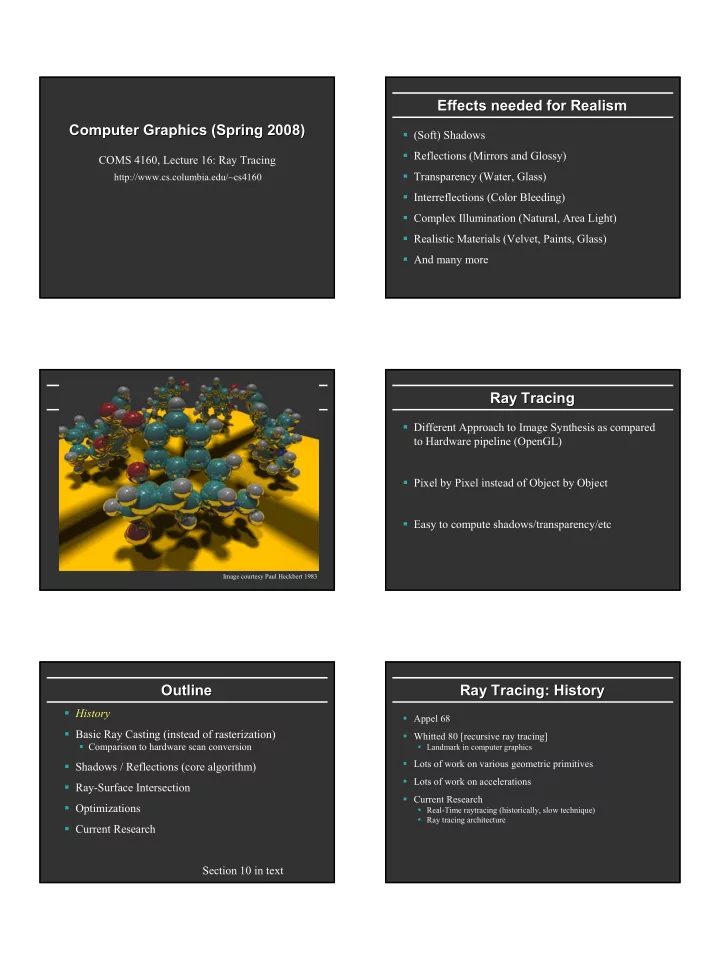
Effects needed for Realism Effects needed for Realism Computer - - PDF document

effects needed for realism effects needed for realism
SMART_READER_LITE
LIVE PREVIEW

Effects needed for Realism Effects needed for Realism Computer - - PDF document

Effects needed for Realism Effects needed for Realism Computer Graphics (Spring 2008) Computer Graphics (Spring 2008) (Soft) Shadows Reflections (Mirrors and Glossy) COMS 4160, Lecture 16: Ray Tracing Transparency (Water, Glass)


slide-1
SLIDE 1

Computer Graphics (Spring 2008) Computer Graphics (Spring 2008)

COMS 4160, Lecture 16: Ray Tracing

http://www.cs.columbia.edu/~cs4160

Effects needed for Realism Effects needed for Realism

(Soft) Shadows Reflections (Mirrors and Glossy) Transparency (Water, Glass) Interreflections (Color Bleeding) Complex Illumination (Natural, Area Light) Realistic Materials (Velvet, Paints, Glass) And many more

Image courtesy Paul Heckbert 1983

Ray Tracing Ray Tracing

Different Approach to Image Synthesis as compared to Hardware pipeline (OpenGL) Pixel by Pixel instead of Object by Object Easy to compute shadows/transparency/etc

Outline Outline

History Basic Ray Casting (instead of rasterization)

Comparison to hardware scan conversion

Shadows / Reflections (core algorithm) Ray-Surface Intersection Optimizations Current Research Section 10 in text

Ray Tracing: History Ray Tracing: History

Appel 68 Whitted 80 [recursive ray tracing]

Landmark in computer graphics

Lots of work on various geometric primitives Lots of work on accelerations Current Research

Real-Time raytracing (historically, slow technique) Ray tracing architecture

slide-2
SLIDE 2

Outline Outline

History Basic Ray Casting (instead of rasterization)

Comparison to hardware scan conversion

Shadows / Reflections (core algorithm) Ray-Surface Intersection Optimizations Current Research

Ray Casting Ray Casting

Produce same images as with OpenGL

Visibility per pixel instead of Z-buffer Find nearest object by shooting rays into scene Shade it as in standard OpenGL

Section 10.1-10.2 in text (we show visually, omitting math)

Ray Casting

Virtual Viewpoint Virtual Screen Objects Ray misses all objects: Pixel colored black Ray intersects object: shade using color, lights, materials Multiple intersections: Use closest one (as does OpenGL)

Comparison to hardware scan Comparison to hardware scan-

  • line

line

Per-pixel evaluation, per-pixel rays (not scan-convert each

  • bject). On face of it, costly

But good for walkthroughs of extremely large models (amortize preprocessing, low complexity) More complex shading, lighting effects possible

Outline Outline

History Basic Ray Casting (instead of rasterization)

Comparison to hardware scan conversion

Shadows / Reflections (core algorithm) Ray-Surface Intersection Optimizations Current Research

Shadows

Virtual Viewpoint Virtual Screen Objects 10.5 in textbook Light Source Shadow ray to light is unblocked: object visible Shadow ray to light is blocked: object in shadow

slide-3
SLIDE 3

Shadows: Numerical Issues

  • Numerical inaccuracy may cause intersection to be

below surface (effect exaggerated in figure)

  • Causing surface to incorrectly shadow itself
  • Move a little towards light before shooting shadow ray

Mirror Reflections/Refractions

Virtual Viewpoint Virtual Screen Objects 10.6 in textbook Generate reflected ray in mirror direction, Get reflections and refractions of objects

Recursive Ray Tracing Recursive Ray Tracing

For each pixel

Trace Primary Eye Ray, find intersection Trace Secondary Shadow Ray(s) to all light(s)

Color = Visible ? Illumination Model : 0 ;

Trace Reflected Ray

Color += reflectivity * Color of reflected ray

Also see section 10.4 in text

Problems with Recursion Problems with Recursion

Reflection rays may be traced forever Generally, set maximum recursion depth Same for transmitted rays (take refraction into account)

Turner Whitted 1980

Effects needed for Realism

  • (Soft) Shadows
  • Reflections (Mirrors and Glossy)
  • Transparency (Water, Glass)
  • Interreflections (Color Bleeding)
  • Complex Illumination (Natural, Area Light)
  • Realistic Materials (Velvet, Paints, Glass)

Discussed in this lecture Not discussed but possible with distribution ray tracing (10.11) Hard (but not impossible) with ray tracing; radiosity methods

slide-4
SLIDE 4

Outline Outline

History Basic Ray Casting (instead of rasterization)

Comparison to hardware scan conversion

Shadows / Reflections (core algorithm) Ray-Surface Intersection Optimizations Current Research

Ray/Object Intersections Ray/Object Intersections

Heart of Ray Tracer

One of the main initial research areas Optimized routines for wide variety of primitives

Various types of info

Shadow rays: Intersection/No Intersection Primary rays: Point of intersection, material, normals Texture coordinates

Work out examples

Triangle, sphere, polygon, general implicit surface Section 10.3

Ray Ray-

  • Tracing Transformed Objects

Tracing Transformed Objects

We have an optimized ray-sphere test

But we want to ray trace an ellipsoid…

Solution: Ellipsoid transforms sphere

Apply inverse transform to ray, use ray-sphere Allows for instancing (traffic jam of cars)

Mathematical details worked out in class

Section 10.8 of text

Outline Outline

History Basic Ray Casting (instead of rasterization)

Comparison to hardware scan conversion

Shadows / Reflections (core algorithm) Ray-Surface Intersection Optimizations Current Research

Acceleration Acceleration

Testing each object for each ray is slow

Fewer Rays

Adaptive sampling, depth control

Generalized Rays

Beam tracing, cone tracing, pencil tracing etc.

Faster Intersections

Optimized Ray-Object Intersections Fewer Intersections Section 10.9 goes into more detail, we just discuss some approaches at high level

Acceleration Structures Acceleration Structures

Bounding boxes (possibly hierarchical)

If no intersection bounding box, needn’t check objects

Bounding Box Ray

Spatial Hierarchies (Oct-trees, kd trees, BSP trees)

slide-5
SLIDE 5

Acceleration Structures: Grids Acceleration Structures: Grids Outline Outline

History Basic Ray Casting (instead of rasterization)

Comparison to hardware scan conversion

Shadows / Reflections (core algorithm) Ray-Surface Intersection Optimizations Current Research

Interactive Interactive Raytracing Raytracing

Ray tracing historically slow Now viable alternative for complex scenes

Key is sublinear complexity with acceleration; need not process all triangles in scene

Allows many effects hard in hardware OpenRT project real-time ray tracing (http://www.openrt.de)

Raytracing Raytracing on Graphics Hardware

  • n Graphics Hardware

Modern Programmable Hardware general streaming architecture Can map various elements of ray tracing Kernels like eye rays, intersect etc. In vertex or fragment programs Convergence between hardware, ray tracing [Purcell et al. 2002, 2003] http://graphics.stanford.edu/papers/photongfx