Effectively Engaging in Should change Have been thinking about - - PDF document

effectively engaging in
SMART_READER_LITE
LIVE PREVIEW

Effectively Engaging in Should change Have been thinking about - - PDF document

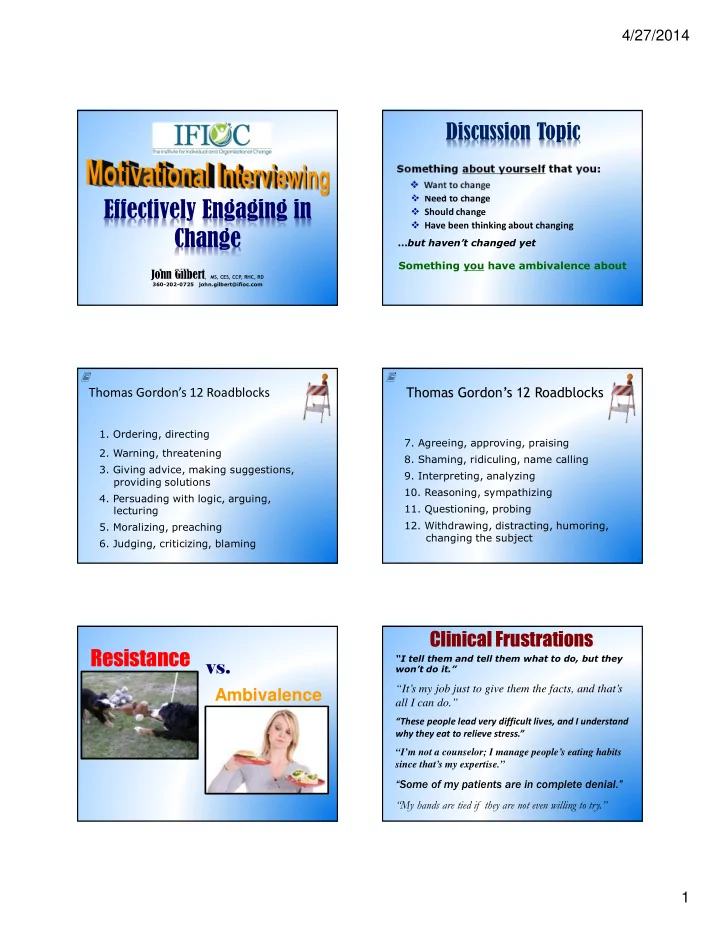
4/27/2014 Discussion Topic Something about yourself that you: Want to change Need to change Effectively Engaging in Should change Have been thinking about changing Change but havent changed yet Something you have


slide-1
SLIDE 1

4/27/2014 1

John Gilbert, MS, CES, CCP, RHC, RD

360-202-0725 john.gilbert@ifioc.com

Effectively Engaging in Change

Something about yourself that you: Want to change Need to change Should change Have been thinking about changing

…but haven’t changed yet

Something you have ambivalence about

Discussion Topic

Thomas Gordon’s 12 Roadblocks

  • 1. Ordering, directing
  • 2. Warning, threatening
  • 3. Giving advice, making suggestions,

providing solutions

  • 4. Persuading with logic, arguing,

lecturing

  • 5. Moralizing, preaching
  • 6. Judging, criticizing, blaming
  • 7. Agreeing, approving, praising
  • 8. Shaming, ridiculing, name calling
  • 9. Interpreting, analyzing
  • 10. Reasoning, sympathizing
  • 11. Questioning, probing
  • 12. Withdrawing, distracting, humoring,

changing the subject

Thomas Gordon’s 12 Roadblocks

Ambivalence

Resistance vs.

Clinical Frustrations

“I tell them and tell them what to do, but they won’t do it.”

“It’s my job just to give them the facts, and that’s all I can do.”

“These people lead very difficult lives, and I understand why they eat to relieve stress.” “I’m not a counselor; I manage people’s eating habits since that’s my expertise.”

“Some of my patients are in complete denial.” “My hands are tied if they are not even willing to try.”

slide-2
SLIDE 2

4/27/2014 2

Paradigm Shift

OUT OF Telling “YOU should…”

  • You’re expert
  • You educate
  • Lots of advice
  • You write Plan

INTO Curious Facilitator of Pt saying “I should…”

  • You’re still an expert in

health… AND Collaboration

  • Pt is expert in what they will

actually do

  • FACILITATOR: You guide

conversation so Pt argues for change

  • Edu / Menu of options

when asked for…

  • Pt writes plan based on

importance / confidence

Ambivalence

Resistance vs.

WARNING!!!

Mismatching your intervention to the client’s stage of change fosters resistance When you get attached to an outcome OR YOU push a quicker pace, you facilitate “resistance”

SELF-DETERMINATION THEORY

VS.

Healthcare Research

Eight studies were identified in the fields of diabetes, asthma, hypertension, hyperlipidemia, and heart disease. The majority of studies found positive results for effects of MI

  • n psychological, physiological, and

life-style change outcomes.

Why Use MI?

A systematic review of motivational interviewing in physical health care settings

  • K. M. Knight, L. McGowan, C. Dickens, C. Bundy

2010

Why Use MI?

Over 300 clinical trials demonstrate its efficacy

(www.motivationalinterview.net)

“Motivational Interviewing (MI) is the only health coaching approach to be fully described and consistently demonstrated as causally and independently associated with positive behavioral

  • utcomes (Butterworth, Linden, McClay 2008)

It’s significantly more efficient than other approaches (Lundahl et al. 2010) Standardized method of delivery, training and coding tools exist to assess fidelity

Not a script, more so a skill set

E.g. learning a new language, a new instrument, etc…

slide-3
SLIDE 3

4/27/2014 3

Motivational Interviewing FIDELITY

Why Use MI?

“Healthcare providers who know how to effectively deal with patients’ resistance and ambivalence have adherence rates five times higher than information giving.” #1 predictor of Rx adherence & outcomes is pt perception

  • n provider “empathy”.

Motivation is not enhanced by persuasion or convincing…it’s internal Motivation is increased when pt understands & WANTS TO change symptoms or consequences Pt MUST be involved in setting goals, if it doesn’t match to something important to their life, they won’t do it Bruce Berger, PhD, R.Ph

Head and Professor of Pharmacy Care Systems, Auburn University

Compassionate Helper Successful Evidence-based Practitioner

If the Only Tool You Use is a Hammer then Everything Looks Like a Nail.

Evaluations Motivational Interview

…is goal-oriented

Person-centered, Directional method of communication for enhancing intrinsic motivation by exploring and resolving ambivalence about change

Motivational Interviewing

  • Just a client-centered approach
  • What professionals already do naturally
  • A technique or gimmick
  • Manipulative (whose agenda)
  • A solution to all problems (panacea)

Motivational Interviewing is NOT…

slide-4
SLIDE 4

4/27/2014 4

  • Goal-oriented communication
  • Person-centered collaboration
  • Harnesses intrinsic motivation
  • Explores and resolves ambivalence

about specific target behavior

  • Linguistic focus on change language

Motivational Interviewing

Primary Goals of MI:

Reduce/Minimize resistance Explore discrepancy between behavior and values/goals… resolve ambivalence Elicit “change talk” and move into behavior change

Motivational Interviewing

How is Motivational Interviewing an EBP?

MI =

How do I know when to use MI as my primary approach?

Resistance Low motivation Hesitancy to engage in services Difficulty changing a desired behavior

When would I be less likely to use MI as my primary approach?

When a client is motivated and already working on making positive changes

WARNING!!!

Mismatching your intervention to the client’s stage of change fosters resistance When you get attached to an outcome OR YOU push a quicker pace, you facilitate “resistance”

Empathy

How he/she feels

slide-5
SLIDE 5

4/27/2014 5

People often say motivation doesn’t last. Well neither does bathing. That’s why we recommend it daily.

Zig Zigler

John Gilbert

360-202-0725 john.gilbert@ifioc.com

www.ifioc.com

Motivational Interviewing

ifioc.com

Resources Health Care Section

Motivational Interviewing in Health Care: Helping Patients Change Behavior by William

Miller, Stephen Rollnick, & Christopher Butler

Motivational Interviewing in the Treatment of Psychological Problems

by William Miller, Stephen Rollnick, Hal Arkowitz, & Henny Westra

Motivational Interviewing, Third Edition: Helping People for Change

by William Miller & Stephen Rollnick

Motivational Interviewing Motivational Interviewing

How To Do Motivational Interviewing: A Guidebook for Beginners by Bill Matulich Building Motivational Interviewing Skills by David Rosengren

www.samhsa.go v

TIP 35