Effective Behavior Change Messaging to Increase Consumption of - - PowerPoint PPT Presentation

effective behavior change messaging to increase
SMART_READER_LITE
LIVE PREVIEW

Effective Behavior Change Messaging to Increase Consumption of - - PowerPoint PPT Presentation

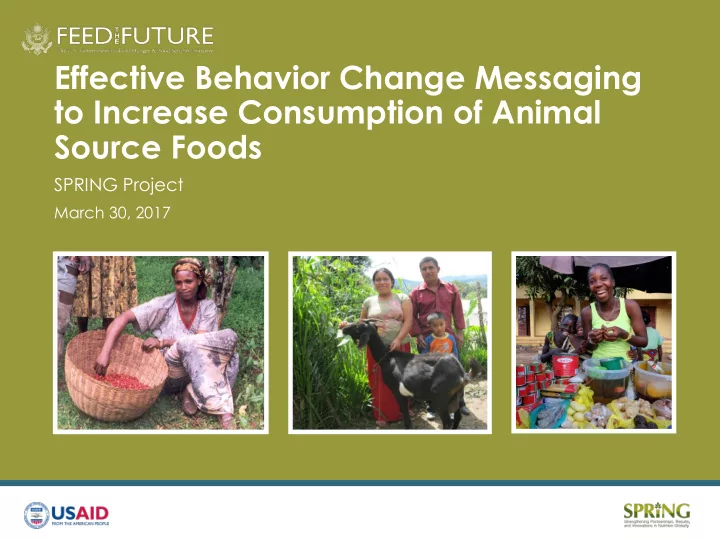
Effective Behavior Change Messaging to Increase Consumption of Animal Source Foods SPRING Project March 30, 2017 About SPRING Who we are What We Do Strengthen global and country efforts to scale up high impact nutrition practices

slide-1
SLIDE 1

Effective Behavior Change Messaging to Increase Consumption of Animal Source Foods

SPRING Project

March 30, 2017

slide-2
SLIDE 2

www.spring-nutrition.org

  • Strengthen global and

country efforts to scale up high impact nutrition practices

  • Prevent stunting and

anemia in the first 1,000 days

  • Link agriculture and

nutrition under Feed the Future

About SPRING

Who we are What We Do

slide-3
SLIDE 3

www.spring-nutrition.org

Weber, Lauren. 2016. “Two Boys With The Same Birth Story Will Live Vastly Different Lives.” The Huffington Post, June 29. TOM MAGUIRE/RESULTS

Why are we here?

slide-4
SLIDE 4

www.spring-nutrition.org

  • 1. What agriculture practices are most

likely to contribute to nutrition in a given context?

  • 2. How can we apply behavioral

science to improve uptake of those practices?

What are the right messages to facilitate changes in practices?

slide-5
SLIDE 5

www.spring-nutrition.org

Taking increasing household consumption of animal source foods as an example

  • Who are the farming, herding, and other market

actors who influence household consumption of ASFs?

  • What are they already doing that contributes

positively to household consumption of ASFs? Can that be amplified and scaled up?

  • What could they do differently within their core

competencies and mission to contribute more to household consumption of ASFs?

  • 1. What agriculture practices are most

likely to contribute to nutrition in a given context?

slide-6
SLIDE 6

www.spring-nutrition.org

How does agriculture affect nutrition?

Food consumed

  • calories
  • protein
  • micronutrients
  • safety

Farm income invested in…

  • diverse diet and

nutrient-rich foods

  • health and WASH

services and products

Gender in agriculture

  • maximizing

women’s control of assets and income

  • managing

demands of women’s time and energy

slide-7
SLIDE 7

www.spring-nutrition.org

Taking increasing household consumption of animal source foods as an example

  • What are the risks and benefits to different

market actors, including households, from current levels of hh consumption of ASFs?

  • What specific improved practice(s) will

increase different actors’ contribution to household consumption of ASFs?

  • What are the risks and benefits involved in

actors adopting the improved practice(s)?

  • 2. How can we apply behavioral science

to improve uptake of those practices?

slide-8
SLIDE 8

www.spring-nutrition.org

The COM-B model: Getting to action

Reproduced from Michie, van Stralen, and West, 2011

slide-9
SLIDE 9

www.spring-nutrition.org

The Socio-Ecological Model

Source: Adapted from McKee, Manoncourt, Chin and Carnegie (2000)

slide-10
SLIDE 10

www.spring-nutrition.org

Planned and deliberate vs automatic and habitual behavior

Conscious decisions and actions Driven by “rational” self- interest Maximize utility We have limited mental resources for this process Automatic decisions and actions Driven by emotions and social approval Adverse to losses More prominent when we’re tired or stressed

slide-11
SLIDE 11

www.spring-nutrition.org

Choice architecture: designing environments to engage our automatic brains

Source: Slideshare presentation by Lola Sanchez

slide-12
SLIDE 12

www.spring-nutrition.org

What do the models mean for messages to increase consumption of animal source foods?

  • Promote ASFs in local terms—what do

consumers value in food?

  • Link ASF consumption to short term risks

and benefits

  • Messages should grab the heart and gut

as well as the mind

  • Social identities and gender roles can

enable or constrain acting on messages

  • Enabling environments move us to action
slide-13
SLIDE 13

www.spring-nutrition.org

Know Your Context

  • Relevant market actors and

their influence on household consumption of ASFs?

  • Specific improved practices

along value chains which contribute to increased hh consumption of ASFs?

  • Risks and benefits for

households and other market actors of increased hh consumption of ASFs?

  • Social, market, physical, or

policy barriers to action?

slide-14
SLIDE 14

www.spring-nutrition.org

Strengthen enablers for change: Facilitate availability, affordability and sustainability of diverse, nutritious foods

  • Impact on local markets is

crucial

  • Avoid doing harm to the

natural resource base: climate-smart ag!

  • Generating demand and

improving supply together

  • Strengthen the enabling

environment for food safety and quality

slide-15
SLIDE 15

www.spring-nutrition.org

Allow for some rapid experimentation to adapt change processes or practices to meet the needs of different actors:

slide-16
SLIDE 16

www.spring-nutrition.org

  • “A hero father makes

sure his wife is getting extra cow milk daily while she’s exclusively breastfeeding to keep her feeling strong.”

  • “A hero father makes

sure each day to leave enough money for his wife to purchase fruits and vegetables for the children because eating fruits and vegetables prevents illness.”

Getting to Messages: “Hero fathers” in Ethiopia

Photo credit: Kelley Lynch

slide-17
SLIDE 17

www.spring-nutrition.org

  • Community-produced

videos show a local family:

  • discussing risks and

benefits together

  • sharing tasks to

improve practices

  • deciding together

when to consume the meat/eggs at home, when to sell the meat/eggs, and how to use the income

Getting to Messages: joint decision- making about chickens in India

Photo credit: Peggy Koniz-Booher

slide-18
SLIDE 18

www.spring-nutrition.org

Coming Soon: Accelerating Behavior Change in Nutrition-Sensitive Agriculture

slide-19
SLIDE 19

www.spring-nutrition.org

  • Criteria for prioritizing nutrition-sensitive

agriculture practices during activity design

  • Research priorities
  • Applying these criteria across a range of contexts and types
  • f market actors
  • Evaluating efficacy and cost-effectiveness of interventions

which incorporate behavior change approaches

  • Scaling opportunities
  • Integrating behavior change approaches and tools into

existing design processes and research/learning agendas

  • Innovative partnerships with private sector firms

Working Group

slide-20
SLIDE 20

This presentation is made possible by the generous support of the American people through the United States Agency for International Development (USAID) and Feed the Future, the U.S. Government’s global hunger and food security initiative, under the terms of the Cooperative Agreement AID-OAA-A-11-00031 (SPRING), managed by JSI Research & Training Institute, Inc. (JSI). The contents are the responsibility of JSI and the authors, and do not necessarily reflect the views of USAID or the U.S. Government.

www.spring-nutrition.org

Working together means changing our

  • wn practices too. But it will pay off!