EECS 373 Design of Microprocessor-Based Systems Prabal Dutta - - PowerPoint PPT Presentation

eecs 373
SMART_READER_LITE
LIVE PREVIEW

EECS 373 Design of Microprocessor-Based Systems Prabal Dutta - - PowerPoint PPT Presentation

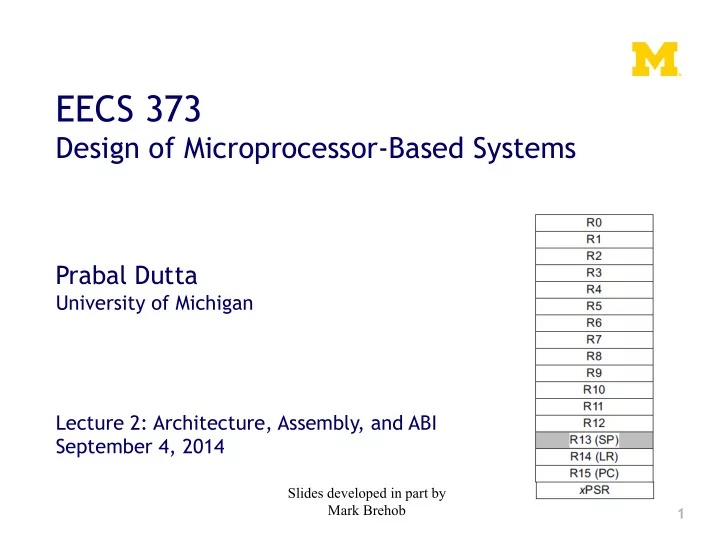
EECS 373 Design of Microprocessor-Based Systems Prabal Dutta University of Michigan Lecture 2: Architecture, Assembly, and ABI September 4, 2014 Slides developed in part by Mark Brehob 1 Announcements Website up

slide-1
SLIDE 1

1

EECS 373

Design of Microprocessor-Based Systems

Prabal Dutta

University of Michigan Lecture 2: Architecture, Assembly, and ABI September 4, 2014

Slides developed in part by Mark Brehob

slide-2
SLIDE 2

2

Announcements

  • Website up

– http://www.eecs.umich.edu/~prabal/teaching/eecs373/

  • Homework 1 posted (mostly a 270 review)
  • Lab and office hours posted on-line.

– My office hours: Tuesdays 1:30-3:00 pm in 4773 BBB

  • Projects

– Start thinking about them now!

slide-3
SLIDE 3

Today… Finish ARM assembly example from last time Walk though of the ARM ISA Software Development Tool Flow Application Binary Interface (ABI)

3

slide-4
SLIDE 4

4

Major elements of an Instruction Set Architecture

(registers, memory, word size, endianess, conditions, instructions, addressing modes)

32-bits 32-bits Endianess

¡ ¡mov ¡r0, ¡#4 ¡ ¡ ¡ldr ¡r1, ¡[r0,#8] ¡

¡ ¡ ¡ ¡ ¡ ¡ ¡r1=mem((r0)+8) ¡

¡ ¡bne ¡loop ¡ ¡ ¡subs ¡r2, ¡#1 ¡

Endianess

slide-5
SLIDE 5

The endianess religious war: 288 years and counting!

  • Modern version

– Danny Cohen – IEEE Computer, v14, #10 – Published in 1981 – Satire on CS religious war

  • Historical Inspiration

– Jonathan Swift – Gulliver's Travels – Published in 1726 – Satire on Henry-VIII’s split with the Church

  • Now a major motion picture!

5

¡ ¡ ¡ ¡ ¡ ¡ ¡ ¡ ¡ ¡ ¡ ¡ ¡ ¡ ¡ ¡ ¡ ¡ ¡ ¡ ¡ ¡ ¡ ¡ ¡ ¡ ¡ ¡ ¡ ¡Memory ¡ ¡ ¡ ¡ ¡Value ¡ ¡ ¡ ¡ ¡ ¡ ¡ ¡ ¡ ¡ ¡ ¡ ¡ ¡ ¡ ¡ ¡ ¡ ¡ ¡ ¡ ¡ ¡ ¡ ¡ ¡ ¡ ¡ ¡ ¡ ¡Offset ¡ ¡(LSB) ¡(MSB) ¡ ¡ ¡ ¡ ¡ ¡ ¡ ¡ ¡ ¡ ¡ ¡ ¡ ¡ ¡ ¡ ¡ ¡ ¡ ¡ ¡ ¡ ¡ ¡ ¡ ¡ ¡ ¡ ¡ ¡ ¡====== ¡ ¡=========== ¡ uint8_t ¡a ¡ ¡= ¡1; ¡ ¡ ¡ ¡ ¡ ¡ ¡ ¡ ¡ ¡ ¡ ¡ ¡ ¡ ¡0x0000 ¡ ¡01 ¡02 ¡FF ¡00 ¡ uint8_t ¡b ¡ ¡= ¡2; ¡ uint16_t ¡c ¡= ¡255; ¡// ¡0x00FF ¡ uint32_t ¡d ¡= ¡0x12345678; ¡ ¡ ¡ ¡ ¡ ¡0x0004 ¡ ¡78 ¡56 ¡34 ¡12 ¡

  • Little-Endian

– LSB is at lower address

  • Big-Endian

– MSB is at lower address

¡ ¡ ¡ ¡ ¡ ¡ ¡ ¡ ¡ ¡ ¡ ¡ ¡ ¡ ¡ ¡ ¡ ¡ ¡ ¡ ¡ ¡ ¡ ¡ ¡ ¡ ¡ ¡ ¡ ¡Memory ¡ ¡ ¡ ¡ ¡Value ¡ ¡ ¡ ¡ ¡ ¡ ¡ ¡ ¡ ¡ ¡ ¡ ¡ ¡ ¡ ¡ ¡ ¡ ¡ ¡ ¡ ¡ ¡ ¡ ¡ ¡ ¡ ¡ ¡ ¡ ¡Offset ¡ ¡(LSB) ¡(MSB) ¡ ¡ ¡ ¡ ¡ ¡ ¡ ¡ ¡ ¡ ¡ ¡ ¡ ¡ ¡ ¡ ¡ ¡ ¡ ¡ ¡ ¡ ¡ ¡ ¡ ¡ ¡ ¡ ¡ ¡ ¡====== ¡ ¡=========== ¡ uint8_t ¡a ¡ ¡= ¡1; ¡ ¡ ¡ ¡ ¡ ¡ ¡ ¡ ¡ ¡ ¡ ¡ ¡ ¡ ¡0x0000 ¡ ¡01 ¡02 ¡00 ¡FF ¡ uint8_t ¡b ¡ ¡= ¡2; ¡ uint16_t ¡c ¡= ¡255; ¡// ¡0x00FF ¡ uint32_t ¡d ¡= ¡0x12345678; ¡ ¡ ¡ ¡ ¡ ¡0x0004 ¡ ¡12 ¡34 ¡56 ¡78 ¡

slide-6
SLIDE 6

Addressing: Big Endian vs Little Endian (370 slide)

  • Endian-ness: ordering of bytes within a word

– Little - increasing numeric significance with increasing memory addresses – Big – The opposite, most significant byte first – MIPS is big endian, x86 is little endian

slide-7
SLIDE 7

Instruction encoding

  • Instructions are encoded in machine language opcodes
  • Sometimes

– Necessary to hand generate opcodes – Necessary to verify assembled code is correct

  • How? Refer to the “ARM ARM”

Instructions ¡ movs ¡r0, ¡#10 ¡ ¡ movs ¡r1, ¡#0 ¡ ARMv7 ARM Register ¡Value ¡ ¡ ¡ ¡ ¡ ¡Memory ¡Value ¡ 001|00|000|00001010 ¡(LSB) ¡(MSB) ¡ (msb) ¡ ¡ ¡ ¡ ¡ ¡ ¡ ¡ ¡(lsb) ¡0a ¡20 ¡00 ¡21 ¡ 001|00|001|00000000 ¡

slide-8
SLIDE 8

Assembly example data: .byte 0x12, 20, 0x20, -1 func: mov r0, #0 mov r4, #0 movw r1, #:lower16:data movt r1, #:upper16:data top: ldrb r2, [r1],#1 add r4, r4, r2 add r0, r0, #1 cmp r0, #4 bne top

8

slide-9
SLIDE 9

Instructions used

  • mov

– Moves data from register or immediate. – Or also from shifted register or immediate!

  • the mov assembly instruction maps to a bunch of

different encodings! – If immediate it might be a 16-bit or 32-bit instruction

  • Not all values possible
  • why?
  • movw

– Actually an alias to mov

  • “w” is “wide”
  • hints at 16-bit immediate

9

slide-10
SLIDE 10

From the ARMv7-M Architecture Reference Manual

(posted on the website under references)

10

There are similar entries for move immediate, move shifted (which actually maps to different instructions) etc.

slide-11
SLIDE 11

Directives

  • #:lower16:data

– What does that do? – Why?

11

slide-12
SLIDE 12

12

slide-13
SLIDE 13

Loads!

  • ldrb -- Load register byte

– Note this takes an 8-bit value and moves it into a 32-bit location!

  • Zeros out the top 24 bits
  • ldrsb -- Load register signed byte

– Note this also takes an 8-bit value and moves it into a 32-bit location!

  • Uses sign extension for the top 24 bits

13

slide-14
SLIDE 14

Addressing Modes

  • Offset Addressing

– Offset is added or subtracted from base register – Result used as effective address for memory access – [<Rn>, <offset>]

  • Pre-indexed Addressing

– Offset is applied to base register – Result used as effective address for memory access – Result written back into base register – [<Rn>, <offset>]!

  • Post-indexed Addressing

– The address from the base register is used as the EA – The offset is applied to the base and then written back – [<Rn>], <offset>

slide-15
SLIDE 15

So what does the program _do_? data: .byte 0x12, 20, 0x20, -1 func: mov r0, #0 mov r4, #0 movw r1, #:lower16:data movt r1, #:upper16:data top: ldrb r2, [r1],#1 add r4, r4, r2 add r0, r0, #1 cmp r0, #4 bne top

15

slide-16
SLIDE 16

Today… Finish ARM assembly example from last time Walk though of the ARM ISA Software Development Tool Flow Application Binary Interface (ABI)

16

slide-17
SLIDE 17

17

An ISA defines the hardware/software interface

  • A “contract” between architects and programmers
  • Register set
  • Instruction set

– Addressing modes – Word size – Data formats – Operating modes – Condition codes

  • Calling conventions

– Really not part of the ISA (usually) – Rather part of the ABI – But the ISA often provides meaningful support.

slide-18
SLIDE 18

ARM Architecture roadmap

18

+M4 : DSP ISA

slide-19
SLIDE 19

A quick comment on the ISA: From: ARMv7-M Architecture Reference Manual

19

slide-20
SLIDE 20

20

ARM Cortex-M3 ISA

Register Set Address Space Branching Data processing Load/Store Exceptions Miscellaneous Instruction Set 32-bits 32-bits Endianess Endianess

slide-21
SLIDE 21

21

Mode dependent

Registers

SP_main (MSP) used by:

  • OS kernel
  • Exception handlers
  • App code w/

privileded access SP_process (PSP) used by:

  • Base app code

(when not running an exception handler)

Note: there are two stack pointers!

slide-22
SLIDE 22

22

Address Space

slide-23
SLIDE 23

23

Instruction Encoding ADD immediate

slide-24
SLIDE 24

24

slide-25
SLIDE 25

25

Branch

slide-26
SLIDE 26

26

Data processing instructions

Many, Many More!

slide-27
SLIDE 27

27

Load/Store instructions

slide-28
SLIDE 28

28

Miscellaneous instructions

slide-29
SLIDE 29

Addressing Modes (again)

  • Offset Addressing

– Offset is added or subtracted from base register – Result used as effective address for memory access – [<Rn>, <offset>]

  • Pre-indexed Addressing

– Offset is applied to base register – Result used as effective address for memory access – Result written back into base register – [<Rn>, <offset>]!

  • Post-indexed Addressing

– The address from the base register is used as the EA – The offset is applied to the base and then written back – [<Rn>], <offset>

slide-30
SLIDE 30

<offset> options

  • An immediate constant

– #10

  • An index register

– <Rm>

  • A shifted index register

– <Rm>, LSL #<shift>

  • Lots of weird options…
slide-31
SLIDE 31

31 ARMv7-M Architecture Reference Manual ARMv7-M_ARM.pdf

slide-32
SLIDE 32

Application Program Status Register (APSR)

slide-33
SLIDE 33

Updating the APSR

  • SUB Rx, Ry

– Rx = Rx - Ry – APSR unchanged

  • SUBS

– Rx = Rx - Ry – APSR N, Z, C, V updated

  • ADD Rx, Ry

– Rx = Rx + Ry – APSR unchanged

  • ADDS

– Rx = Rx + Ry – APSR N, Z, C, V updated

slide-34
SLIDE 34

Overflow and carry in APSR unsigned_sum = UInt(x) + UInt(y) + UInt(carry_in); signed_sum = SInt(x) + SInt(y) + UInt(carry_in); result = unsigned_sum<N-1:0>; // == signed_sum<N-1:0> carry_out = if UInt(result) == unsigned_sum then ’0’ else ’1’;

  • verflow = if SInt(result) == signed_sum then ’0’ else ’1’;

34

slide-35
SLIDE 35

Conditional execution: Append to many instructions for conditional execution

slide-36
SLIDE 36

36

The ARM architecture “books” for this class

slide-37
SLIDE 37

37

The ARM software tools “books” for this class

slide-38
SLIDE 38

38

... ¡ start: ¡ ¡movs ¡r0, ¡#1 ¡ ¡movs ¡r1, ¡#1 ¡ ¡movs ¡r2, ¡#1 ¡ ¡sub ¡ ¡r0, ¡r1 ¡ ¡bne ¡ ¡done ¡ ¡movs ¡r2, ¡#2 ¡ done: ¡ ¡b ¡ ¡ ¡ ¡done ¡ ... ¡ Exercise: What is the value of r2 at done?

slide-39
SLIDE 39

39

... ¡ start: ¡ ¡movs ¡r0, ¡#1 ¡// ¡r0 ¡ß ß ¡1, ¡Z=0 ¡ ¡movs ¡r1, ¡#1 ¡// ¡r1 ¡ß ß ¡1, ¡Z=0 ¡ ¡movs ¡r2, ¡#1 ¡// ¡r2 ¡ß ß ¡1, ¡Z=0 ¡ ¡sub ¡ ¡r0, ¡r1 ¡// ¡r0 ¡ß ß ¡r0-­‑r1 ¡ ¡ ¡ ¡ ¡// ¡but ¡Z ¡flag ¡untouched ¡ ¡ ¡ ¡ ¡// ¡since ¡sub ¡vs ¡subs ¡ ¡bne ¡ ¡done ¡ ¡// ¡NE ¡true ¡when ¡Z==0 ¡ ¡ ¡ ¡ ¡// ¡So, ¡take ¡the ¡branch ¡ ¡movs ¡r2, ¡#2 ¡// ¡not ¡executed ¡ done: ¡ ¡b ¡ ¡ ¡ ¡done ¡ ¡// ¡r2 ¡is ¡still ¡1 ¡ ... ¡ Solution: what is the value of r2 at done?

slide-40
SLIDE 40

Today… Finish ARM assembly example from last time Walk though of the ARM ISA Software Development Tool Flow Application Binary Interface (ABI)

40

slide-41
SLIDE 41

41

How does an assembly language program get turned into a executable program image?

Assembly ¡ files ¡(.s) ¡ Object ¡ files ¡(.o) ¡ as ¡ (assembler) ¡ ld ¡ (linker) ¡

¡ Memory ¡ layout ¡

Linker ¡ script ¡(.ld) ¡ Executable ¡ image ¡file ¡ Binary ¡program ¡ file ¡(.bin) ¡ Disassembled ¡ code ¡(.lst) ¡

slide-42
SLIDE 42

42

What are the real GNU executable names for the ARM?

  • Just add the prefix “arm-none-eabi-” prefix
  • Assembler (as)

– arm-none-eabi-as

  • Linker (ld)

– arm-none-eabi-ld

  • Object copy (objcopy)

– arm-none-eabi-objcopy

  • Object dump (objdump)

– arm-none-eabi-objdump

  • C Compiler (gcc)

– arm-none-eabi-gcc

  • C++ Compiler (g++)

– arm-none-eabi-g++

slide-43
SLIDE 43

43 $ ¡arm-­‑none-­‑eabi-­‑as ¡-­‑mcpu=cortex-­‑m3 ¡-­‑mthumb ¡example1.s ¡-­‑o ¡example1.o ¡ ¡ ¡

How are assembly files assembled?

  • $ arm-none-eabi-as

– Useful options

  • -mcpu
  • -mthumb
  • -o
slide-44
SLIDE 44

44 ¡.equ ¡STACK_TOP, ¡0x20000800 ¡ ¡.text ¡ ¡.syntax ¡unified ¡ ¡.thumb ¡ ¡.global ¡_start ¡ ¡.type ¡start, ¡%function ¡ ¡ _start: ¡ ¡.word ¡STACK_TOP, ¡start ¡ start: ¡ ¡movs ¡r0, ¡#10 ¡ ¡movs ¡r1, ¡#0 ¡ loop: ¡ ¡adds ¡r1, ¡r0 ¡ ¡subs ¡r0, ¡#1 ¡ ¡bne ¡ ¡loop ¡ deadloop: ¡ ¡b ¡ ¡ ¡ ¡deadloop ¡ ¡.end ¡ ¡

A “real” ARM assembly language program for GNU

slide-45
SLIDE 45

45 ¡.equ ¡STACK_TOP, ¡0x20000800 ¡/* ¡Equates ¡symbol ¡to ¡value ¡*/ ¡ ¡.text ¡ ¡ ¡ ¡/* ¡Tells ¡AS ¡to ¡assemble ¡region ¡*/ ¡ ¡.syntax ¡unified ¡ ¡ ¡/* ¡Means ¡language ¡is ¡ARM ¡UAL ¡*/ ¡ ¡.thumb ¡ ¡ ¡ ¡/* ¡Means ¡ARM ¡ISA ¡is ¡Thumb ¡*/ ¡ ¡.global ¡_start ¡ ¡ ¡/* ¡.global ¡exposes ¡symbol ¡*/ ¡ ¡ ¡ ¡ ¡ ¡/* ¡_start ¡label ¡is ¡the ¡beginning ¡*/ ¡ ¡ ¡ ¡ ¡ ¡/* ¡...of ¡the ¡program ¡region ¡*/ ¡ ¡.type ¡start, ¡%function ¡ ¡/* ¡Specifies ¡start ¡is ¡a ¡function ¡*/ ¡ ¡ ¡ ¡ ¡ ¡/* ¡start ¡label ¡is ¡reset ¡handler ¡*/ ¡ _start: ¡ ¡ ¡ ¡ ¡ ¡ ¡.word ¡STACK_TOP, ¡start ¡ ¡/* ¡Inserts ¡word ¡0x20000800 ¡*/ ¡ ¡ ¡ ¡ ¡ ¡/* ¡Inserts ¡word ¡(start) ¡*/ ¡ start: ¡ ¡ ¡ ¡ ¡ ¡ ¡movs ¡r0, ¡#10 ¡ ¡ ¡/* ¡We’ve ¡seen ¡the ¡rest ¡... ¡*/ ¡ ¡movs ¡r1, ¡#0 ¡ ¡ ¡ ¡ loop: ¡ ¡ ¡ ¡ ¡ ¡ ¡adds ¡r1, ¡r0 ¡ ¡ ¡ ¡ ¡subs ¡r0, ¡#1 ¡ ¡ ¡ ¡ ¡bne ¡ ¡loop ¡ ¡ ¡ ¡ deadloop: ¡ ¡ ¡ ¡ ¡ ¡b ¡ ¡ ¡ ¡deadloop ¡ ¡ ¡ ¡ ¡.end ¡ ¡

What’s it all mean?

slide-46
SLIDE 46

46 all: ¡ ¡arm-­‑none-­‑eabi-­‑as ¡-­‑mcpu=cortex-­‑m3 ¡-­‑mthumb ¡example1.s ¡-­‑o ¡example1.o ¡ ¡arm-­‑none-­‑eabi-­‑ld ¡-­‑Ttext ¡0x0 ¡-­‑o ¡example1.out ¡example1.o ¡ ¡arm-­‑none-­‑eabi-­‑objcopy ¡-­‑Obinary ¡example1.out ¡example1.bin ¡ ¡arm-­‑none-­‑eabi-­‑objdump ¡-­‑S ¡example1.out ¡> ¡example1.lst ¡

A simple (hardcoded) Makefile example

slide-47
SLIDE 47

47

What information does the disassembled file provide?

¡.equ ¡STACK_TOP, ¡0x20000800 ¡ ¡ ¡.text ¡ ¡.syntax ¡unified ¡ ¡.thumb ¡ ¡.global ¡_start ¡ ¡.type ¡start, ¡%function ¡ ¡ _start: ¡ ¡.word ¡STACK_TOP, ¡start ¡ start: ¡ ¡movs ¡r0, ¡#10 ¡ ¡movs ¡r1, ¡#0 ¡ loop: ¡ ¡adds ¡r1, ¡r0 ¡ ¡subs ¡r0, ¡#1 ¡ ¡bne ¡ ¡loop ¡ deadloop: ¡ ¡b ¡ ¡ ¡ ¡deadloop ¡ ¡.end ¡ ¡ ¡ example1.out: ¡ ¡ ¡ ¡ ¡file ¡format ¡elf32-­‑littlearm ¡ ¡ ¡ Disassembly ¡of ¡section ¡.text: ¡ ¡ 00000000 ¡<_start>: ¡ ¡ ¡ ¡0: ¡20000800 ¡ ¡.word ¡0x20000800 ¡ ¡ ¡ ¡4: ¡00000009 ¡ ¡.word ¡0x00000009 ¡ ¡ 00000008 ¡<start>: ¡ ¡ ¡ ¡8: ¡200a ¡ ¡ ¡ ¡ ¡ ¡ ¡movs ¡r0, ¡#10 ¡ ¡ ¡ ¡a: ¡2100 ¡ ¡ ¡ ¡ ¡ ¡ ¡movs ¡r1, ¡#0 ¡ ¡ 0000000c ¡<loop>: ¡ ¡ ¡ ¡c: ¡1809 ¡ ¡ ¡ ¡ ¡ ¡ ¡adds ¡r1, ¡r1, ¡r0 ¡ ¡ ¡ ¡e: ¡3801 ¡ ¡ ¡ ¡ ¡ ¡ ¡subs ¡r0, ¡#1 ¡ ¡ ¡10: ¡d1fc ¡ ¡ ¡ ¡ ¡ ¡ ¡bne.n ¡c ¡<loop> ¡ ¡ 00000012 ¡<deadloop>: ¡ ¡ ¡12: ¡e7fe ¡ ¡ ¡ ¡ ¡ ¡ ¡b.n ¡12 ¡<deadloop> ¡ ¡

all: ¡ ¡arm-­‑none-­‑eabi-­‑as ¡-­‑mcpu=cortex-­‑m3 ¡-­‑mthumb ¡example1.s ¡-­‑o ¡example1.o ¡ ¡arm-­‑none-­‑eabi-­‑ld ¡-­‑Ttext ¡0x0 ¡-­‑o ¡example1.out ¡example1.o ¡ ¡arm-­‑none-­‑eabi-­‑objcopy ¡-­‑Obinary ¡example1.out ¡example1.bin ¡ ¡arm-­‑none-­‑eabi-­‑objdump ¡-­‑S ¡example1.out ¡> ¡example1.lst ¡

slide-48
SLIDE 48

48

How does a mixed C/Assembly program get turned into a executable program image?

Assembly ¡ files ¡(.s) ¡ Object ¡ files ¡(.o) ¡ as ¡ (assembler) ¡ gcc ¡ (compile ¡ + ¡link) ¡

¡ Memory ¡ layout ¡

Linker ¡ script ¡(.ld) ¡ Executable ¡ image ¡file ¡ Binary ¡program ¡ file ¡(.bin) ¡ Disassembled ¡ Code ¡(.lst) ¡ ld ¡ (linker) ¡ Library ¡object ¡ files ¡(.o) ¡ C ¡files ¡(.c) ¡

slide-49
SLIDE 49

Today… Finish ARM assembly example from last time Walk though of the ARM ISA Software Development Tool Flow Application Binary Interface (ABI)

49

slide-50
SLIDE 50

50

slide-51
SLIDE 51

ABI quote

  • A subroutine must preserve the contents of the

registers r4-r8, r10, r11 and SP (and r9 in PCS variants that designate r9 as v6).

51

slide-52
SLIDE 52

52

Questions? Comments? Discussion?