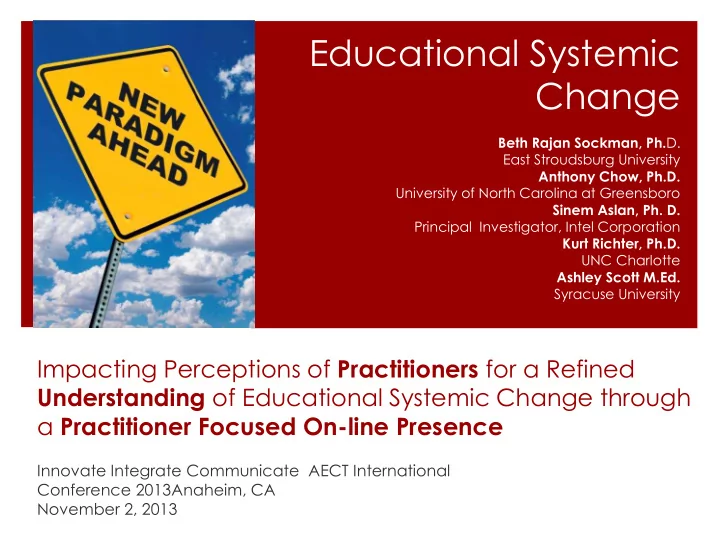
Educational Systemic Change Beth Rajan Sockman, Ph. D. East - - PowerPoint PPT Presentation

educational systemic
SMART_READER_LITE
LIVE PREVIEW

Educational Systemic Change Beth Rajan Sockman, Ph. D. East - - PowerPoint PPT Presentation

Educational Systemic Change Beth Rajan Sockman, Ph. D. East Stroudsburg University Anthony Chow, Ph.D. University of North Carolina at Greensboro Sinem Aslan, Ph. D. Principal Investigator, Intel Corporation Kurt Richter, Ph.D. UNC


slide-1
SLIDE 1

Impacting Perceptions of Practitioners for a Refined Understanding of Educational Systemic Change through a Practitioner Focused On-line Presence

Innovate Integrate Communicate AECT International Conference 2013Anaheim, CA November 2, 2013

Educational Systemic Change

Beth Rajan Sockman, Ph.D. East Stroudsburg University Anthony Chow, Ph.D. University of North Carolina at Greensboro Sinem Aslan, Ph. D. Principal Investigator, Intel Corporation Kurt Richter, Ph.D. UNC Charlotte Ashley Scott M.Ed. Syracuse University

slide-2
SLIDE 2

What if….

 What would it be like if practitioners and community members had an understanding of educational systemic change?

slide-3
SLIDE 3
slide-4
SLIDE 4

Objectives

View of educational systemic change Value of Usability Study Evaluate the research of a study Identify what practitioners say about a Systemic Change Website: http://systemicchange.wordpress.com/

slide-5
SLIDE 5

It is all about being fair…

Picture from http://weknowmemes.com/tag/please-climb-that-tree/
slide-6
SLIDE 6

Personalizing learning experiences is a key to be fair!

Picture from http://personalizedlearningsd8.yolasite.com/view.php
slide-7
SLIDE 7

Technology as enabler for new paradigm of education

slide-8
SLIDE 8

The Need is Nationally Recognized!

slide-9
SLIDE 9

Some Highlights

 The USA Race to the Top initiatives and reports  University programs  School Official Certifications  The International Society for Technology in Education (ISTE)  Backlash to No Child Left Behind  Voices of Vision  Multiple authors/researchers

slide-10
SLIDE 10

What can we do about it?

 The national movement towards understanding change provides a ripe time for the AECT division.  Creating an accessible repository of material may bridge a divide between practitioners and academics/researchers for understanding systemic change.

slide-11
SLIDE 11

Usability Study - Context

 Fall 2012  17-item usability survey  11 graduate students

Website- 5.6 Video 5.6 Overall Satisfaction 5.9 7 Point Scale

slide-12
SLIDE 12

Background to Project Goal

 Bridge gap between practitioners and researchers of educational systemic change

Researchers Practitioners

Begin a conversation

Increase profile on the web and become a Viable Resource Center for Practitioners Division of Systemic Change Strategic Plan Strategic Goal 2.5. This goal is about extending the reach of our division and expanding the promise of systemic change into leadership preparation programs.

slide-13
SLIDE 13

2012 Recommendations

Providing concrete examples of how systemic change works in public education Videos were effective – More? Opportunities - Recommendations

slide-14
SLIDE 14

Usability

 Access to what you are looking for fast and conveniently  Efficiency, Effectiveness, and Satisfaction (ISO- 9241)  UX or User Experience is becoming more important in our “information overload” world.  25-35 seconds to convince a user to stay (Nielsen & Loranger, 2006).  Usability provides precise way of measuring and improving websites in a systematic fashion.

slide-15
SLIDE 15

Research Questions

1.) How do practitioners perceive the overall usability of the website? 2.) Does the practitioner find the website’s content useful for understanding systemic change in K-12 schools? 3.) After time spent on the website, do practitioners perceive that they would like to learn more about systemic change for the benefit of leading change efforts? 4.) What suggestions do practitioners give for the improvement of the

  • n-line delivery and conversation systems to connect practitioners with

researchers of educational systemic change?

slide-16
SLIDE 16

Method

Social Networks, Emails, 1 Graduate class

Solicitations-Online Survey- 23 Item study

Completed

41

Participants

slide-17
SLIDE 17

Participants

41

Participants

20

K-12 Education

16

Higher Education

5

Other

+ + = 57

Multiple Choice

slide-18
SLIDE 18

Findings

slide-19
SLIDE 19

Question 1

0% 10% 20% 30% 40% 50% 60% 70% 80% 90% 100% Find looking for.. Highly Satisfied Graphics Videos How do practitioners perceive the

  • verall usability?
slide-20
SLIDE 20

Open Comments

Positive

 Design - Clean  Architecture - Efficient  Navigation - Easy

Negative

 Mechanics- Some links didn’t work  Content - Not in-depth  Reliability – Can verify who completed

slide-21
SLIDE 21

Question 2

75 80 85 90 95 100 High Quality Useful Videos Efficient Efficient

  • verall

Perceptions in representing systemic change

Does the practitioner find the website’s content useful for understanding

systemic change in K-12 schools?

slide-22
SLIDE 22

Open Comments - Positive

 CONTENT: 3 Positive Comments on video learning and organization - Home page and Individual  “I felt that the site facilitated learning at both a surface or deep level. I loved how the video names were meaningful and spoke to the section heading.”

slide-23
SLIDE 23

Question 3

After time spent on the website, do practitioners perceive that they would like to learn more about systemic change for the benefit of leading change efforts? Dissatisfaction Informed Leadership Corresponds with Survey Question: Why are you interested in Systemic Change? Answered Characterized by the following:

slide-24
SLIDE 24

Dissatisfaction – 9 Comments

Schools need it & how is important No child left behind failed I feel like it's constantly the same old song playing on the record player...children aren't getting the education the need or deserve. It's frustrating. But it's great to know people are still out there trying to help fight this system of standardization

slide-25
SLIDE 25

Informed – 14 Comments

I am an educator I’m a librarian any change to education will change what the library should offer it's patrons. I'm an educator. I want to prepare my students for their futures as best I can.

slide-26
SLIDE 26

Leadership– 2 Comments

know how to lead it The organization I work for, Curriculum Leadership Institute prides itself on help school districts achieve positive systemic change.

slide-27
SLIDE 27

Question 4

What suggestions do practitioners give for the improvement of the on-line delivery and conversation systems to connect practitioners with researchers of educational systemic change? 3 Reliability of information 4 Design of information – Graphics & Brighter colors 3 Content – Specific Strategies, Tools, Examples

  • f working, more

personal, Success stories 2 Mechanics– Links 1 Architecture – Videos tab

slide-28
SLIDE 28

Conclusions

slide-29
SLIDE 29

Relevant & Useful 5.5

Usability Study – CONTENT

 Fall 2013  23-item usability survey  57 practitioner

Website 5.7 Video 5.7 Overall Satisfaction 5.7 7 Point Scale

slide-30
SLIDE 30

Overall Participants felt…

59% Use website in future 82% Recommend to a colleague 14 Supplied Email

slide-31
SLIDE 31

Conclusion

 Interest with Practitioners  Why interested? Dissatisfaction & want to be informed  Limitations

 Usability study – short survey & not an in-depth understanding  Does generate interest? Maybe  Question: Is it worth it?  Changes to website to consider: Design/graphic/link

slide-32
SLIDE 32

References

 Aslan, S., & Reigeluth, C. M. (2012). A Trip to the past and future of educational computing: Understanding its evolution. Contemporary Educational Technology, 2(1), 1-17. Banathy, B. H. (1996). Conversation as a medium for change in education. Educational Technology, 36(1), 39-41.  Duffy, F. M. (2010). Dream! Create! Sustain! Mastering the Art and Science of Tranforming School Systems. Lanham, MD: Rowman & Littlefield Education.  Fullan, M. G. (2010). All systems go. Thousand Oaks, CA: Corwin Press.  Reigeluth, C. M., & Duffy, F. M. (2008). The AECT FutureMinds Initiative: Transforming America's School Systems. Educational Technology, 48(3), 45-49.  Reigeluth, C. M., & Karnopp, J. R. (2013). Reinventing Schools: It's Time to Break the Mold. Lanham, MD: Rowman & Littlefield Education.

slide-33
SLIDE 33

Contact Info

 Website: http://systemicchange.wordpress.com/  Beth Sockman: bsockman@esu.edu  Anthony Chow: aschow@uncg.edu.