ECRH on the Levitated Dipole Experiment S. Mahar, J. Kesner, A.C. - - PowerPoint PPT Presentation

ecrh on the levitated dipole experiment
SMART_READER_LITE
LIVE PREVIEW

ECRH on the Levitated Dipole Experiment S. Mahar, J. Kesner, A.C. - - PowerPoint PPT Presentation

ECRH on the Levitated Dipole Experiment S. Mahar, J. Kesner, A.C. Boxer, J.E. Ellsworth, I. Karim, A. Roach MIT PSFC A.K. Hansen, D.T. Garnier, M.E. Mauel, E.E. Ortiz Columbia University Presented at the 46th Meeting of the American


slide-1
SLIDE 1

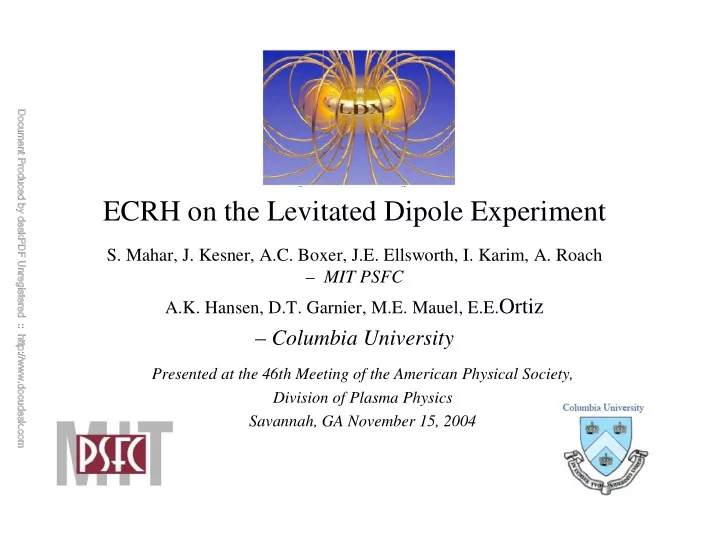
ECRH on the Levitated Dipole Experiment

  • S. Mahar, J. Kesner, A.C. Boxer, J.E. Ellsworth, I. Karim, A. Roach

– MIT PSFC A.K. Hansen, D.T. Garnier, M.E. Mauel, E.E.Ortiz

– Columbia University

Presented at the 46th Meeting of the American Physical Society, Division of Plasma Physics Savannah, GA November 15, 2004

slide-2
SLIDE 2

Abstract

The use of multiple frequencies of electron cyclotron resonance heating (ECRH) in the Levitated Dipole Experiment is an important tool that will tailor the plasma

  • profiles. The construction and details of the ECRH system

will be discussed and initial experimental results will be

  • presented. The effects of different combinations of pulse

lengths and powers will be examined in terms of electron temperature profile and the plasma pressure profile. Future plans for different frequencies will also be discussed.

slide-3
SLIDE 3

ECRH Basics

  • Accelerate electrons with microwaves at the

electron cyclotron frequency,

  • Will heat up electrons along lines of constant

magnetic field amplitude

  • Can shape pressure profile by using varying the

power level in each frequency

  • Calculate position of heating when magnetic field

values are known

e

m neB γ = Ω

( )

ne m f ne m r B

e e

γ π γ 2 = Ω =

slide-4
SLIDE 4

LDX Resonance Zones

  • B-field resonance:
  • Current frequencies:

– 2.45 GHz (0-3 kW) – 6.4 GHz (0-3 kW)

  • In progress:

– 10.5 GHz (0-10 kW)

  • Future:

– 18 GHz (0-10 kW) – 28 GHz (0-10 kW)

T B T B

harmonic nd harmonic st

0438 . 0875 .

2 1

= =

  • Note: Calculations for the first and second harmonics are done using a gamma of 1. However,

Gammas of 1 up to 1.16 have been obtained in our September and August runs.

T B T B

harmonic nd harmonic st

114 . 229 .

2 1

= =

  • T

B T B

harmonic nd harmonic st

188 . 375 .

2 1

= =

  • T

B T B

harmonic nd harmonic st

321 . 643 .

2 1

= =

  • T

B T B

harmonic nd harmonic st

500 . 00 . 1

2 1

= =

  • ( )

ne m f r B

e

γ π 2 =

slide-5
SLIDE 5

Positioning of Feedthroughs

  • 2.45 GHz and 6.4 GHz

use cavity heating

– Microwaves are sprayed in through side port and reflect until absorbed – Launched extraordinary mode

  • 10.5 GHz will use

directional heating

– Microwaves are launched from the bottom – Parallel to magnetic field in middle of dipole field

6.4 GHz feedthrough 2.45 GHz feedthrough

slide-6
SLIDE 6

2.45 GHz System

  • Magnetron generates microwaves
  • The circulator protects the magnetron from reflected power
  • The directional coupler detects forward and reflected power
  • The expander expands WR284 waveguide to WR340
  • The window separates the vacuum from the atmospheric air
  • The conflat is where the feedthrough attaches to the vacuum vessel
  • The feedthrough is the “antenna” inside the vacuum
slide-7
SLIDE 7

2.45 GHz Magnetron

  • A magnetron converts electrical energy

to microwave radiation

  • Electrons are emitted from a central
  • cathode. The anode surrounding the

cathode attracts the electrons. Instead of traveling in a straight line, permanent magnets force the electrons to take a circular path

  • As they pass by resonating cavities,

they generate a continuous pulsating magnetic field, or electromagnetic radiation

  • Gerling Magnetron, Power of 0-3 kW
slide-8
SLIDE 8

2.45 GHz Circulator

  • Circulator is used to

protect the magnetron from reflected power

  • Circulator deflects the

microwaves into a dummy load

  • Because of the power

and potential long pulses, system is be water-cooled

slide-9
SLIDE 9

2.45 GHz Directional Coupler

  • Directional Couplers are a

diagnostic to determine the forward and reflected power

  • Electric Field is detected

in the waveguide

  • Signal is passed through

an attenuator and through a crystal diode

  • 55.6 dB attenuation with

Krytar crystal diodes

slide-10
SLIDE 10

2.45 GHz Waveguide Run

  • Mostly aluminum waveguide
  • Magnetron side uses WR284
  • Feedthrough side used WR340
  • 12 inch expander section joins

waveguide

  • 20 feet of WR284
  • Less than 6 feet of WR340
  • 3, H-Plane Bends
  • 1, E-Plane Bend
  • 1, 2 foot bendable section

– Bent 90 degrees

  • 1, 45 degree twist section
slide-11
SLIDE 11

2.45 GHz Window

  • Window separates vessel

side (vacuum pressure) from waveguide side (atmospheric pressure)

  • WR340 size, which is why

the expander was needed

  • The window is a ceramic
  • Capable of being water-

cooled

– Do not need this with only 3 kW of power

slide-12
SLIDE 12

2.45 GHz Feedthrough

  • Copper WR340 feedthrough

silver-soldered onto stainless steel conflat

  • Cut at 44.96 degrees to

minimize reflected power

  • Isotropically launches

microwaves at midplane to cavity heat

  • Extraordinary mode
  • 7 inches long (vacuum side)
  • Sticks out 1 inch past wall
slide-13
SLIDE 13

6.4 GHz System

  • Klystron generates microwaves
  • The directional coupler detects forward and reflected power
  • The window separates the vacuum from the atmospheric air
  • The conflat is where the feedthrough attaches to the vacuum vessel
  • The feedthrough is the “antenna” inside the vacuum
slide-14
SLIDE 14

6.4 GHz Klystron

  • A klystron converts electrical energy to

microwave radiation

  • An electron gun produces an intense flow
  • f electrons into the klystron
  • In the first cavity, a low-energy

microwave signal intersects this continuous electron beam, breaking it up into a pulsed beam consisting of separate "bunches" of electrons

  • These electrons pass through a tuned drift

tube to a second cavity, where they are amplified and produce the microwaves that leave the chamber into the waveguide

  • Our Klystron Specs:

– Power of 0-3 kW – Beam voltage: 8.3 kV DC – Beam current: 1.08 Amps – Heater voltage: 6 V DC – Heater current: 6.8 Amps

slide-15
SLIDE 15

6.4 GHz Directional Coupler

  • Directional Couplers are a

diagnostic to determine the forward and reflected power.

  • Electric Field is detected in the

waveguide

  • Signal is passed through an

attenuator and through a crystal diode

  • Couplers are inside klystron

cabinet

  • 0-10 V Forward power output

from central logic

  • Reflected power is taken from

internal coupler

slide-16
SLIDE 16

6.4 GHz Window

  • Window separates

vessel side (vacuum pressure) from waveguide side (atmospheric pressure)

  • The window is made
  • f quartz
slide-17
SLIDE 17

6.4 GHz Feedthrough

  • Copper WR137 feedthrough

silver-soldered onto stainless steel conflat

  • Cut at 44.31 degrees to

minimize reflected power

  • Isotropically launches

microwaves at midplane to cavity heat

  • Extraordinary mode
  • 8 inches long (vacuum side)
  • Sticks out 2 inch past wall
slide-18
SLIDE 18

ECRH Triggering

  • Signal from timer module is

changed to a fiber optic signal and run to the sources – Changed back into 0-5 V signal at source side

  • 2.45 signal is input directly

into the source

– An inhibit switch is run through the Programmable Logic Controller, (PLC)

  • 6.4 signal goes through a solid

state switch, controlled by the PLC, to enable the source

Solid State Switch Fiber Optic 0-5 Volt Signal To the 2.45 & 6.4 GHz Controls To the PLC

slide-19
SLIDE 19

ECRH Data

  • Forward and reversed

power are detected by the directional couplers

  • 2.45 forward and reflected

power comes directly from couplers

  • 6.4 forward power is an
  • utput from cabinet
  • 6.4 reflected power comes

directly from coupler

slide-20
SLIDE 20

ECRH Data

  • Signals run from couplers

to digitizer cabinet in twisted pair cable

  • Through a ribbon cable to

the isolation amplification board

  • 1:1 Inverting amplifier
  • Through the digitizer and

stored in the data tree

  • Calibrations change

voltages into power (kW)

  • Shot 040917020
slide-21
SLIDE 21

ECRH Data From 9-17-2004

Shot: 20 Shot: 19

slide-22
SLIDE 22

Future Plans

  • Data

– Directional Couplers

  • Calibrate the directional couplers
  • Make the couplers more reliable

– Plasma Radiation

  • Use filters at heating frequencies to detect what frequencies and

powers the plasma radiates

  • 10.5 GHz Source

– Waveguide run has been ordered – Water-cool the klystron – Finish electronic work in the cabinet – Set up detectors and data acquisition

  • 18 and 28 GHz Sources Eventually