
SLIDE 1
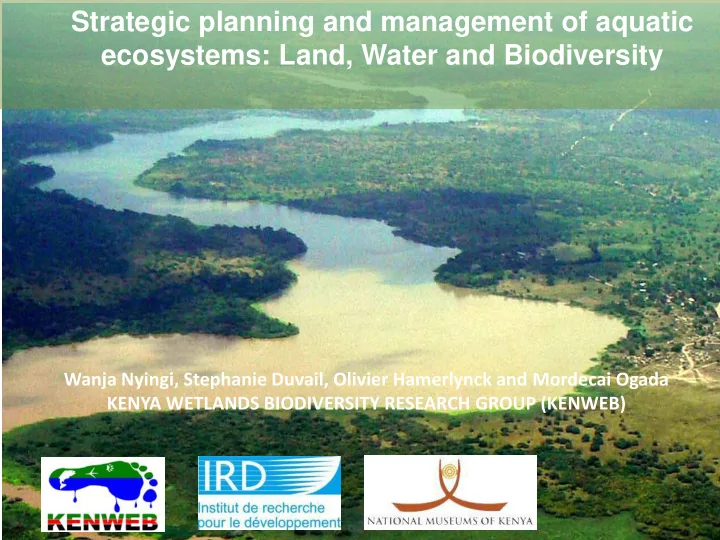
Strategic planning and management of aquatic ecosystems: Land, Water and Biodiversity
Wanja Nyingi, Stephanie Duvail, Olivier Hamerlynck and Mordecai Ogada KENYA WETLANDS BIODIVERSITY RESEARCH GROUP (KENWEB)
ecosystems: Land, Water and Biodiversity Wanja Nyingi, Stephanie - - PowerPoint PPT Presentation
Strategic planning and management of aquatic ecosystems: Land, Water and Biodiversity Wanja Nyingi, Stephanie Duvail, Olivier Hamerlynck and Mordecai Ogada KENYA WETLANDS BIODIVERSITY RESEARCH GROUP (KENWEB) Tana River Basin main river in
Wanja Nyingi, Stephanie Duvail, Olivier Hamerlynck and Mordecai Ogada KENYA WETLANDS BIODIVERSITY RESEARCH GROUP (KENWEB)
Tana River Basin
at Garsen
1980s provide 50% of Kenya’s power
area (the engine in the system) while the Delta population has doubled to 200,000
Masinga 1981 Kamburu 1975 Kindaruma 1968 Gitaru 1978 Kiambere 1988
No shared territories Conflict (200 victims)
Reduced Fish productivity
Masinga 1981 Kamburu 1975 Kindaruma 1968 Gitaru 1978 Kiambere 1988
Food Aid
2009: 200,000 inhabitants
Mosaic of Coastal Deltaic & Floodplain Ecosystems
species of which > dozen threatened trees, other groups not sufficiently studied, indications of Congo forest affiliation
Floodplain Lakes Mangrove Riverine forest Red Colobus Mangabey ET
Recession agriculture Fisheries Forest use woody & non- woody Livestock keeping The high productivity sustains a range of traditional activities
Pokomo Luo, Pokomo, Orma, Wataa Orma, Wardei, Somali Pokomo Wataa
THREATS
project
planning meetings conducted
biodiversity inclusion
sustainability of activities
agreements on the sharing of the floodplain and passage of livestock (dry season grazing) Oda branch (West) Pokomo Matomba branch (East) Orma
drought, conflicts resolved by council of elders
delta = government land + small trust land (council) contrast with most of semi- arid Kenya: trust land
ranches : World Bank take out development loans with land as collateral (failed)
blocks not adapted to mobile livestock keeping
committee members
for 45 years to private companies, minimal fee unless highly successful and only after lag period
by TARDA who have only failed irrigation schemes to show for
Bedford Biofuels Mat International G4 BB TDIP – TARDA – Japan Failed irrigation scheme 1990s Mumias Sugar
Following a few key principles of co-management :
communities
(involves compromises, re-elaboration, consensus building)
Co-management of natural resources with the local communities
KENWEB has provided for Tana Delta opinion sharing through:
“baraza” or group meetings
Day celebrations
World Wetlands Day Celebration – Moa Village (2-Feb-2012)
Children’s Activities (artwork, drama), Special lectures, Interactive games (boat races, tag of war) ……..
Local communities: represented by village elders, Community Based Organizations, Beach management Units Diplomatic missions – French Embassy Researchers: KENWEB, NMK, KWS Government Ministries and Agencies: Environment, Water, Lands, Wildlife, Forestry International and National NGOs: Wetlands International, UNEP, UNDP, Nature Kenya, EAWLS
sustainable development and ensure that projects are in themselves considering the role of communities;
implementation and avoid raising undue expectations of communities for funding
funding and having independent views on project EIAs; and that communities are onboard through a free prior and informed participatory process
stakeholder involvement in a manner that ensures a true bottom-up approach.