
SLIDE 1
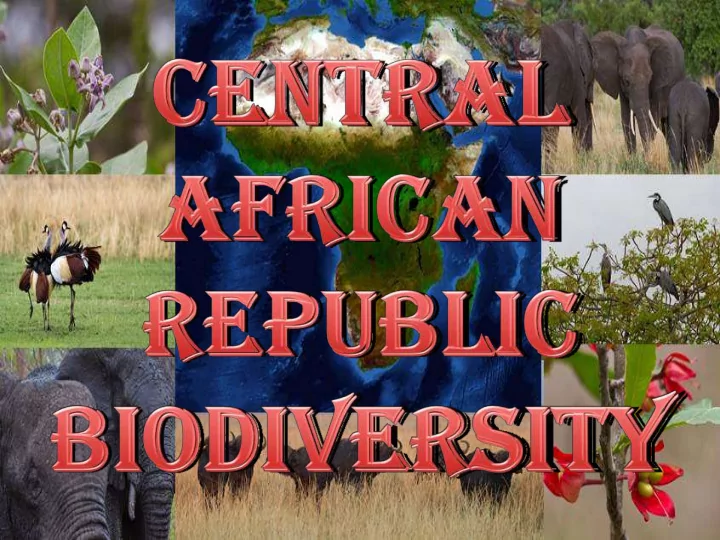
biodiversity? Biodiversity is the variety and differences among - - PowerPoint PPT Presentation
What is a biodiversity? Biodiversity is the variety and differences among living organisms from all sources, including terrestrial, marine, and other aquatic ecosystems and the ecological complexes of which they are a part.Thus, in
Biodiversity boosts ecosystem productivity where each species, no matter how small, all have an important role to play.
variety of crops.
sustainability for all life forms
can better withstand and recover from a variety of disasters.
dominate this planet, we still need to preserve the diversity in wildlife.
Republic (CAR) is a landlocked country in Central Africa. It borders Chad in the north, Sudan in the northeast, South Sudan in the east, the Democratic Republic of the Congo and Congo in the south, and Cameroon in the west. The CAR covers a land area of about 240,000 square miles (620,000 km2), and has an estimated population of about 4.4 million as of
city.
southwest contains luxuriant plant growth, with some trees reaching a height of 46 m (150 ft). Toward the north, the forest gradually becomes less dense, with wider patches of grassland, and eventually gives way to the rolling hills of the savanna, interrupted by taller growths along riverbeds.
The flora of the Central African Republic has not been very well studied at all, although at least 3600 species are known. However there are likely to be as many as 5000 species. The country is mainly dominated by Sudanian woodland, although a small area of Acacia dominates the Sahelian woodland in the extreme north. Many of the species which are endemic to the country are located in the hills of northeast.
lowland forest and secondary grassland interspersed with forest .Lowland forest exists in the southwest in the Dzangha- Sangha areas. Shrubs and bush vegetation is mostly confined in the extreme northern region.
Tropical forests cover 3.5 million hectare. The tropical forests contain luxuriant plant growth with hundreds of plant species. Woodland savannah mainly consists
paradoxa, Combretum spp., Acacia spp., An
africana, Isoberlinia doka, Terminalia spp., Khaya senegalensis ,Rafia sudanica and Borassus spp. along the rivers.
The African rain forest is home to many unique animals including the aardvark, bonobo (pygmy chimpanzee), common chimpanzee and gorilla as well as the duiker, bongo and bushbuck antelopes. Animal life is greatly varied in over relatively small areas in the rain forest; a 4-mile patch is capable of sustaining hundreds of species of birds, butterflies and amphibians.
Many of these cannot be found anywhere else, making the African rain forest an extremely important conservation environment. The pygmy hippopotamus, which makes its home solely in Sierra Leone and the Côte d'Ivoire's Bandama River, is classified as endangered by the International Union for Conservation of Nature, which estimates the remaining number at 3,000 individuals.
Threat to biodiversity in central African region
threat to the region's biodiversity is the commercial hunting of wildlife for the bush meat trade and the illegal ivory
include the destruction of forest habitats by timber companies, and the increase in the numbers of people clearing forests for agricultural
logging operations
poverty
governance and policy framework
forest management
network
species
genetic pool
soil
downstream
elephants, duikers) eliminated with consequential change in forest patterns and regeneration
Sustainable and equitable natural resource management is the key not just to the maintenance of biodiversity but equally to human development and well-being. Biodiversity conservation in Central Africa presents a difficult challenge. Habitat destruction, overexploitation of natural resources, invasive species and pollution all directly threaten the ecosystems
. Yet, conserving the unique and rich