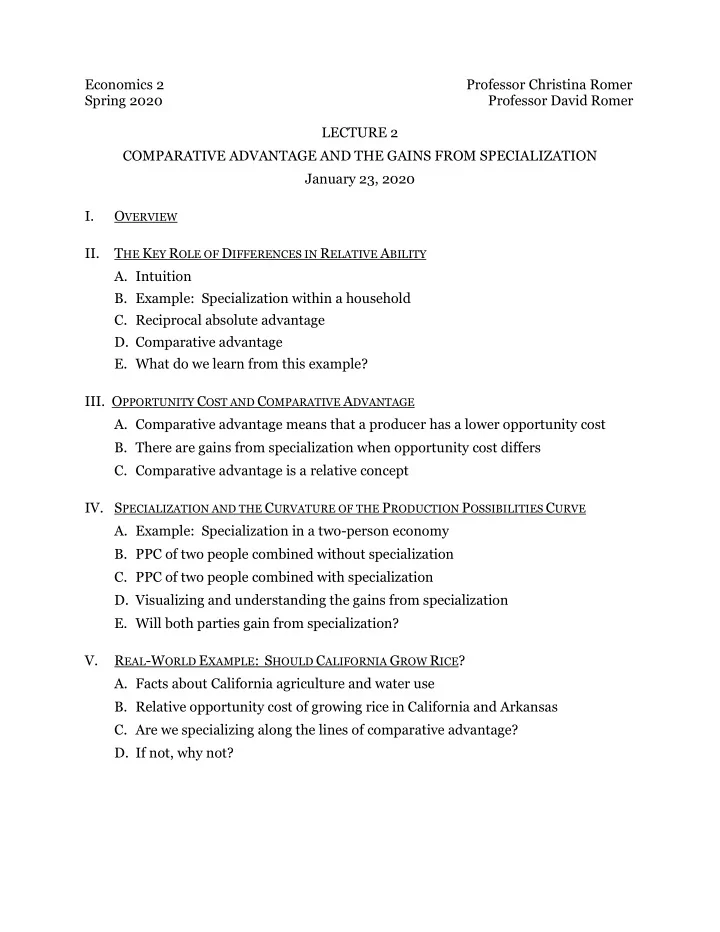
SLIDE 1 Economics 2 Professor Christina Romer Spring 2020 Professor David Romer LECTURE 2 COMPARATIVE ADVANTAGE AND THE GAINS FROM SPECIALIZATION January 23, 2020 I. OVERVIEW II. THE KEY ROLE OF DIFFERENCES IN RELATIVE ABILITY
- A. Intuition
- B. Example: Specialization within a household
- C. Reciprocal absolute advantage
- D. Comparative advantage
- E. What do we learn from this example?
- III. OPPORTUNITY COST AND COMPARATIVE ADVANTAGE
- A. Comparative advantage means that a producer has a lower opportunity cost
- B. There are gains from specialization when opportunity cost differs
- C. Comparative advantage is a relative concept
- IV. SPECIALIZATION AND THE CURVATURE OF THE PRODUCTION POSSIBILITIES CURVE
- A. Example: Specialization in a two-person economy
- B. PPC of two people combined without specialization
- C. PPC of two people combined with specialization
- D. Visualizing and understanding the gains from specialization
- E. Will both parties gain from specialization?
V. REAL-WORLD EXAMPLE: SHOULD CALIFORNIA GROW RICE?
- A. Facts about California agriculture and water use
- B. Relative opportunity cost of growing rice in California and Arkansas
- C. Are we specializing along the lines of comparative advantage?
- D. If not, why not?
SLIDE 2
LECTURE 2 Comparative Advantage and the Gains from Specialization
January 23, 2020
Economics 2 Christina Romer Spring 2020 David Romer
SLIDE 3 Announcements
- Reminder: please put away all electronic devices.
- It is essential that you attend section this week.
- Some hints on taking notes and reading the
textbook.
- Please talk loudly so that the whole class can hear.
SLIDE 5 Two Fundamental Building Blocks
- Scarcity, choice, and opportunity cost.
- Comparative advantage and the gains from
specialization.
SLIDE 6
- II. THE KEY ROLE OF DIFFERENCES IN
RELATIVE ABILITY
SLIDE 7 Example: Specialization within a Household
- Two activities: dishwashing and painting.
- There are 3 walls that need painting (and many
dirty dishes).
SLIDE 8
Reciprocal Absolute Advantage
Walls Dishes Abilities (per hour) C. 4 12 D. 2 20 No Specialization (Each paints ½ hr. and washes ½ hr.) C. 2 6 D. 1 10 3 16 Specialization (C. paints ¾ hr. and washes ¼ hr.; D. washes 1 hr.) C. 3 3 D. 20 3 23
SLIDE 9 Absolute Advantage
- Someone or something can produce more with a
given amount of resources.
SLIDE 10
Comparative Advantage
Walls Dishes Abilities (per hour) C. 4 24 D. 2 20 No Specialization (Each paints ½ hr. and washes ½ hr.) C. 2 12 D. 1 10 3 22 Specialization (C. paints ¾ hr. and washes ¼ hr.; D. washes 1 hr.) C. 3 6 D. 20 3 26
SLIDE 11 Comparative Advantage
- Someone or something is relatively more
productive at one activity than at another.
SLIDE 12 Messages
- Comparative advantage is necessary for there to
be gains from specialization.
- Reciprocal absolute advantage is just a special
case of comparative advantage.
SLIDE 13
- III. OPPORTUNITY COST AND COMPARATIVE
ADVANTAGE
SLIDE 14
Opportunity Cost and Comparative Advantage
Abilities (per hour) C. 4 walls or 24 dishes D. 2 walls or 20 dishes Opportunity Cost of 1 Wall C. 24/4 = 6 dishes D. 20/2 = 10 dishes Opportunity Cost of 1 Dish C. 4/24 = 1/6 wall D. 2/20 = 1/10 wall Lower opportunity cost implies comparative advantage.
SLIDE 15 Some Observations
- There are gains from specialization when
- pportunity cost differs.
- How much we want to specialize depends on how
many of the two activities need to be done.
- Comparative advantage is inherently a relative
concept.
SLIDE 16
- IV. SPECIALIZATION AND THE CURVATURE OF THE
PRODUCTION POSSIBILITIES CURVE
SLIDE 17 Example: Specialization in a Two-Person Economy
- Two goods: fish and coconuts.
- Abilities:
- In an hour, Robinson can catch 1 fish or
gather 1 coconut.
- In an hour, Friday can catch 8 fish or gather 2
coconuts.
- Each of them works 6 hours a day.
SLIDE 18 Production Possibilities Curve (PPC)
- Diagram showing the combinations of two types
- f goods that could be produced in an economy
just using all of the available inputs.
- In this case, the two goods are fish and coconuts.
- We will draw the PPC for a day.
- Recall, the slope of the PPC is (minus) the
- pportunity cost of the good on the horizontal
axis.
SLIDE 19 Opportunity Cost When Robinson and Friday Allocate Their Time the Same Way (No Specialization)
- In an hour, they could catch 9 fish (1 from
Robinson and 8 from Friday).
- Or they could gather 3 coconuts (1 from Robinson
and 2 from Friday).
- So, they trade off 9 fish for 3 coconuts.
- The opportunity cost of 1 coconut is 3 fish.
SLIDE 20
Island PPC without Specialization
00 Coconuts Fish 54 18
Slope is −3, because the opportunity cost of gathering 1 coconut for the two combined without specialization is 3 fish.
PPC
SLIDE 21 Individual Abilities and Opportunity Costs
- In an hour, Robinson could catch 1 fish or gather 1
coconut.
- So, the opportunity cost of having Robinson
gather 1 coconut is 1 fish.
- In an hour, Friday could catch 8 fish or gather 2
coconut.
- So, the opportunity cost of having Friday
gather 1 coconut is 4 fish.
- Robinson is the low opportunity cost provider of
coconuts.
SLIDE 22
Island PPC with Specialization
00 Coconuts Fish 54 18 PPC Slope = −4 Slope = −1 48 6
SLIDE 23
Gains from Specialization
00 Coconuts Fish 54 18 PPC with Specialization 48 6 PPC without Specialization Gains from Specialization
SLIDE 24 What do we learn from this example?
- There are gains from specialization when
- pportunity cost differs across producers and
production is organized according to comparative advantage.
- This explains why the PPC for a country is likely to
be bowed out.
- One determinant of the size of the gains from
specialization is the difference in opportunity cost.
SLIDE 25 Will Robinson and Friday both benefit from specialization?
- Simple Answer: As long as there is no coercion, if
two parties choose to specialize and trade, both must be benefitting.
- More complicated answer: In a market system,
prices will tend to adjust to ensure that both parties gain from specialization and trade.
SLIDE 26 Implications of the Gains from Specialization
- It explains why we see trade at all levels.
- To have trade, we need markets.
SLIDE 27
SHOULD CALIFORNIA GROW RICE?
SLIDE 28
Source: Congressional Research Service, “California Agricultural Production and Irrigated Water Use,” 2015.
SLIDE 29
Source, Congressional Research Service, “California Agricultural Production and Irrigated Water Use,” 2015.
SLIDE 30 Source: USA Rice Federation, https://www.usarice.com/resources/market-information.
U.S. Rice Production by State
In Thousand CWT | 2015-2017
SLIDE 31 Is California the low-opportunity-cost rice producer in the U.S.?
- What does California give up to grow rice?
- Or, to put it another way, what are the likely
alternative uses of the resources (particularly the scarce water) used to grow rice?
- What do other rice-compatible states (such as
Arkansas) give up to grow rice?
SLIDE 32
Source, Congressional Research Service, “California Agricultural Production and Irrigated Water Use,” 2015.
SLIDE 33 Given that California almost surely isn’t the low-opportunity-cost rice producer:
- Does it make sense that California has specialized
(to some degree) in rice production?
- What might explain why this has happened?