Economic Approach to International Affairs Advisor: Roman - - PDF document

economic approach to
SMART_READER_LITE
LIVE PREVIEW

Economic Approach to International Affairs Advisor: Roman - - PDF document

8/8/2009 John Tichotsky Economic Approach to International Affairs Advisor: Roman Abramovich, Head of Chukotka Parliament, Russia (private sector Energy Issues consultant) Arctic Research Consortium US Board member; Scott Polar


slide-1
SLIDE 1

8/8/2009 1

Economic Approach to Energy Issues

Lessons for Northeast Asia’s Young Leaders August 2009 John Tichotsky, Ph.D. (Cantab.)

Alaska Cambridge Group, LLC

John Tichotsky

  • International Affairs Advisor: Roman Abramovich, Head
  • f Chukotka Parliament, Russia (private sector

consultant)

  • Arctic Research Consortium US Board member; Scott

Polar Research Institute, University of Cambridge (UK); Institute of Social and Economic Research, University of Alaska; University of Hawaii, Alaska Pacific University

  • Director and CFO, gold exploration company; small-scale

developer (practical business experience)

  • Economist and Consultant specializing natural resource

economics (Russia, Mongolia, UK, US)

  • Fitch-IBCA, credit ratings
  • Education: Dartmouth College (USA); Jesus College,

University of Cambridge (UK)

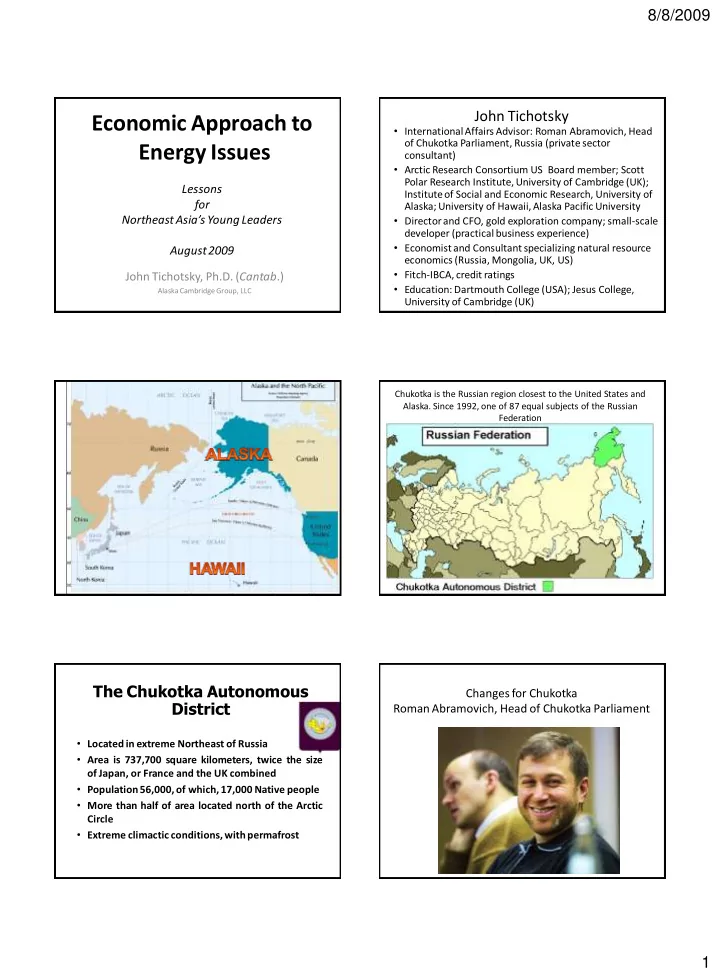
Chukotka is the Russian region closest to the United States and

  • Alaska. Since 1992, one of 87 equal subjects of the Russian

Federation

The Chukotka Autonomous District

  • Located in extreme Northeast of Russia
  • Area is 737,700 square kilometers, twice the size
  • f Japan, or France and the UK combined
  • Population56,000,of which,17,000 Native people
  • More than half of area located north of the Arctic

Circle

  • Extreme climactic conditions, withpermafrost

Changes for Chukotka Roman Abramovich, Head of Chukotka Parliament

slide-2
SLIDE 2

8/8/2009 2

Why isn’t this Economic Crisis like 1933?

FOREIGN TRADE…A GLOBAL ECONOMY

What happens during a Recession?

  • Correction in asset prices – mostly done?
  • Liquidity crisis – getting resolved?
  • Insolvency – in some sectors…
  • Complete collapse? Seems not yet…
  • Prices (overall, energy, commodities)– it

depends

– Deflation – Inflation – Stagflation (rising prices, stagnant economy)

  • Unemployment – already up in the US…

Business Cycle

A New US Energy Policy

Energy Plan is a “Green Plan”

  • “Invest in alternative

and renewable energy, end our addiction to foreign

  • il, address the global

climate crisis and create millions of new jobs.”

“New Energy for America” From US Policy Statement

  • Help create five million new jobs by strategically investing

$150 billion over the next ten years to catalyze private efforts to build a clean energy future.

  • Within 10 years save more oil than we currently import

from the Middle East and Venezuela combined.

  • Put 1 million Plug-In Hybrid cars -- cars that can get up to

150 miles per gallon -- on the road by 2015, cars that we will work to make sure are built here in America.

  • Ensure 10 percent of our electricity comes from

renewable sources by 2012, and 25 percent by 2025.

  • Implement an economy-wide cap-and-trade program to

reduce greenhouse gas emissions 80 percent by 2050.

slide-3
SLIDE 3

8/8/2009 3

$150 Billion?????

  • “Help create five million new

jobs by strategically investing $150 billion over the next ten years to catalyze private efforts to build a clean energy future.”

What is the real scale of the problem?

  • EXAMPLE: $45.22 Billion profit only for Exxon

Mobil for 2008

  • $150 billion OVER TEN YEARS = $15 billion a

year investment in a “clean energy future” seems to be a joke…

Major Integrated Oil Companies 2007

(Millions)

Source: CRS Report for Congress Oil Industry Profit Review 2007Robert Pirog, Specialist in Energy Economics, Resources, Science, and Industry Division April 4, 2008

Independent oil producers 2007

(millions)

Source: CRS Report for Congress Oil Industry Profit Review 2007Robert Pirog, Specialist in Energy Economics, Resources, Science, and Industry Division April 4, 2008

US POLICY: “Eliminate Our Current Imports from the Middle East and Venezuela within 10 Years”

  • Increase Fuel Economy Standards.
  • Get 1 Million Plug-In Hybrid Cars on the Road by

2015.

  • Create a New $7,000 Tax Credit for Purchasing

Advanced Vehicles.

  • Establish a National Low Carbon Fuel Standard.
  • A “Use it or Lose It” Approach to Existing Oil and

Gas Leases.

  • Promote the Responsible Domestic Production of

Oil and Natural Gas.

US Energy Dependence

slide-4
SLIDE 4

8/8/2009 4

CANADA 20% MEXICO 17% VENEZUELA 12% NIGERIA 11% ANGOLA 5% KUWAIT 2% IRAQ 6% SAUDI ARABIA 15%

Other 23% NORWAY 1% RUSSIA 1% BRAZIL 1% ECUADOR 3% ALGERIA 4% CHAD 1% UNITED KINGDOM 1%

US Crude Oil Imports (Top 15 Countries) 000s barrels

Source: EIA

Even if it were realistic or desirable to eliminate imports from Venezuela and Mid-East – what would that percentage be?

  • 60 percent TIMES 35 per cent =

21 percent

  • That means the US would have to

increase its domestic production 2% to 4% a year over ten years

US Policy Advisor Benjamin Franklin

“There never was a good war or a bad peace.”

A comparison of scale: How much did/does The War cost in terms of oil ?

Price per barrel

T

  • tal number of

barrels US imports per day Days of 100% subsidy of foreign oil

Years of 100% subsidy

  • f foreign
  • il

$150

5,333,333,333 10,055,153 530

1.45 $130

6,153,846,154 10,055,153 612

1.68 $100

8,000,000,000 10,055,153 796

2.18 $60 13,333,333,333 10,055,153

1326

3.63 $30 26,666,666,667 10,055,153

2652

7.27 $15 53,333,333,333 10,055,153

5304

14.53

If Americans were willing to spend billions and billions on The War – why don’t we want to spend billions and billions on The Recovery? The false dichotomy of Main Street versus Wall Street

slide-5
SLIDE 5

8/8/2009 5

Wasilla Main Street = Parks Highway

Capital Costs Changing American behavior

China USA- how do you cut gasoline consumption?

  • 1. High fuel price OR
  • 2. Lack of consumer

spending Europe

NEW CAFE Regulations 39 miles per gallon by 2016 $1200 per vehicle higher cost Electric cars are “green”- but where does/will the electricity come from?? Electrical Generation

slide-6
SLIDE 6

8/8/2009 6

Electricity generation by fuel

  • Coal continues as base fuel in US
  • Natural gas is number two
  • Environmental and Political pressure

to increase share of Nuclear, petroleum and renewable fuels generation

Who will produce these cars? Internal Combustion Engine Reliable Since 1885

PROBLEM OF EMISSIONS

Carbon Emissions and US Public

  • Public will exists to reduce emissions

that induce climate change.

  • Public will for change in US policy on

emissions

  • However,

“Conservation” and environment

  • Why do we need to conserve (preserve)

for conservation’s sake? –Do we need oil for “future generations”?

  • “Depleting non-renewable” resources to

generate energy is NOT SYNONOMOUS with emissions of greenhouse gases.

Conservation: PHYSICAL REALITIES

  • Energy cannot be created or

destroyed – it can only be TRANSFORMED from one form to another

E=mc2

slide-7
SLIDE 7

8/8/2009 7

SOURCES OF ENERGY AVAILABLE

  • Nuclear Fusion (SUN: Main source)

– Solar – Hydrocarbon fuel: coal, oil, natural gas (is all gas biotic?), ethanol – wind, hydro – fusion plants (future),

  • Nuclear Fission

– current nuclear plants

  • Gravity

– tidal and hydro (solar component))

Hydrogen? Hydrogen Basics

  • Hydrogen is not primary fuel, but method of

energy storage

  • Hydrogen does not occur freely in large

quantities.

  • Two ways to create free hydrogen

– Electrolysis – Reforming hydrocarbons (fossil fuels)

  • treatment of methane with steam
  • CH4 (g) + H2O + e > 3H2(g) + CO(g).
  • CO(g) carbon monoxide gas (greenhouse

gas).

  • What is the best way to store

hydrogen?

H2 or as a Liquid in combination with Carbon????

FORMS OF ENERGY FOR USE and STORAGE

  • We know how to USE energy
  • Better understanding ENERGY

STORAGE may be the breakthrough needed for our energy PROBLEMS… Liquid Hydrocarbons remain one of the most effective methods for transporting and storing energy

slide-8
SLIDE 8

8/8/2009 8 Capital Investment in New Energy Sources, New Energy Infrastructure or New Energy Technology

  • A promise of an upward trend demand in

energy, infrastructure and technology

  • A promise of an upward trend in prices, that is

represented by greater demand

  • OR much greater volume of demand with

falling prices – the process of commoditization.

LONG-TERM REALITIES

  • INVESTMENT

IN ALTERNATIVE ENERGIES AND NEW TECHNOLOGY

Investment in Alternative Energies

  • Problem if prices of traditional fuel is low –

what is the incentive??

  • Government funding potentially competes

with investment for conventional fuels and creates distortions to the markets.

  • Dampens anticipated long-term prices for

conventional fuels – but what is real outcome.

  • What role does economic crisis and

investment climate play in reality of such investment…

“Clean Coal” Technology

  • Carbon Capture
  • Using supercritical and ultra-supercritical

steam to reduce coal consumption at the plant

  • USA – 0

China- more than 40

Technology

  • Need recognition of the LONG TIME TO

IMPLEMENT from idea to mass use –At least 3 years from idea to proto- type –At least 3 years from proto-type to pilot plant –At least 2 years from pilot to mass use

  • f technology

–Elections cycles are much shorter…

Where does new technology come from?

  • Large corporation R&D
  • Universities and research

institutes

  • Government laboratories

(including military and space programs)

  • Entrepreneurs
slide-9
SLIDE 9

8/8/2009 9 White House Policy Reduce our Greenhouse Gas Emissions 80 Percent by 2050

  • Implement an economy-wide cap-and-trade

program to reduce greenhouse gas emissions 80 percent by 2050.

  • Make the U.S. a Leader on Climate Change.

North American’s Long term Natural Gas Dilemma

How can North America resolve its need for natural gas as demand is likely to increase?

http://www.npc.org/

US has the “reverse” Japan problem

www.energy.ca.gov/lng/worldwide_asia_pacific.html

Pipelines in US

US Natural Gas Imports and Exports

Source: Energy Information Administration, based on data from the Office of Fossil Energy , U.S. Department of Energy, Natural Gas Imports and Exports.

slide-10
SLIDE 10

8/8/2009 10

Japan has 23 LNG import terminals and South Korea has three.

Why doesn’t Japan have an internal trunk pipeline system like South Korea?

http://www.inpex.co.jp/english/business/japan/img/japa n_map02.gif

NORTHEAST ASIA MARKET

Alaska already part of Northeast Asia’s energy infrastructure LNG to Japan since 1969

www.energy.ca.gov/lng/photos.html

Natural Gas Reserves Production Ratio

http://www.bp.com/liveassets/bp _internet/globalbp/globalbp_uk_e nglish/reports_and_publications/st atistical_energy_review_2008/STA GING/local_assets/downloads/pdf /natural_gas_section_2008.pdf

US Long-term trend natural gas prices

http://tonto.eia.doe.gov/dnav/ng/hist/n9190us3m.htm

slide-11
SLIDE 11

8/8/2009 11 Is the solution MORE LNG to US Markets?

www.alaskagaslineportauthority.com

MORE LNG TERMINALS ARE NOT REALLY POSSIBLE, SINCE PEOPLE ON WEST COAST ARE AFRAID OF LNG

http://www.raceforcleanenergy.org/img/original/f6_nopipeline.jpg http://www.bbidisplays.com/images/LNG-Pierce_Brosnan.jpg

LNG Terminal in BAJA CALIFORNIA, Mexico

Gas from Arctic Alaska and Canada

http://www.neb.gc.ca/clf- nsi/rpblctn/spchsndprsnttn/2007/hy drcrbn/hydrcrbn-eng.html

All about scale

  • Alaska gas pipeline is now estimated

as high as $40 Billion

  • Proposed pipeline would initially be

designed to carry 4.5 Bcf/d of natural gas at an operating pressure of 2,500 psig.

  • Federal guarantee (2006) of $18

Billion for 80% is NOW TOO SMALL How the North Slope and Mackenzie tie into US Natural gas transmission

http://www.transcanada.com/investor/annual_reports/2008/comm

  • n/images/mda/pipeline_map-transmissions.png
slide-12
SLIDE 12

8/8/2009 12

Relevance - Scale

  • f project is on
  • rder of most

Northeast Asian gas pipeline projects

Source: eneken.ieej.or.jp/en/data/pdf/240.pdf

Canada-US Movement of Natural Gas

http://www.neb.gc.ca/clf- nsi/rnrgynfmtn/nrgyrprt/trnsprttn/trnsprttnssssmnt2008/trnsprttnss ssmnt2008-eng.html

Canada-US Relations 1814-1850 WHERE WILL THE MONEY FOR ENERGY INFRASTRUCTURE COME FROM?? Ex-Governor Sarah Palin of Alaska

GOVERNOR PALIN and the GAS PIPELINE

  • Alaska Legislature passes Law Alaska Gasline

Inducement Act (AGIA) and approves TransCanada application - an energy transportation company - (2008). –Comes with $500 million from State of Alaska

  • Legislation changed net profits tax from

22.5% to 25%

  • Why not a contract with the producers (BP,

Exxon, Conoco-Phillips)?

slide-13
SLIDE 13

8/8/2009 13

A Trans-Alaska –Canada Gas Pipeline needs “The Producers”

  • This is

recognized by TransCanada,

  • NOT

recognized by much of Alaska political leadership...

“The Producers” - North Slope Alaska Natural gas ownership

BP 24% Exxon 37% Conoco- Phillips 37%

  • ther

2%

“Prioritize the Construction of the Alaska Natural Gas Pipeline.” President Obama

www.ctv.ca

Potential of Methane Hydrates Lessons for Northeast Asia

  • Energy Infrastructure is constrained at the

level of demand no greater than Year 2002 at historic prices (Average $15 real 1985).

  • Governments are stressed by current

commitments for economic crisis

  • Private capital is risk adverse
  • Natural Gas prices are down
  • “Paradigm shift” in markets

– Not opposed to the idea – But most of the time the fundamentals are the best explanation….

Will Russia change its strategy of excluding or reducing foreign investors, while funding its own development?

slide-14
SLIDE 14

8/8/2009 14

Why is multi-lateral worse than bi-lateral? Why avoid Mongolia to deliver Kovykta Gas to China?

North Korean Pipeline Corridor?

Robert Malthus – Protect Fair Domestic Price

  • It would be dangerous

for Britain to rely on imported corn - lower prices since it would reduce workers wages and manufacturers would lose out due to the fall in purchasing power of landlords and farmers

David Ricardo Comparative Advantage

  • Free trade will allow

Britain could use its capital and population efficiently to utilize the countries comparative advantage.

  • Price is a tool for

determining amount and mix of imports and domestic production.

More Ricardo…

  • Main argument against trade and

price control is that these policies are ultimately COSTLYto nation.

  • Are government planners any better
  • r worse at guessing prices than

speculators ?

“No nation was ever ruined by trade.” US Policy Advisor Benjamin Franklin

slide-15
SLIDE 15

8/8/2009 15

Avoiding the Managerial Revolution