
SLIDE 1
Philippines policy dialogue
Shuvojit Banerjee Macroeconomic Policy and Financing for Development Division
4 June 2020
Economic and Social Survey
- f Asia and the Pacific 2020
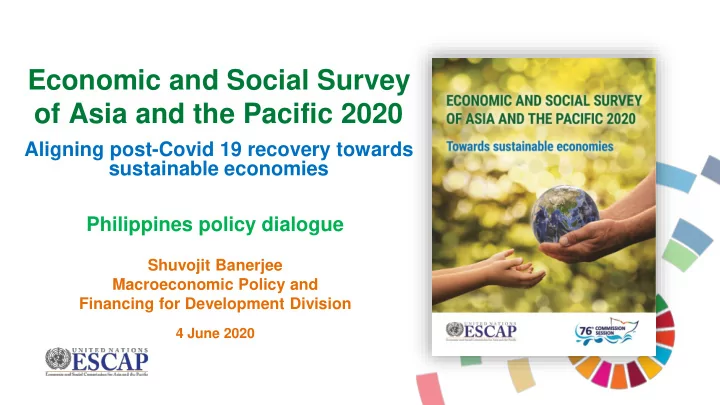
Economic and Social Survey of Asia and the Pacific 2020 Aligning - - PowerPoint PPT Presentation
Economic and Social Survey of Asia and the Pacific 2020 Aligning post-Covid 19 recovery towards sustainable economies Philippines policy dialogue Shuvojit Banerjee Macroeconomic Policy and Financing for Development Division 4 June 2020 Key
Shuvojit Banerjee Macroeconomic Policy and Financing for Development Division
4 June 2020
production and environmental well-being… …the economic growth-centric development approach should be revisited
… but the policy responses should prioritize people over economic recovery and the journey towards the 2030 Agenda should continue
long-term vision… …through collective policy actions led by Governments and supported by businesses and people along with enhanced global and regional cooperation
comprehensive fiscal package to meet the short-term impacts of the pandemic ….however going forward greater spending will be required to ensure future health preparedness and improve social protection, as well as decarbonizing the economy
50 100 150 200 250 2000 2001 2002 2003 2004 2005 2006 2007 2008 2009 2010 2011 2012 2013 2014 2015 2016 2017 2018 2019 Index, 2000 = 100
Economic growth and its social impact in Asia and the Pacific
Source: ESCAP data portal (accessed on 4 December 2019); ESCAP calculation based on World Bank, PovcalNet, available at http://iresearch.worldbank.org/PovcalNet/home.aspx (accessed on 13 February 2020); IMF, World Economic Outlook database, October 2019 (accessed on 4 December 2019); Global Carbon Atlas, available at www.globalcarbonatlas.org/en/CO2-emissions (accessed on 13 February 2020).
GDP per capita Employment Poverty headcount ($1.90 per day)
50 100 150 200 50 100 150 200 250 2000 2001 2002 2003 2004 2005 2006 2007 2008 2009 2010 2011 2012 2013 2014 2015 2016 2017 2018 2019 Index, 2000 = 100
Economic growth and its social impact in Asia and the Pacific
Source: ESCAP data portal (accessed on 4 December 2019); ESCAP calculation based on World Bank, PovcalNet, available at http://iresearch.worldbank.org/PovcalNet/home.aspx (accessed on 13 February 2020); IMF, World Economic Outlook database, October 2019 (accessed on 4 December 2019); Global Carbon Atlas, available at www.globalcarbonatlas.org/en/CO2-emissions (accessed on 13 February 2020). Note: LHS = left-handed side axis; RHS = right-handed side axis.
GDP per capita
(LHS)
Poverty headcount ($3.20 per day)
(RHS)
Poverty headcount ($5.50 per day)
(RHS)
Poverty headcount ($1.90 per day)
(RHS) Index, 2000 = 100
Top 1% Next 9% Middle 40% Bottom 50% Top 10% Share of income (pre-tax national income) by income groups in Asia
Source: WID (accessed 3 October 2019)
0% 10% 20% 30% 40% 50% 60% 70% 80% 90% 100% 1980 1982 1984 1986 1988 1990 1992 1994 1996 1998 2000 2002 2004 2006 2008 2010 2012 2014 2016
100 120 140 160 180 200 220 240 2000 2001 2002 2003 2004 2005 2006 2007 2008 2009 2010 2011 2012 2013 2014 2015 2016 2017 2018 2019 Index, 2000 = 100
Growth of resource use and CO2 emissions in Asia and the Pacific, 2000-2019
Source: ESCAP data portal (accessed on 4 December 2019); ESCAP calculation based on World Bank, PovcalNet, available at http://iresearch.worldbank.org/PovcalNet/home.aspx (accessed on 13 February 2020); IMF, World Economic Outlook database, October 2019 (accessed on 4 December 2019); Global Carbon Atlas, available at www.globalcarbonatlas.org/en/CO2-emissions (accessed on 13 February 2020).
Domestic resource use CO2 emissions
Source: ESCAP data portal (accessed on 2 May 2020); ESCAP calculation based on World Bank, PovcalNet, available at http://iresearch.worldbank.org/PovcalNet/home.aspx (accessed on 13 February 2020); IMF, World Economic Outlook database, October 2019 (accessed on 4 December 2019); Global Carbon Atlas, available at www.globalcarbonatlas.org/en/CO2-emissions (accessed on 13 February 2020); UNEP-IRP, Global Material Flows Database (accessed 2 May 2020).
60 80 100 120 140 160 180 200 2000 2003 2006 2009 2012 2015 2018 Index, 2000 = 100
CO2 emissions Poverty headcount ($5.50 per day) Poverty headcount ($3.20 per day)
Poverty headcount ($1.90 per day)
GDP per capita Employment Domestic resource use
Economic growth and its social and environment impact in the Philippines
Snapshot of SDG progress in 2019: Asia-Pacific region
Source: ESCAP (2020). Asia and the Pacific SDG Progress Report 2020.
8 Key Targets focusing on sustainable...
Business Practices & Reporting Green Public Procurement Resource Management Living Tourism Market Mechanism Finance
Synergies between Goal 12 and other Goals
2.3 Double agricultural productivity and incomes of small-scale food producers 2.4 Ensure sustainable food production systems and resilient agricultural practices 7.2 Energy efficiency 7.3 Renewable energy 6.3 Water quality 6.4 Water-use efficiency 4.7 education for sustainable development and sustainable lifestyles.. 8.4 Global resource efficiency for sustained economic growth. 11.6 Environmental impact of cities 11.B Resource efficiency for disaster risk management 13.2 Integrate climate change measures into national policies, strategies and planning 14.2 Sustainably manage and protect marine and coastal ecosystems 15.1 Use of ecosystems 15.3 Restoration of degraded land 15.9 Ecosystems and biodiversity in planning 9.4 Upgrade infrastructure and retrofit industries 9.A Sustainable and resilient infrastructure in developing countries
Source: One Planet Network, 2019.
fuels
carbon
for externalities
habits
awareness
LAYOFF WORKERS
Measures to Contain COVID-19
(e.g. travel restrictions, suspension of production, and lockdown of cities)
PEOPLE FIRMS
SMEs are more vulnerable.
FINANCIAL MARKETS
Stock markets and foreign exchange markets
Higher demand for Healthcare Disruptions in Supply Chains Lower demand for Commodities
Lower demand for Goods and Services
(Tourism, Hospitality, Civil Aviation)
Affect commodity importers and exporters Affect other countries’ manufacturers in supply chains People mobility to affect
Potential financial contagion
LOWER EARNINGS
DEMAND SIDE CHANNEL SUPPLY SIDE CHANNEL FINANCIAL MARKET CHANNEL CROSS-BORDER CHANNEL Source: ESCAP.
Source: ESCAP, based on DESA’s World Economic Forecasting Model (based on data and information available up to 27 April 2020).
Downgrade of GDP growth in Asia and the Pacific
Fiscal policies: Large and targeted fiscal measures to contain and respond to COVID-19, and to ease the shock to jobs and guarantee minimum living standards
Size of fiscal support packages (as a share of GDP) by country grouping
Source: ESCAP, based on information available up to 1 May 2020 from IMF Policy Responses to COVID-19, ILO COVID-19 Country Policy Responses, OECD Country Policy Tracker, and various national sources. Note: If a country announced a fiscal stimulus package but did not reveal its size, then it is not included in calculating the range and the median.
The government launched a PHP 595.6 billion fiscal package (about 3.1 percent of 2019 GDP) for vulnerable individuals and groups, which includes the following measures: (1) PHP 205 billion cash aid program (1.1 percent of 2019 GDP) for 18 million low-income households, under which eligible households are expected to receive cash transfers of between PHP 5,000 and PHP 8,000 a month for a period of two months; (2) Over PHP 56 billion social protection measures for vulnerable workers, including for displaced and overseas Filipino workers (0.3 percent of 2019 GDP); (3) Over PHP 54 billion on COVID-19-related medical response (0.3 percent of 2019 GDP); and (4) PHP 120 billion (0.6 percent of 2019 GDP) credit guarantee for small businesses and support to the agriculture sector. Financial assistance will also be provided to affected micro-, small-, and medium-size enterprises (MSMEs) and vulnerable households through specialized microfinancing loans and loan restructuring.
Source: IMF, Policy Response to COVID-19 (accessed 25 May 2020).
Investment needs in health emergency preparedness: Asia-Pacific developing countries
Source: ESCAP estimates, based on WHO SDG Health Price Tag.
100 200 300 400 500 600 700 800 900 1 000 2020 2021 2022 2023 2024 2025 2026 2027 2028 2029 2030 Millions of United States dollars South-East Asia South Asia China and other Asia
Public spending on social protection, as a share of GDP
Source: ESCAP, Economic and Social Survey 2019.
Additional annual investment needs to provide social protection floor in the Philippines
Source: ESCAP.
0.0 0.2 0.4 0.6 0.8 1.0 1.2 1.4 The Philppines
Percentage of GDP
Universal old-age pension benefits Universal disability benefits Universal unemployment benefits Universal maternity benefits Universal child benefits
Annual additional investment requirements to achieve the 2030 Agenda in the Philippines
Source: ESCAP, Economic and Social Survey 2019.
0.0 0.1 0.2 0.3 0.4 0.5 0.6 ICT Water and sanitation Percentage of GDP Additional annual investment needs to enhance climate resilience Additional annual investment needs
Difference between October 2019 and April 2020 projections of fiscal balance in 2020
Source: ESCAP, based on latest World Economic Outlook database.
Monetary policies: Targeted monetary easing to ensure overall financial sector health and support SMEs
Changes in policy rates since the beginning of 2020
Other measures by the Bangko Sentral ng Pilipinas:
1) Reserve requirement ratio cuts (by 200 bps) 2) Open market operation (purchase of PHP300 billion govt securities (1.5% of GDP)) 3) Temporary relaxation of requirements on compliance reporting, penalties on required reserves, and single borrower limits 4) Easier access to the BSP’s rediscounting facility 5) Temporary relaxation of provisioning requirements 6) Relaxation of prudential regulations regarding marking- to-market of debt securities 7) Loans to MSMEs to be counted as part of banks’ compliance with reserve requirements 8) Zero risk weight on loan exposures guaranteed by the Philippine Guarantee Corporation
Source: ESCAP, based on information available up to 1 May 2020 from IMF Policy Responses to COVID-19, ILO COVID-19 Country Policy Responses, and various national sources. Note: *For Viet Nam, its Central Bank cut benchmark policy rates by 50-100 basis points, effective on March
Fiscal policies:
and to ease the shock to jobs and guarantee minimum living standards
Monetary policies
Regional cooperation
Domestic material consumption GHG emissions
100 110 120 130 140 150 160 170 180
2020 2030 2040 2050 2060
Index, 2020 = 100
Domestic material consumption and GHG emissions in 2020-2060, compared with 2020 levels
Source: ESCAP, ESCAP, based on methodology in UNEP International Resource Panel’s Global Resource Outlook 2019.
GOVERNMENTS Businesses Consumers Cross-border cooperation
100 200 300 400 500
Fossil fuel subsidies (in 2018) Investment in renewable (in 2018) Average annual investment needed to achieve affordable and clean energy
Billion United States dollars
$240 billion
$150 billion
Source: ESCAP (2020 and 2019), IMF (2019) Note: Fossil-fuel subsidies or only post-tax. All pre-tax subsidies according to the definition of the IWF have been discontinued.
Fossil-fuel subsidies accounted for 3.4%
Source: ESCAP, based on IMF (2019g)
10 20 30 40 50 60 Percentage reduction
below business as usual in 2030
Reductions in carbon emissions
Based on $35 per ton Additional amount based on $70 per ton 0.5 1 1.5 2 2.5 3 3.5 4 Percentage of GDP in 2030
Carbon tax revenue
Based on $35 per ton Additional amount based on $70 per ton
implemented in the Philippines yet and plans for doing so have been discontinued
excise taxes on carbon intensive products (petroleum, cars, coal)
taxes would lead to carbon prices between US$ 1.60 for coal and US$ 95 for gasoline
Source: rappler.com (2018)
Financial Incentives
green projects
government guarantees
Regulatory Incentives
reporting, disclosure and transition through TCFD and NGFS
The Bangko Sentral ng Pilipinas is not a member of NGFS.
by Aboitiz Power Cooperation in 2016
Unibank who launched a US$150 million green bond backed by the IFC
renewable energy generation, saving
are expected to reach US$2 billion in 2020
Commission has issued green bond standards in line with ASEAN guidelines in August 2018
Source: IFC (2019), citi (2019)
GOVERNMENTS Businesses Consumers Cross-border cooperation
Environment
Social
slavery
communities globally
Governance
Guidelines to integrate ESG into business functions Participation in PRI in Asia-Pacific is only
There are 0 signatories from the Philippines currently.
TCFD Signatories
Developed Asia-Pacific Developing Asia-Pacific Other regions
57%
34%
Source: Aboitiz (2020), TCFD
the use of or plan to implement carbon pricing are in Asia-Pacific
The real-estate company Ayala Land is the first in the Philippines to adopt internal carbon pricing.
Source: CDP (2017)
GOVERNMENTS Businesses Consumers Cross-border cooperation
Plant-based diet and eating what you need Animal-based diet and food waste Biking, ride-sharing and commuting on public transportation
Source: World Bank Group, ADB (2019)
0.6 0.7 0.8 0.9 1 1.1 2005 2006 2007 2008 2009 2010 2011 2012 2013 2014
CO2 Emissions (metric tons per capita)
Metro Manila is the most congested city in developing Asia (out of 279 cities).
Mandatory energy labels on electric appliances in Singapore
AirBnb OWTO Foodpanda Ringle
GOVERNMENTS Businesses Consumers Cross-border cooperation
❑ Establish cooperation on regional climate-related policies
▪ Harmonize climate-related standards among countries ▪ Cooperate on climate-risk management
❑ Establish cooperation on regional climate-related policies ❑ Move towards decarbonization
▪ Develop regional carbon markets ▪ Scale up transboundary power trade
Energy Efficiency in the Philippines has improved since the beginning of the 2000s
❑ Establish cooperation on regional climate-related policies ❑ Move towards decarbonization ❑ Implement 10-Year Framework of Programmes on SCP
The Philippines has already made progress implementing 10YFP, especially eco-labeling
Source: climateactiontracker.com
The Philippines’ commitment is rated at 2°C compatible but is not sufficient to stay within the 1.5°C Paris Agreement limit The Philippines aims to reduce carbon emissions by 70% in 2030 compared to the business as usual scenario
GOVERNMENTS Businesses Consumers Cross-border cooperation
the immediate impacts of the pandemic
need to build back better
preparedness and greater social protection for vulnerable groups, while also taking steps to decarbonize the economy
strong fiscal position and good macroeconomic management
that prioritizes people and the planet… …which is critical as the region is facing a climate emergency
action);
should be more mindful of their lifestyles (people action); and
solutions (global action).
Towards sustainable economies
Please visit https://www.unescap.org/publi cations/economic-and-social- survey-asia-and-pacific-2020
UNESCAP UNESCAP UNESCAP UNITEDNATIONSESCAP UNITEDNATIONSESCAP