
SLIDE 1
Policy Dialogue with the Economic Research Institute for ASEAN and East-Asia Zheng Jian Macroeconomic Policy and Financing for Development Division
10 June 2020
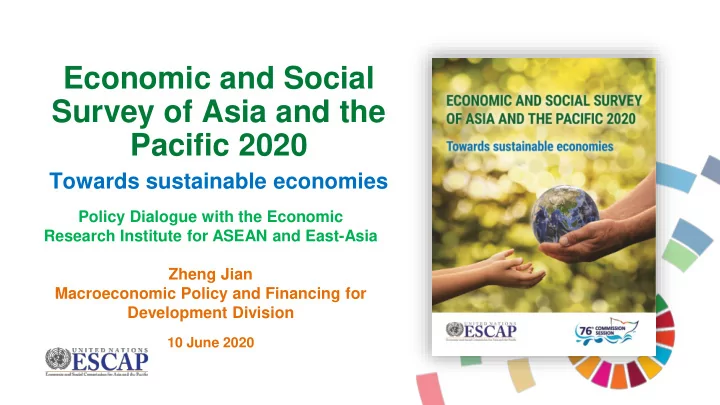
Economic and Social Survey of Asia and the Pacific 2020 Towards - - PowerPoint PPT Presentation
Economic and Social Survey of Asia and the Pacific 2020 Towards sustainable economies Policy Dialogue with the Economic Research Institute for ASEAN and East-Asia Zheng Jian Macroeconomic Policy and Financing for Development Division 10
Policy Dialogue with the Economic Research Institute for ASEAN and East-Asia Zheng Jian Macroeconomic Policy and Financing for Development Division
10 June 2020
The transformation towards an inclusive and sustainable economy is a primary development challenge for the Asia-Pacific region. Paradigm shifts in our consumption and production patterns would be central for achieving this objective. Sustainable consumption and production would require collective efforts of all stakeholders on four action fronts:
The COVID-19 crisis brings immense challenges for inclusive and sustainable development, but we can also turn it into a valuable opportunity
50 100 150 200 50 100 150 200 250 2000 2001 2002 2003 2004 2005 2006 2007 2008 2009 2010 2011 2012 2013 2014 2015 2016 2017 2018 2019 Index, 2000 = 100
Economic growth and its social impact in Asia and the Pacific
Source: ESCAP data portal (accessed on 4 December 2019); ESCAP calculation based on World Bank, PovcalNet, available at http://iresearch.worldbank.org/PovcalNet/home.aspx (accessed on 13 February 2020); IMF, World Economic Outlook database, October 2019 (accessed on 4 December 2019); Global Carbon Atlas, available at www.globalcarbonatlas.org/en/CO2-emissions (accessed on 13 February 2020). Note: LHS = left-handed side axis; RHS = right-handed side axis.
GDP per capita
(LHS)
Poverty headcount ($3.20 per day)
(RHS)
Poverty headcount ($5.50 per day)
(RHS)
Poverty headcount ($1.90 per day)
(RHS) Index, 2000 = 100
Top 1% Next 9% Middle 40% Bottom 50% Top 10% Share of income (pre-tax national income) by income groups in Asia
Source: WID (accessed 3 October 2019)
0% 10% 20% 30% 40% 50% 60% 70% 80% 90% 100% 1980 1982 1984 1986 1988 1990 1992 1994 1996 1998 2000 2002 2004 2006 2008 2010 2012 2014 2016
Share of income (pre-tax national income) by income groups in Asia
Source: WID (accessed 3 October 2019)
0% 2% 4% 6% 8% 10% 12% 14% 16% 18% 20% 1980 1982 1984 1986 1988 1990 1992 1994 1996 1998 2000 2002 2004 2006 2008 2010 2012 2014 2016 Bottom 50% Top 1%
Income groups
Source: ESCAP (2020). Asia and the Pacific SDG Progress Report 2020.
100 120 140 160 180 200 220 240 2000 2002 2004 2006 2008 2010 2012 2014 2016 2018 Index, 2000 = 100 DMC CO2 emissions
Natural resource use and carbon emissions have more than doubled since 2000, and will continue to rise albeit at slower pace
Domestic material consumption and CO2 emissions in Asia-Pacific region
Source: ESCAP data portal (accessed on 4 December 2019); ESCAP calculation based on World Bank, PovcalNet, available at http://iresearch.worldbank.org/PovcalNet/home.aspx (accessed on 13 February 2020); IMF, World Economic Outlook database, October 2019 (accessed on 4 December 2019); Global Carbon Atlas, available at www.globalcarbonatlas.org/en/CO2-emissions (accessed on 13 February 2020).
100 110 120 130 140 150 160 170 180 2020 2030 2040 2050 2060 Index, 2020 = 100
Source: ESCAP, based on methodology in UNEP International Resource Panel’s Global Resource Outlook 2019.
Source: ESCAP, based on UNDP Human Development Data and Global Footprint Network (accessed on 29 February 2020)
2.3 Double agricultural productivity and incomes of small-scale food producers 2.4 Ensure sustainable food production systems and resilient agricultural practices 7.2 Energy efficiency 7.3 Renewable energy 6.3 Water quality 6.4 Water-use efficiency 4.7 Education for sustainable development and sustainable lifestyles 8.4 Global resource efficiency for sustained economic growth. 11.6 Environmental impact of cities 11.B Resource efficiency for disaster risk management 13.2 Integrate climate change measures into national policies, strategies and planning 14.2 Sustainably manage and protect marine and coastal ecosystems 15.1 Use of ecosystems 15.3 Restoration of degraded land 15.9 Ecosystems and biodiversity in planning 9.4 Upgrade infrastructure and retrofit industries 9.A Sustainable and resilient infrastructure in developing countries Source: One Planet Network, 2019.
GOVERNMENTS Businesses Consumers Cross-border cooperation
…requires collective actions of ALL STAKEHOLDERS
100 200 300 400 500
Fossil fuel subsidies (in 2018) Investment in renewable (in 2018) Average annual investment needed to achieve affordable and clean energy
Billion United States dollars
$240 billion
$150 billion
Source: ESCAP (2020 and 2019), IMF (2019) Note: Fossil-fuel subsidies or only post-tax. All pre-tax subsidies according to the definition of the IWF have been discontinued.
Indonesia and Malaysia respectively spend 1.7% and 0.5% of GDP on fossil fuel subsidies
Source: ESCAP, based on IMF (2019g)
10 20 30 40 50 60 Percentage reduction
below business as usual in 2030
Reductions in carbon emissions
Based on $35 per ton Additional amount based on $70 per ton 0.5 1 1.5 2 2.5 3 3.5 4 Percentage of GDP in 2030
Carbon tax revenue
Based on $35 per ton Additional amount based on $70 per ton
percent of GDP on average from 2012-2014, to an average of 0.9 percent of GDP from 2015-2018
the Philippines yet and plans for doing so have been discontinued
carbon intensive products (petroleum, cars, coal)
Trading System (ETS)
(Thailand V-ETS)
between $10 and $15/tCO2e by 2030.
Financial Incentives
green projects
government guarantees
Regulatory Incentives
reporting, disclosure and transition through TCFD and NGFS
The Bank of Indonesia is a member of NGFS.
Sustainability- related guidelines
reporting guidelines
Good Governance
Governance Code
Association(TBA) and Bank of Thailand(BOT)
Banking Guidelines- Responsible Lending
BSP announced its sustainable finance framework, circular #1085 on April 29, 20
Malaysia(SC)
Responsible Investment Sukuk Framework
Berhad
Reporting Guide
(BNM)
Intermediation Financing and Investment Impact Assessment Framework for Islamic banking
Authority of Indonesia
regulation on sustainable finance – POJK 60 and guidelines on green bonds, sustainable banking and blended finance schemes
Partnership with IFC
(since 2012)
BOT to accelerate sustainable financing in Thailand (2019)
Pilipinas and IFC on SBN (since 2013)
Environment and Natural Resources
(DEPN) on SBN (since 2013)
via the SBN (since 2012). Important project:
Case Study
Capacity building and knowledge- sharing platforms
Environment
Social
slavery
communities globally
Governance
Guidelines to integrate ESG into business functions Participation in PRI in Asia-Pacific is only
Indonesia: 5 Singapore: 31 Thailand: 10 Malaysia: 9 Vietnam: 1
None in other ASEAN countries
TCFD Signatories
Developed Asia-Pacific Developing Asia-Pacific Other regions
57%
34%
Source: Aboitiz (2020), TCFD
the use of or plan to implement carbon pricing are in Asia-Pacific
Source: CDP (2017)
As of 2017, 8 Thai and 1 Filipino companies have adopted or plan to adopt internal carbon pricing None from Indonesia and Malaysia
Sources: ESCAP based on BPS - Statistics Indonesia; ADB (2016)
pollutants and 23% of GHG emissions.
Mandatory energy labels on electric appliances in Singapore
AirBnb Deliveree Gojek Ruang guru
❑ Establish cooperation on regional climate-related policies
▪ Harmonize climate-related standards among countries ▪ Cooperate on climate-risk management
❑ Establish cooperation on regional climate-related policies ❑ Move towards decarbonization
▪ Develop regional carbon markets ▪ Scale up transboundary power trade
❑ Establish cooperation on regional climate-related policies ❑ Move towards decarbonization ❑ Implement 10-Year Framework of Programmes on SCP
consumer information on sustainability and (3) eco-tourism
Nations (ASEAN)
Not a crisis due to economic mismanagement, frictions or inefficiency
A shock to the physical feasibility of consumption and production
The poor and the working class taking the brunt of the hit
A truly global crisis
Health emergency management
Policies to support households and stabilize the economy
Post-pandemic economic recovery policies
Global cooperation
Setbacks and new challenges
New hopes
sustainable development
production and consumption
sustainability
multilateralism
Put people rather than GDP figures first in all our policy responses
economic healthiness, social-economic inclusiveness, and environmental sustainability
Prioritize investments that kill two birds with one stone, especially in the recovery phase
environmental benefits
Use the opportunity to increase public awareness and rally public support
Without paradigm shifts in our consumption and production patterns, it is very likely that Asia and the Pacific would fall far short of the environmental sustainability objectives of the 2030 Agenda for Sustainable Development. Collective action by all stakeholders is not an option, but a necessity for the region to achieve SDG12 on sustainable consumption and production. The COVID-19 crisis provides a golden opportunity for us to reflect on the balance between and the interdependence of the economic, social and environmental pillars, and deviate from the GDP-centric development approach. Smart policy choices that respond to both short and long-term policy drives, seek synergy in economic, social and environmental gains, and fit the local realities would have the best chance in promoting post-COVID progresses on sustainable development.
Towards sustainable economies
Please visit https://www.unescap.org/publi cations/economic-and-social- survey-asia-and-pacific-2020
UNESCAP UNESCAP UNESCAP UNITEDNATIONSESCAP UNITEDNATIONSESCAP