ECO 199 B GAMES OF STRATEGY Spring Term 2004 B March 4 ASYMMETRIC - - PDF document

eco 199 b games of strategy spring term 2004 b march 4
SMART_READER_LITE
LIVE PREVIEW

ECO 199 B GAMES OF STRATEGY Spring Term 2004 B March 4 ASYMMETRIC - - PDF document

ECO 199 B GAMES OF STRATEGY Spring Term 2004 B March 4 ASYMMETRIC INFORMATION DIRECT COMMUNICATION Works if players have identical interests, for example in assurance-type games can achieve good outcome Rousseaus Stag Hunt game Barny Stag


slide-1
SLIDE 1

ECO 199 B GAMES OF STRATEGY Spring Term 2004 B March 4 ASYMMETRIC INFORMATION DIRECT COMMUNICATION Works if players have identical interests, for example in assurance-type games can achieve good outcome

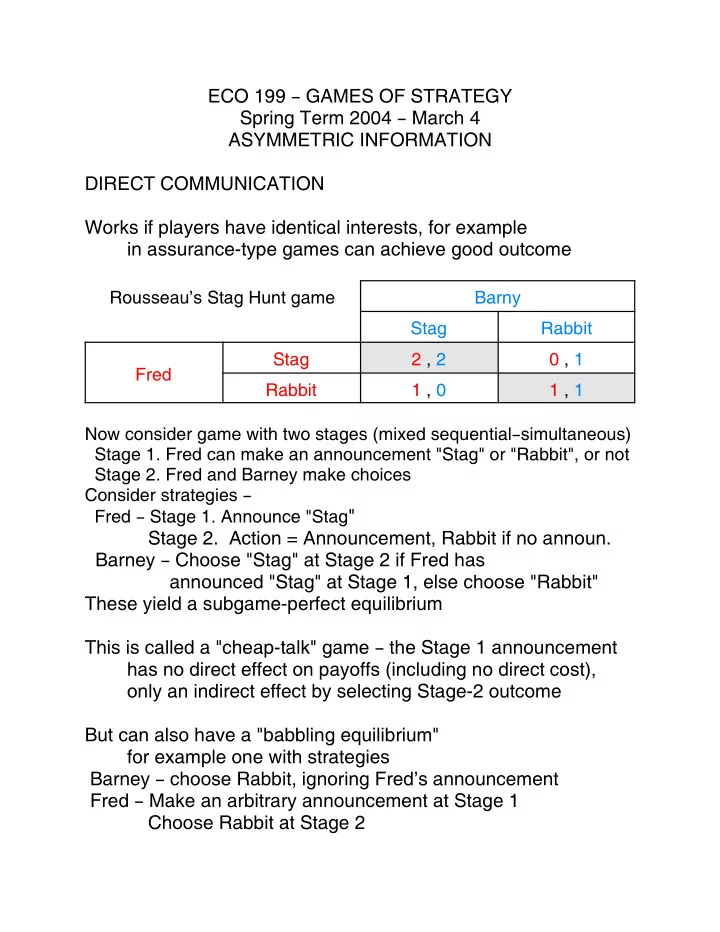
Rousseau’s Stag Hunt game Barny Stag Rabbit Fred Stag 2 , 2 0 , 1 Rabbit 1 , 0 1 , 1 Now consider game with two stages (mixed sequentialBsimultaneous) Stage 1. Fred can make an announcement "Stag" or "Rabbit", or not Stage 2. Fred and Barney make choices Consider strategies B Fred B Stage 1. Announce "Stag"

Stage 2. Action = Announcement, Rabbit if no announ. Barney B Choose "Stag" at Stage 2 if Fred has announced "Stag" at Stage 1, else choose "Rabbit" These yield a subgame-perfect equilibrium This is called a "cheap-talk" game B the Stage 1 announcement has no direct effect on payoffs (including no direct cost),

  • nly an indirect effect by selecting Stage-2 outcome

But can also have a "babbling equilibrium" for example one with strategies Barney B choose Rabbit, ignoring Fred’s announcement Fred B Make an arbitrary announcement at Stage 1 Choose Rabbit at Stage 2

slide-2
SLIDE 2

Cheap talk does not work if players’ interests strictly opposed, so game is zero-sum (or constant-sum)

Cops City Suburb Robbers City 20 70 Suburb 80 30 If two stages where Robbers make announcement at Stage 1 No subgame perfect equilibrium where Cops’ Stage-2 choice differs from their ordinary Nash equilibrium mixture, depending in any way on Robbers’ Stage-1 announcement,

because Robbers will manipulate this to their own advantage So Cops must disregard Robbers’ announcement, and then the Robbers’ announcement can be arbitrary Game has only the babbling equilibrium More generally, extent of credible communication depends on extent of alignment of players’ interests In reality, often this extent of alignment is itself a matter of information asymmetry between the players Then must use costly actions as credible signals instead of costless cheap talk

slide-3
SLIDE 3

MAIN TYPES OF INFORMATION ASYMMETRY MORAL HAZARD

  • 1. Firm’s owner can’t observe

effort (quality) of manager or worker

  • 2. Insurance company can’t observe

contributory negligence of policyholder

  • 3. Policyholder exaggerates amount of loss

Each player knows own action, but has only imperfect or inferential knowledge of other’s action ADVERSE SELECTION

  • 1. Employee’s innate skill, insuree’s innate riskiness
  • 2. A player's values or payoffs

Common interests or conflict Patience, risk-aversion in bargaining Risk-tolerance in brinkmanship

  • 3. Actions available to a player

weaponry, war-readiness of country Usually, each player knows (perfectly, or at least better) such information about himself than about the other Call all such relevant personal info a player’s TYPE Call a player’s information or type "good" if he gets higher payoff when others know this info/type and "bad" if he gets lower payoff when the info leaks Then each player wants others to think he is a "good" type And each wants to find out the others’ true type

slide-4
SLIDE 4

STRATEGIES TO MANIPULATE INFORMATION FOR BETTER-INFORMED PLAYER B

  • 1. SIGNALING B Revealing "good" information truthfully

Examples: your skill or carefulness your commitment, threat or promise your lack of hostile intent Credible signal - observable action that someone with "worse" type would not mimic. Relies on differential costs of signal Example B signal or screen for skill by taking tough courses, signal for low-risk by accepting partial insurance

  • 2. SIGNAL-JAMMING B Concealing "bad" information,

misleading (bluffing in poker), involves mixed strategy Mimic actions of a "better" type FOR LESS-INFORMED PLAYER

  • 1. Coping with adverse selection (at a cost)

employer - employee's skill or effort insurance company - applicant's risk class Screening by examination - test or audit Screening by self-selection - induce action by the other, more informed, player that is optimal for one type but not for another, so "separates" and reveals other player's type Example B air fares with restrictions, separate tourist & business

  • 2. Coping with moral hazard

incentive payments based on observable outcome Example B stock or options for managers Sometimes better to remain ignorant B achieve deniability, remain immune from others’ threats