ECFA HL-LHC Workshop for 21 st to 23 rd October October 2013 ECFA - - PowerPoint PPT Presentation

ecfa hl lhc workshop for 21 st to 23 rd october
SMART_READER_LITE
LIVE PREVIEW

ECFA HL-LHC Workshop for 21 st to 23 rd October October 2013 ECFA - - PowerPoint PPT Presentation

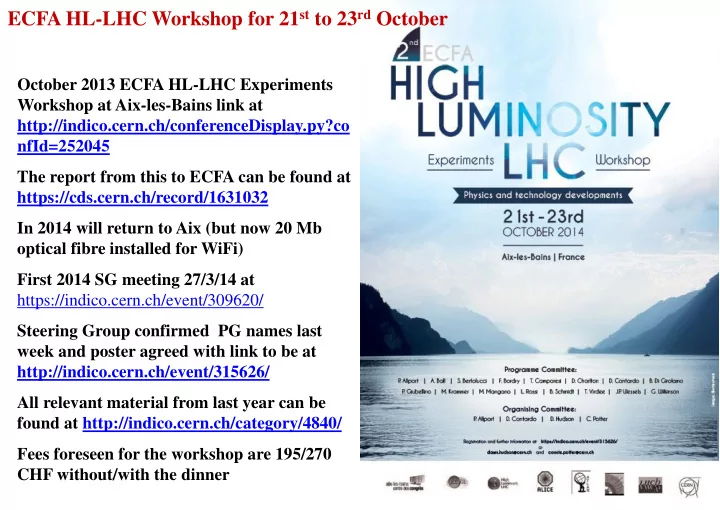
ECFA HL-LHC Workshop for 21 st to 23 rd October October 2013 ECFA HL-LHC Experiments Workshop at Aix-les-Bains link at http://indico.cern.ch/conferenceDisplay.py?co nfId=252045 The report from this to ECFA can be found at


slide-1
SLIDE 1

ECFA HL-LHC Workshop for 21st to 23rd October

October 2013 ECFA HL-LHC Experiments Workshop at Aix-les-Bains link at http://indico.cern.ch/conferenceDisplay.py?co nfId=252045 The report from this to ECFA can be found at https://cds.cern.ch/record/1631032 In 2014 will return to Aix (but now 20 Mb

  • ptical fibre installed for WiFi)

First 2014 SG meeting 27/3/14 at https://indico.cern.ch/event/309620/ Steering Group confirmed PG names last week and poster agreed with link to be at http://indico.cern.ch/event/315626/ All relevant material from last year can be found at http://indico.cern.ch/category/4840/ Fees foreseen for the workshop are 195/270 CHF without/with the dinner

slide-2
SLIDE 2

https://indico.cern.ch/conferenceOtherViews.py?view=standard&confId=252045

2013 Agenda

slide-3
SLIDE 3

2013 Preparatory Groups

– PG1: Physics goals and performance reach

  • CERN Theory: G.Salam, A. Weiller
  • ALICE: Peter Braun Munzinger, Andrea Dainese
  • ATLAS: Leandro Nisati, Pippa Wells, Bill Murray
  • CMS: Chris Hill, Markus Klute, Isabell Melzer-Pellmann
  • LHCb: Tim Gershon, Guy Wilkinson

– PG2: Tracking devices and associated electronics and readout

  • ALICE: Vito Manzari, Werner Riegler
  • ATLAS: Ingrid Gregor, Didier Ferrere, Craig Buttar
  • CMS: Duccio Abbaneo, Francois Vasey, Stefano Mersi
  • LHCb: Massimiliano Ferro-Luzzi

– PG3: Calorimetry and associated electronics and readout

  • ALICE: David Silvermyr
  • ATLAS: Francesco Lanni, Alberto Valero
  • CMS: Marcello Mannelli, Dave Barney, Pawel. De Barbaro
  • LHCb: Frederic Machefert

– PG4: Muon Systems and associated electronics and readout

  • ALICE: Pascal Dupieux
  • ATLAS: Christoph Amelung, Oliver Kortner, Stefano Veneziano
  • CMS: Marcello Abbrescia, Kerstin Hoepfner, Alexei Safonov
  • LHCb: Alessandro Cardini

Note:

  • At least one member per

experiments

  • Chairs from ATLAS and

CMS

  • Enlarged to other

contributions in the preparation process (full list

  • f contributors signed the

ECFA report)

slide-4
SLIDE 4

– PG5: Trigger/DAQ/Offline/Computing

  • ALICE: Pierre Vande Vyvre, Thorsten Kollegger, Predrag Buncic
  • ATLAS: David Rousseau, Benedetto Gorini, Nikos Konstantinidis
  • CMS: Wesley Smith, Christoph Schwick, Ian Fisk, Peter Elmer
  • LHCb: Renaud Legac, Niko Neufeld

– PG6: Electronics and read-out systems

  • ALICE: Alex Kluge
  • ATLAS: Philippe Farthouat, Maurice Garcia-Sciveres, Tony Weidberg
  • CMS: Magnus Hansen, Jorgen Christiansen
  • LHCb: Ken Wyllie

– PG7: Long Shutdown constraints and radiation and activation effects

  • ALICE: Werner Riegler
  • ATLAS: Olga Beltramello, Beniamino Di Girolamo
  • CMS: Wolfram Zeuner, Christoph Schaefer
  • LHCb: Rolf Lindner

– PG8: Accelerator and Experiment interface

  • CERN Accelerator: L. Rossi, O. Bruning
  • ALICE: Hannes Wessels
  • ATLAS: Christoph Rembser, Beniamino Di Girolamo, Antonio Sbrizzi
  • CMS: Maria Chamizo Llatas, Wolfram Zeuner
  • LHCb: Burkhard Schmidt

2013 Preparatory Groups

slide-5
SLIDE 5
  • We have started from the previous preparatory group structure but with

modifications as the session topics do not map so well to the previous groups

  • We again ask a few individuals per topic (PG chairs) to help organise each

session, but we should find a way to ensure we engage fully with the relevant players in all four LHC experiments, theory and accelerator communities and do so in as inclusive a way as possible

  • The audience composition might be broader if we can emphasise more the

links with the accelerator and theory communities

How to Organise This Time:

slide-6
SLIDE 6

How to Organise This Time:

  • Stay with all plenary format to keep the communication flow
  • Should not need as much introduction
  • Should involve theory and accelerator communities much more closely with more

talks in these areas

  • Try to build on synergies identified/developed since last time and emphasise

common approach

  • Therefore have proposed to organise sessions now more by R&D area than sub-

detector/system

  • Need to keep clear relationship with HL-LHC detector needs (not a generic

R&D discussion)

  • Need a way of preparing material that is as inclusive as possible ie:
  • pen groups to contributions from all interested collaborators

through dedicated meeting or mini-workshops

  • Can be more flexible and include a few invited talks on topics not included in

sessions

slide-7
SLIDE 7

ECFA HL-LHC 2014: Possible Schedule

Opening 30’ Accelerator Update Current status and plans; injectors and LHC upgrades 60’ Experiment Requirements Motivation for R&D topics 80’

PG1: Physics theory,

Physics experiment, performance Old PG1 (Physics goals and performance reach), plus theory talks 180’ R&D sessions PG2: Solid state tracking detectors Old PG2 (tracker)+HGCAL 120’ PG3: Scintillating devices Old PG3 (calorimeter)+Tracking (LHCb) 60’ Liquid noble gas Invited talk 30’ Large area fast timing detectors Invited talk 30’ PG4: Gaseous detector systems ( incl micro-pattern) Old PG4 (muons)+TPC+CAL 90’ PG5: Electronics systems

ASIC - HDI - HBW links - Powering Scheme - Power Supply - Modular electronics & xTCA

Old PG6 (electronics) 150’ PG6: Mechanics and Cooling New session area 60’ PG7: Trigger, Online and Offline Computing Old PG5 (trigger/DAQ/Offline/Computing) 120’ PG8: Accelerator and experiment interface, activation and mitigation Old PG7 (LS and activation) and PG8 (accelerator experiment interface) 90’ Conclusion (1 talk) 30’

slide-8
SLIDE 8

ECFA HL-LHC 2014: (PG membership not to be restricted and some additional names already known)

Accelerator/Theory

ALICE

ATLAS

CMS LHCb

Opening Accelerator Update N/A

N/A N/A N/A N/A PG1: Physics theory, Physics experiment, performance Gavin Salam, Andreas Weiler Peter Braun Munzinger, Andrea Dainese Leandro Nisati + 5

  • ther suggested

names to involve Markus Klute + Vincenzo Vagnoni Tim Gershon

Experiment Requirements

N/A N/A N/A N/A

R&D sessions PG2: Solid state tracking detectors

Walter Snoeys Vito Manzari Daniel Munnstermann + 3 Frank Hartmann + Paula Collins

PG3: Scintillating devices

Federico Ronchetti, David Silvermyr Jimmy Proudfoot Pawel de Barbaro + Christian Joram

Liquid noble gas

N/A N/A N/A N/A

Large area fast timing detectors

N/A N/A N/A N/A

PG4: Gaseous detector systems (incl micro-pattern)

Christian Lippmann Pascal Dupieux Oliver Kortner, + 1 Marcello Abbrescia + Alessandro Cardini

PG5: Electronics systems

ASIC - HDI - HBW links - Powering Scheme - Power Supply - Modular electronics & xTCA Alex Kluge Philippe Farthouat + 3 Magnus Hansen + Ken Wyllie

PG6: Mechanics and Cooling

Hannes Wessels Danilo Giugni + 3 Paola Tropea +

Massimiliano Ferro-Luzzi, Burkhard Schmidt

PG7: Trigger, Online and Offline Computing

Pierre Vande Vyvre, Predrag Buncic Graeme Stewart + 4 Wesley Smith + Niko Neufeld, Pete Clarke

PG8: Accelerator and experiment interface, activation and mitigation

Oliver Bruning, Helmut Burkhardt Werner Riegler Olga Beltramello Wolfram Zeuner + Gloria Corti +

Conclusion (1 talk 30‘)

N/A N/A N/A N/A
slide-9
SLIDE 9

Preparatory Groups: Charge

9

  • The workshop is organized with only plenary sessions dedicated to each of the

areas outlined above

  • The preparatory groups are charged to identify the key topics to be discussed

and to organize their corresponding session at the workshop. In conjunction with program of other groups (avoid overlaps)

  • They will propose the detailed agenda within that session and propose speakers

to the workshop Steering Committee

  • Chairs of the PGs will write a document of few pages summarizing the main
  • utcomes of the workshop and proposing further steps on each topic

See 2013 charge at: http://indico.cern.ch/event/250557/material/0/1.pdf

slide-10
SLIDE 10

Preparatory Groups: Modus Operandi

10

  • The chairs of PGs compile mailing lists of all those willing to contribute and
  • rganise dedicated meetings and/or mini-workshops advertised within the HL-

LHC community to fulfil the objectives outlined above.

  • A common TWIKI page should be used to collect and circulate information

and progress of each group as last time (see https://twiki.cern.ch/twiki/bin/view/ECFA/ECFAHiLumiLHC)

  • The meetings of the groups should normally be fully open, although a

mechanism to review talks and discuss material still being approved for release should be organised by the relevant PG chairs

  • The email lists from last time along with internal lists within the theory,

accelerator and individual experiments can be used to find volunteers: E-mail list of the PG members: PGMembers-HL-LHC-ECFA@cern.ch E-mail list of the PG chairs: HL-LHC-ECFA-PGChairs@cern.ch E-mail list of the workshop SC: HL-LHC_ECFAWorkshop_SC@cern.ch

slide-11
SLIDE 11

Next Steps and Upcoming Events

11

  • Meetings of each PG
  • Define topics to be addressed at the workshop
  • Meeting among all chairs to compare proposed talk areas by end of June
  • Meeting of PGs with Workshop SC
  • A half day meeting by end of July
  • Presentation of progress from each PGs
  • Develop the workshop agenda
  • Session titles, number of talks and durations agreed and entered into

indico with draft talk titles

  • September Preview of the Final Workshop Session Content
  • Chairs report to the workshop SC
  • Names of possible speakers to be discussed with SC
  • Final talk titles to be entered into indico with speakers names