EBOLA VIRUS AWARENESS Yvonne S. Butler, MD Assistant Professor; - - PowerPoint PPT Presentation

ebola virus awareness
SMART_READER_LITE
LIVE PREVIEW

EBOLA VIRUS AWARENESS Yvonne S. Butler, MD Assistant Professor; - - PowerPoint PPT Presentation

EBOLA VIRUS AWARENESS Yvonne S. Butler, MD Assistant Professor; Obstetrics and Gynecology Global Womens Health Program Liberia Chevron-Liberia / BIPAI Partnership Baylor College of Medicine Texas Childrens Hospital What Is Ebola? A


slide-1
SLIDE 1

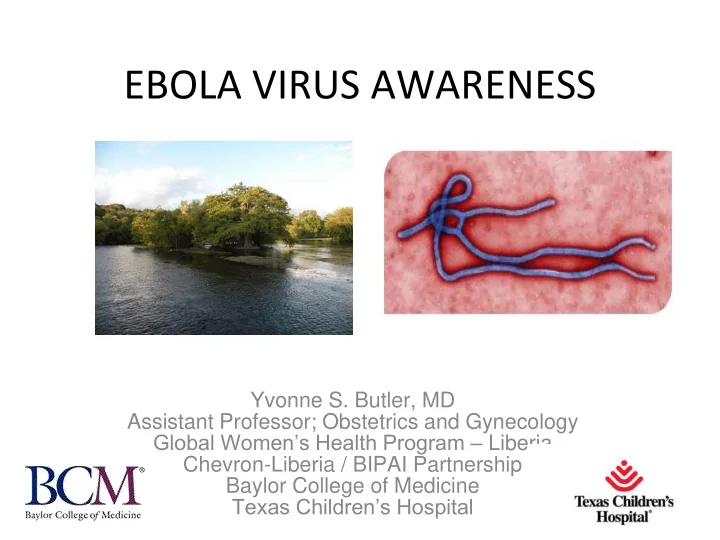
EBOLA VIRUS AWARENESS

Yvonne S. Butler, MD Assistant Professor; Obstetrics and Gynecology Global Women’s Health Program – Liberia Chevron-Liberia / BIPAI Partnership Baylor College of Medicine Texas Children’s Hospital
slide-2
SLIDE 2

What Is Ebola?

  • A Filovirus that causes haemorrhagic fever resulting

in damage to the blood vessels and many organs (intestines, stomach, liver, etc)

  • There are five species of the virus, typically named

from the region/country it was isolated:

– Bundibugyo Ebolavirus – Reston Ebolavirus – Sudan Ebolavirus – Tai Forest Ebolavirus – Zaire Ebolavirus

slide-3
SLIDE 3

Viral Hemorrhagic Fevers

  • Ebola Virus
  • Lassa Fever
  • Marburg fever
  • Yellow fever
  • Rift Valley Fever
  • Crimean-Congo fever
slide-4
SLIDE 4

How Does It Spread?

  • Human to human contact

– Contact with an infected person’s blood, saliva (spit), semen, vaginal fluid, vomit, feces (toilet), urine – Contact with any objects, including clothes, etc. that an infected person (or a dead person) has contaminated – Contact with infected bush meat – Contact with infected fruit bats

slide-5
SLIDE 5

Centers for Infectious Disease Control and Prevention 2014

slide-6
SLIDE 6

Ebola Transmission (Spread)

  • You can get infected

through direct contact with an infected wild animal, like gorillas, monkeys, etc

– AVOID BUSH MEAT

  • Bats might spread the

Ebola virus to animals (monkeys, gorillas)

– DO NOT EAT or HANDLE BATS

http://www.dawn.com/news/934016/bushmeat-off- the-menu-in-the-us

slide-7
SLIDE 7

Transmission in Health Facilities

slide-8
SLIDE 8

Ebola Symptoms

  • Fever, headache, chills, weakness
  • Vomiting and diarrhea
  • Rash, Joint pain
  • Red eyes
  • Hiccups
  • Bleeding

Internal – gut (stomach, throat, etc.) External – Eyes, nose, ears, mouth, vagina, etc

slide-9
SLIDE 9

Uganda MOH Viral Hemorrhagic Fever

slide-10
SLIDE 10

Transmission Time

  • The amount of time from infection to the
  • nset of symptoms varies

– 2 to 21 days – This means that if you are exposed to the Ebola virus, it may take up to 21 days before you start to have symptoms

slide-11
SLIDE 11

Do I Have Ebola if I Have…

WHO Infection Control for Viral Hemorrhagic Fever.1998

slide-12
SLIDE 12

Is Ebola A Serious Illness

  • Yes
  • Up to 90% of people infected with Ebola (Zaire

sub-type) will die

  • There is no cure
  • There is no vaccine
  • Everyone is at risk for getting this disease
slide-13
SLIDE 13

How Do You Test For It?

  • Special blood tests in a few labs across the

world

– Guinea – France – United States – Central Africa

slide-14
SLIDE 14

What Is The Treatment?

  • There is no medication to cure Ebola
  • Patients are provided oxygen, IV fluids (drips),

blood, etc. for general support

slide-15
SLIDE 15

Who Is At Greatest Risk For Ebola?

  • Healthcare workers
  • People in areas where Ebola cases have been

documented

  • Family members of patients suspected or

diagnosed with Ebola

  • People who come in close contact with a

person diagnosed with Ebola

slide-16
SLIDE 16

Ebola Virus Prevention (1)

  • Stay away from high risk

areas

– Lofa County – Guinea

  • Conakry, Guekedou,

Macenta, Dabola

– Sierra Leone/Liberia Border

slide-17
SLIDE 17

Ebola Virus Prevention (2)

  • Avoid people who are

sick from high risk areas

  • Avoid isolation areas at

hospitals and clinics

– JFK – Cholera Unit – Firestone – Isolation Unit – Redemption Hospital – Isolation camp outside

WHO Infection Control for Viral Hemorrhagic Fever.1998

slide-18
SLIDE 18

Ebola Virus Prevention (3)

  • Wash your hands

frequently

  • Do not touch blood, body

fluids, or secretions of anyone

  • Avoid touching your face
  • Do not touch the body of a

dead person suspected of having Ebola

slide-19
SLIDE 19

Ebola Virus Prevention (4)

WHO Infection Control for Viral Hemorrhagic Fever.1998

slide-20
SLIDE 20

Prevention in Health Facility

http://www.bbc.com/news/world-africa-26701733 WHO Infection Control for Viral Hemorrhagic Fever.1998

slide-21
SLIDE 21

What If You Feel Sick ?

Uganda MOH Viral Hemorrhagic Fever

slide-22
SLIDE 22

If You Feel Sick…Do NOT

  • Do NOT report to work

– Call your boss, and inform him/her of your illness

  • Do NOT have contact with your wife, children,

family, neighbors (etc.)

– Protect your family

  • Do NOT take take public transport (taxi, pem-

pem, etc.

  • Do NOT lie about how you feel or the symptoms

you have

slide-23
SLIDE 23

If You Feel Sick…Do

  • Wear a mask to protect others
  • Report to the nearest isolation center or
  • Call the MOH and ask where can you get

treated

  • Call everyone you’ve come in contact with and

warn them to avoid others, and report for an evaluation

slide-24
SLIDE 24

Is This Ebola Thing Real Doc?

  • Guinea

– 122 suspected cases (who 4/1/2014) – Probable and suspected cases include 11 health care workers – 80 deaths

  • Sierra Leone (Kailahun & Kambia Districts)

– WHO states that there are suspected cases – 4 deaths (unverified)

slide-25
SLIDE 25

Ebola In Liberia

  • 8 cases reported by

MOH to WHO (04/01/2014)

– 2 confirmed cases in Lofa County – 2 deaths – Firestone with 1 confirmed case

  • 32 possible contacts

SOS International Ebola Awareness Presentation 31-03-2014 Webinar

slide-26
SLIDE 26

Are We All Doomed?

  • NO
  • The situation is changing on a daily basis
  • Monitor the news and ask questions
  • Educate yourself and your family
  • Practice prevention strategies
  • Plan for what you will do if you become

exposed

  • Help us educate your community
slide-27
SLIDE 27

Ebola Hotlines (Liberia)

  • Ministry of Health

– 0770198517 – 0777549805 – 0886530260 – 0886549805

slide-28
SLIDE 28

Summary Points

  • Ebola virus is a very serous illness
  • There is no cure for Ebola
  • Preventive measures are the best way to

contain the disease

  • Be honest with yourself and others about any

possible exposure

slide-29
SLIDE 29

Acknowledgement and Questions