
SLIDE 1
Century Associates / Horizon Hill Ventures
Eastern Branch Boys & Girls Club
A proposal for contextually sensitive, community supporting, adaptive reuse
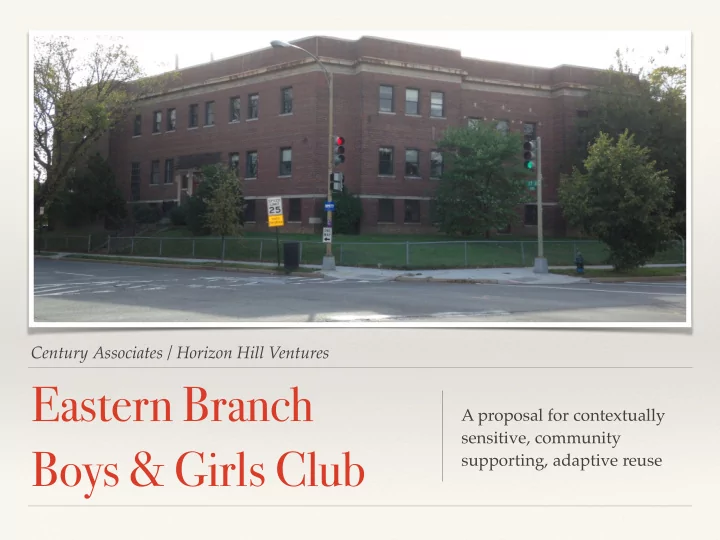
Eastern Branch A proposal for contextually sensitive, community - - PowerPoint PPT Presentation
Century Associates / Horizon Hill Ventures Eastern Branch A proposal for contextually sensitive, community Boys & Girls Club supporting, adaptive reuse The Project Team Developer: Century Associates / Horizon Hill Ventures
Century Associates / Horizon Hill Ventures
A proposal for contextually sensitive, community supporting, adaptive reuse
❖ Developer: Century Associates / Horizon Hill Ventures ❖ Architect: Environmental Design Group (EDG) ❖ Contractor: Stanton View Development (SVD) ❖ Community Partner: Capitol Hill Village (PROPOSED)
C E N T U R Y ASSOCIATES
❖ Senior housing ❖ Neighborhood non-profit serving seniors ❖ Indoor children’s play center
“I am at a loss for an explanation for why none of the new construction
addition to the influx of young families, there are many residents who are thinking about moving to one floor units (apartments or condos) to avoid the two or three flights of stairs in their current homes. As everyone knows space for new construction or renovation is at a premium on the Hill and it appears that seniors will have no choice but to leave the Hill despite the fact that they do not want to.”
❖ 25 senior apartments ❖ 2 caregiver apartments ❖ A range of unit sizes, including
larger units marketed toward seniors living in Capitol Hill row houses
❖ Independent living, but with senior
❖ Fully accessible (universal) design ❖ Walkable - proximity to urban
amenities and transportation
❖ Office and amenity space leased to and programmed by
❖ Would manage programming and caregiver component ❖ Serve both building residents and seniors aging in place
❖ Preliminary discussions with Capitol Hill Village but
❖ Former gymnasium to be
repurposed as 4,200 square foot indoor children’s play space
❖ Data from other locales with
similar demographics suggests unmet demand on Capitol Hill
❖ Open to public, fee based ❖ Both programmed activities and
unstructured, free play
❖ Similar concepts: Kidville, The
Coop, Studio Grow, Building Zone
❖ Relief required for almost any redevelopment scenario ❖ 11,125 square foot site allows only 12 units by-right ❖ Indoor play space not a by-right allowable use ❖ Business use also requires zoning relief ❖ Building occupies 100% of lot area, parking relief may be
required unless parking can be incorporated into structure
❖ R-4 zoning constrains both maximum number of units
and vertical development
❖ Visual observation during walk through suggests the presence
❖ ACMs (asbestos containing materials) ❖ Lead based paint ❖ Bird Guano ❖ A hazardous materials survey is required to quantify the
extent of the materials requiring abatement and to determine an estimate of probable cost for remediation
❖ Existing stairs do not meet current code requirements for
tread depth and riser height and will require replacement.
❖ Existing building lacks an elevator ❖ Multiple level changes within building make accessibility
a challenge in general
❖ Front entrance includes both exterior and interior stairs ❖ Most seniors consider parking an essential feature,
building has none
❖ RFP requirements impact project feasibility: ❖ Required lease structure adversely affects equity investor and lender interest ❖ Only two respondents on what is otherwise a highly desirable site ❖ Prohibition on applying any other public subsidy (i.e. HPTF subsidy, District LIHTC
allocation, etc) reduces feasibility
❖ “The District will not be providing any public subsidy to fill any funding gaps or
shortfalls.” (Page 13)
❖ Contracting requirements (i.e. Davis Bacon) inflate construction cost ❖ Cellular tower lease encumbers rooftop, further limiting vertical expansion (in addition to R-4
zoning designation)
❖ Impact of new District 30% affordability requirement on all publicly owned projects is unclear ❖ Extensive basement and sub-basement areas that require renovation, yet will not generate income
❖ We would love to incorporate
affordable housing, but doing so requires public subsidy, an
the solicitation.
❖ If purchasing the property is a
possibility, we would aggressively pursue this as a mixed income cohousing project.
Intentional Community
A type of housing community that features both private dwellings and shared common facilities.
among residents.
Intentional Community
EDG and its affiliate, Eco Housing Corporation, have developed the first two cohousing communities in Washington:
involved with Takoma Village.
members of Capitol Hill Village that generated substantial interest. Has a list of interested households.
Washington Post, January 3, 2015
“A major trend in the metro area last year was the number of non-family buyers…”
type of home, typically with less maintenance, the
rambler-style home on one level, or an apartment-style condominium.”
people without kids is to live within walking distance to shops and restaurants or public transportation…”
Changing demographics require planning
“There are many communities that aren’t doing enough to prepare for the demographic shifts that are underway… Some are barely even aware of them. There are a lot of localities that are not thinking about this yet — to a surprising degree, actually.”
AARP Home & Community Program