EASM 2014 LITERATURE REVIEW: Situating this study within a tradition - - PDF document

easm 2014
SMART_READER_LITE
LIVE PREVIEW

EASM 2014 LITERATURE REVIEW: Situating this study within a tradition - - PDF document

THE QUEST FOR INDIVIDUAL SPONSORSHIPS ELITE ATHLETES MANOEUVRING BETWEEN THE LOGICS OF SPORT AND BUSINESS Submitting author: Dr Ulrik Wagner University of Southern Denmark, Leadership & Corporate Strategy Slagelse, 4200 Denmark All


slide-1
SLIDE 1

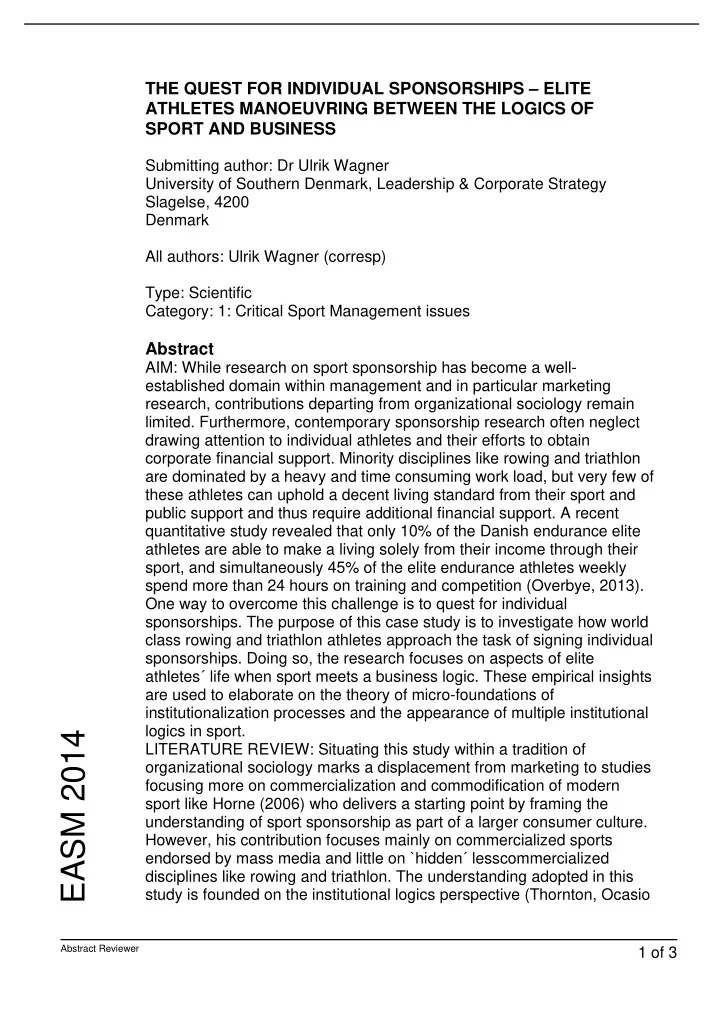
THE QUEST FOR INDIVIDUAL SPONSORSHIPS – ELITE ATHLETES MANOEUVRING BETWEEN THE LOGICS OF SPORT AND BUSINESS

Submitting author: Dr Ulrik Wagner University of Southern Denmark, Leadership & Corporate Strategy Slagelse, 4200 Denmark All authors: Ulrik Wagner (corresp) Type: Scientific Category: 1: Critical Sport Management issues

Abstract

AIM: While research on sport sponsorship has become a well- established domain within management and in particular marketing research, contributions departing from organizational sociology remain

  • limited. Furthermore, contemporary sponsorship research often neglect

drawing attention to individual athletes and their efforts to obtain corporate financial support. Minority disciplines like rowing and triathlon are dominated by a heavy and time consuming work load, but very few of these athletes can uphold a decent living standard from their sport and public support and thus require additional financial support. A recent quantitative study revealed that only 10% of the Danish endurance elite athletes are able to make a living solely from their income through their sport, and simultaneously 45% of the elite endurance athletes weekly spend more than 24 hours on training and competition (Overbye, 2013). One way to overcome this challenge is to quest for individual

  • sponsorships. The purpose of this case study is to investigate how world

class rowing and triathlon athletes approach the task of signing individual

  • sponsorships. Doing so, the research focuses on aspects of elite

athletes´ life when sport meets a business logic. These empirical insights are used to elaborate on the theory of micro-foundations of institutionalization processes and the appearance of multiple institutional logics in sport. LITERATURE REVIEW: Situating this study within a tradition of

  • rganizational sociology marks a displacement from marketing to studies

focusing more on commercialization and commodification of modern sport like Horne (2006) who delivers a starting point by framing the understanding of sport sponsorship as part of a larger consumer culture. However, his contribution focuses mainly on commercialized sports endorsed by mass media and little on `hidden´ lesscommercialized disciplines like rowing and triathlon. The understanding adopted in this study is founded on the institutional logics perspective (Thornton, Ocasio 1 of 3

Abstract Reviewer

EASM 2014

slide-2
SLIDE 2

& Lounsbury, 2012). The assumption is that a sponsorship represents an encounter between the logics of sport and business. This theoretical approach has hitherto been dominated by an inter-organizational perspective, though Thornton, Ocasio and Lounsbury extend it in order to encompass the micro-foundations of the institutionalization processes. Accordingly, institutions are both seen a forwarding a “taken for granted” behaviour, but also opening the space for individual interpretation, strategic action and reflexivity. In this paper, elements from Goffmann´s perceptions of strategic interaction are incorporated (1969) in particular the term coalition as a “... joining of two or more, ordinarily opposed, parties, and their functioning, temporarily and in regard to specific aims, to promote a single interest” (p. 86). RESEARCH DESIGN: The study is founded on a qualitative approach using semi-structured interviews. Inspiration is gained from Alvessons (2011) understanding of research interviews and hereby it transgresses a positivist and romantic approach while subsequently adding more consistency to a constructivist and situational understanding of

  • interviewing. Eight world class athletes from rowing (N. 4; three females)

and triathlon (N. 4; two females) were interviewed in a period between December 2012 and October 2013. In addition, two male sporting directors from national federations (rowing and triathlon respectively) were interviewed in March 2014. While the interviews of athletes were designed to centre on topics such as a) framing of a sponsorship agreement, b) individual experiences, possibilities and boundaries, c) celebrity endorsement and d) future perspectives, the two sporting director interviews were conducted with the purpose of adding an e)

  • rganizational and policy perspective to the issue. Without explicitly

discussing individual athlete cases, these two interviews focused on the role of the elite sport administrative leadership staff and how they perceive and approach a situation where sport is confronted and engage with business interests. In addition, up-dated post-London 2012 policy papers on Elite Strategies from the two national federations are analyzed. RESULTS, DISCUSSION, IMPLICATIONS: This paper represents work- in-progress. The preliminary outcomes from the interviews reveal that the athletes adapt differently to the business logic. The existence of this logic is an inherent, institutionalized and taken for granted practice among the athletes A common feature for all the interviewed athletes is that none of them – despite belonging to the world elite – are able to make a living solely from their sport and public support. However, compared to the triathletes, the rowers, seem (with slight differences though) much more cautious about engaging with business interests This can be interpreted as the triathletes´ ability to form a coalition with commercial parties in order to promote a single interest An utterance about how to approach a sponsor by “providing a little bit more than initially agreed upon” can be identified as a trace of a business (merchant) logic which is an internalized practise

  • nce athletes try to explain their encounter with sponsors Yet, the

engagement is a paradoxical balancing act in order to avoid a counter- 2 of 3

Abstract Reviewer

EASM 2014

slide-3
SLIDE 3

productive absorption in commercial activities. Despite that this problematic is well-known by the national federations sponsorship engagement of individual athletes is not an integrated issue of contemporary elite sport policy strategies of the two particular sports represented in this study.

References

Thornton, P.; Ocasio, W. & Lounsbury, M. (2012). The Institutional Logics Perspective. A New Approach to Culture, Structure and Proces. Oxford: Oxford University Press.

  • Horne, J. (2006). Sport in Consumer Culture. New York: Palgrave

Macmillan.

  • Overbye, M. (2013). Doping og Anti-doping i kontekst. En analyse af

eliteidrætsudøveres oplevelse af anti-doping policy, betydende faktorer for til- eller fravalg af doping, (u) lovlige præstationsfremmende midler, grænser

  • g dilemmaer. PhD. Dissertation, November 2013. University of

Copenhagen.

  • Goffmann, E. (1969). Strategic Interaction. Philadelphia: University of

Pennsylvania Press.

  • Alvesson, M. (2011). Interpreting Interviews. London: SAGE.

3 of 3

Abstract Reviewer

EASM 2014