Early Math Matters 1. Brain development before children begin school - - PDF document

early math matters
SMART_READER_LITE
LIVE PREVIEW

Early Math Matters 1. Brain development before children begin school - - PDF document

10/29/2017 Playful Math Instruction Deborah Stipek November 1, 2017 Early Childhood Investigations Early Math Matters 1. Brain development before children begin school is rapid and provides the foundation for future learning. 2. The


slide-1
SLIDE 1

10/29/2017 1 Playful Math Instruction

Deborah Stipek

Early Childhood Investigations November 1, 2017

Early Math Matters

  • 1. Brain development before children begin school is

rapid and provides the foundation for future learning.

  • 2. The achievement gap in math exists before children

enter kindergarten.

  • 3. The math skills children enter kindergarten with are

highly predictive of later achievement.

  • 4. Kindergarten standards have risen.
  • 5. Young children can and love to do math activities.
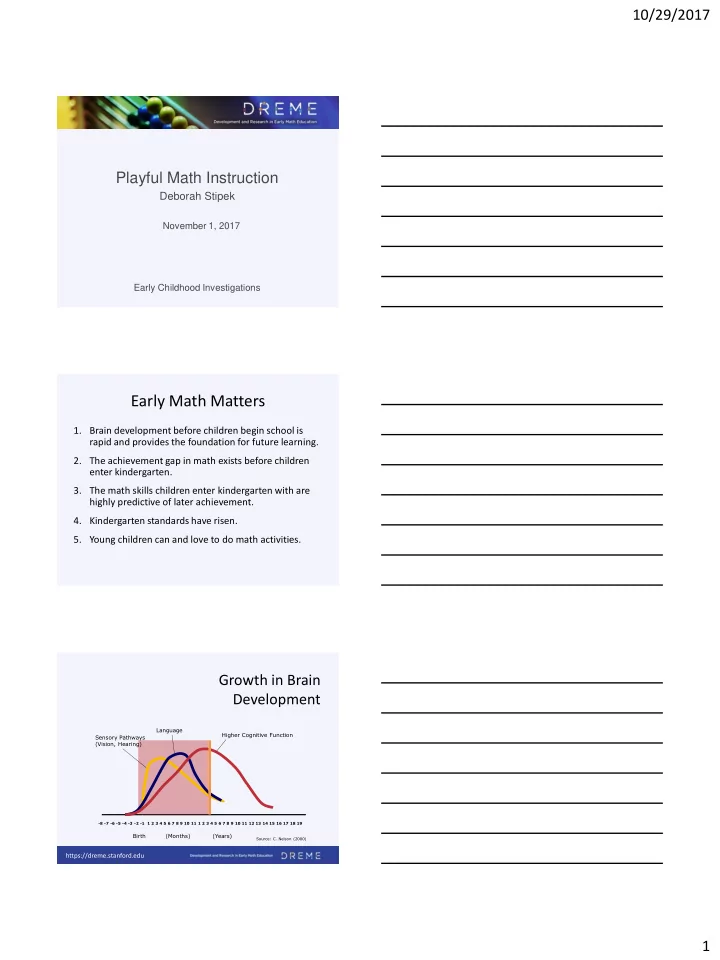
  • 8 -7 -6 -5 -4 -3 -2 -1 1 2 3 4 5 6 7 8 9 10 11 1 2 3 4 5 6 7 8 9 10 11 12 13 14 15 16 17 18 19

Birth (Months) (Years) Sensory Pathways (Vision, Hearing) Language Higher Cognitive Function

Source: C. Nelson (2000)

Growth in Brain Development

https://dreme.stanford.edu

slide-2
SLIDE 2

10/29/2017 2

Weintraub, et al., (2011)

Birth Age (Years) 50 70 80

Skill proficiency

3 5 15 25 30 10

Brain Development for Executive Functions

https://dreme.stanford.edu

10 20 30 40 50 60 70 80 90 100

Mean Percent Correct

Math Knowledge in American 4-yr-olds

Low Income Middle Income

https://dreme.stanford.edu 38 79 123 144 157 25 61 98 123 140 17 46 78 101 120 20 40 60 80 100 120 140 160 180

Fall 1998, Kindergarten Spring 2000, grade 1 Spring 2002, grade 3 Spring 2004, grade 5 Spring 2007, grade 8

Math Achievement Scores of Kindergartners Followed Through Grade 8, by Kindergarten Score Quartile

Highest quartile Middle two quartiles Lowest quartile https://dreme.stanford.edu

slide-3
SLIDE 3

10/29/2017 3

Effect of Persistent vs. No Problems at Ages 6, 8, and 10 on High School Completion and College Attendance

Persistent Problems in… High School Completion College Attendance Reading

  • .05
  • .06

Math

  • .13*
  • .29**

Antisocial Behavior

  • .10***
  • .24*

https://dreme.stanford.edu

Common Core Kindergarten Standards

  • Count to 100 by ones and by tens
  • For any number from 1 to 9, find the number that makes 10 when

added to the given number

  • Compose and decompose numbers from 11 to 19 into ten ones and
  • nes
  • Describe measurable attributes of objects, such as length or weight.
  • Compose simple shapes to form larger shapes.
  • Directly compare two objects with a measurable attribute in

common, to see which object has "more of"/"less of" the attribute, and describe the difference.

POLL

slide-4
SLIDE 4

10/29/2017 4 Kindergarten is the New First Grade

https://dreme.stanford.edu

But not much Math Happening in Preschools

Proportion of Time Spent in Preschool Content Areas

Meal/Nap/Out/ Transition 60% Other (e.g. TV) < 1% Morning Routine < 1% Mixed Content 20% Art 1% Music and/or Movement 3% Social Studies 1% Science 1% Math 3% Reading 2% Code-Based Skills 2% Literacy 7% Reading Readiness 11%

POLL

slide-5
SLIDE 5

10/29/2017 5

Math activities are age-appropriate for preschoolers.

No Exp/No Edu 2+ Yrs Exp/4 Yrs ECE Edu 2+ Yrs Exp/4+ Yrs Edu & Math Ed Course

Agree Agree Strongly Platas, 2011 Agree Somewhat

https://dreme.stanford.edu

POLL Complaints about Standards

  • 1. Focus attention on basic academic skills and

away from other important dimensions of development

  • 2. Encourage developmentally inappropriate

teaching

  • 3. Undermine the joy of learning
slide-6
SLIDE 6

10/29/2017 6

No Standards?

  • If we don’t know our destination, how do we

know how to get there?

– How do we determine whether children are making progress?

Standards can be useful if they…

  • guide but don’t dictate instruction

– Standards provide the long-term goals; the short-term goals (in route) are based on what children know and understand

  • inform assessments used to track children’s

progress

  • inform choice of curriculum used to provide

scope and sequence for learning

– Rebel against strict pacing!!

But what about “teaching”?

slide-7
SLIDE 7

10/29/2017 7 “Teaching” has a bad rap

▪ associated with teacher-directed, didactic instruction—flash cards and worksheets ▪ believed to interfere with children’s natural curiosity and joy of learning ▪ and competes with:

▪ time for play ▪ opportunities to develop social-emotional skills

Theories of Teaching

Child-Centered

(constructivist) Children discover through direct experience Children choose Process stressed Play

Teacher-Directed

(learning theory) Children learn what teachers teach Teachers choose Performance stressed Work

POLL

slide-8
SLIDE 8

10/29/2017 8

What is not included

  • Rote counting
  • Calendar
  • Worksheets
  • Macaroni math

Effective, Playful Math Instruction

  • Teacher plans activities with clear learning

goals

  • Identifies, designs, and prepares materials
  • Provides direction
  • Engages children in conversation
  • Assesses learning
  • Designs individual & group interventions

Teacher Verbal Behavior

(talk by teacher during the 3.25 hour learning opportunity)

Farran, ECMC

Listening 9% Not Talking or Listening 20% To Child 35% To Small Group 7% To Whole Group 25% To Self 1% To Parent/External Adult 1% To Teacher 2% Talking 71%

All Classrooms: Teacher Talking and to Whom

slide-9
SLIDE 9

10/29/2017 9

Child Verbal Behavior

(Talk by children during the 3.25 hour learning opportunity)

Farran, ECMC

Not Talking or Listening 41% Listening 34% Fuss/Cry 1% To Teacher 4% To Child 9% To Small Group 1% To Whole Group 4% To Self 6% Talking 24%

All Classrooms: Children Talking and to Whom

  • http://pbskids.org/lab/activity/shoesorting/

Other Activities

Letters in name

  • Shape hunt

Map of classroom Store

S A A R H T I M

slide-10
SLIDE 10

10/29/2017 10

Making Counting Fun Using Picture Books Describe, Draw, Describe

slide-11
SLIDE 11

10/29/2017 11

Games Teachable Moments

  • Take advantage
  • But not sufficient

– depends too much on chance

slide-12
SLIDE 12

10/29/2017 12

To learn more about our research and development in early math, visit our website at https://dreme.stanford.edu To access our free early math resources for teacher educators (videos, articles, activities), visit DREME TE at http://prek-math-te.stanford.edu