E19.2174 Cognitive Science & Educational Technology I Jan L. - - PDF document

e19 2174 cognitive science educational technology i jan l
SMART_READER_LITE
LIVE PREVIEW

E19.2174 Cognitive Science & Educational Technology I Jan L. - - PDF document

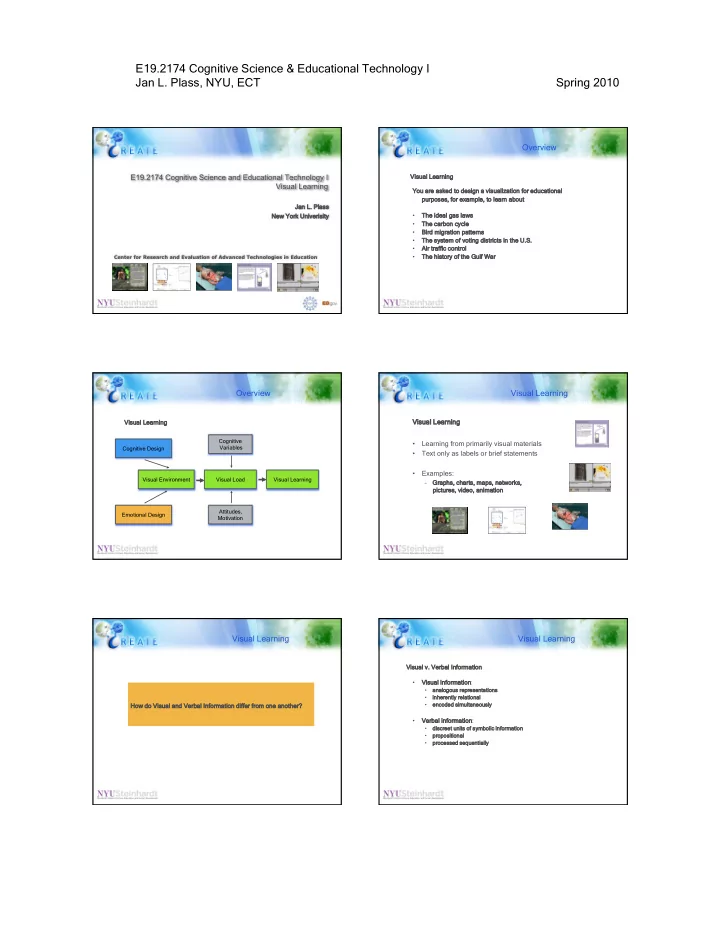
E19.2174 Cognitive Science & Educational Technology I Jan L. Plass, NYU, ECT Spring 2010 Overview Visual Visu l Learn rnin ing You are Yo re aske sked to desig sign a visu visualiza lizatio ion for r educa catio ional l purp


slide-1
SLIDE 1

E19.2174 Cognitive Science & Educational Technology I Jan L. Plass, NYU, ECT Spring 2010

Ja Jan L. Pla Plass ss New Yo York rk Unive iverisit risity

Center for Research and Evaluation of Advanced Technologies in Education

Overview

Visu Visual l Learn rnin ing Yo You are re aske sked to desig sign a visu visualiza lizatio ion for r educa catio ional l purp rpose ses, s, for r exa xamp mple le, to le learn rn about

  • The id

ideal l gas s la laws s

  • The ca

carb rbon cycle cycle

  • Bird

Bird mig migra ratio ion pattern rns s

  • The syst

system m of vo votin ing dist istrict ricts s in in the U.S. S.

  • Air

Air tra raffic ic co contro rol l

  • The hist

istory ry of the Gulf lf War r

Overview

Visu Visual l Learn rnin ing

Visual Learning Visual Load Visual Environment Emotional Design Cognitive Design Cognitive Variables Attitudes, Motivation

Visual Learning

  • Learning from primarily visual materials
  • Text only as labels or brief statements
  • Examples:

– Gra raphs, s, ch chart rts, s, ma maps, s, networks, rks, pict icture res, s, vid video, anima imatio ion

Visu Visual l Learn rnin ing

Visual Learning

How do Visu Visual l and Ve Verb rbal l Informa rmatio ion dif iffer r fro rom m one another? r?

Visual Learning

  • Visu

Visual l in informa rmatio ion:

  • analo

logous s re repre rese sentatio ions s

  • in

inhere rently ly re rela latio ional l

  • enco

coded simu simult ltaneously sly

  • Ve

Verb rbal l in informa rmatio ion:

  • discre

iscreet unit its s of symb symbolic lic in informa rmatio ion

  • pro

roposit sitio ional l

  • pro

roce cesse ssed se sequentia ially lly

Visu Visual l v.

  • v. Ve

Verb rbal l Informa rmatio ion

slide-2
SLIDE 2

E19.2174 Cognitive Science & Educational Technology I Jan L. Plass, NYU, ECT Spring 2010

Visual Learning

Dual l Codin ing Theory ry

(Pa (Paivio ivio, 1986, 1990)

VERBAL STIMULI NONVERBAL STIMULI SENSORY SYSTEMS

VERBAL SYSTEM NONVERBAL SYSTEM REPRESENTATIONAL CONNECTIONS REFERENTIAL CONNECTION S Logogens VERBAL RESPONSES NONVERBAL RESPONSES Imagens REFERENTIAL CONNECTION S Associative Connections Associative Connections

Visual Cognitive Load

  • Intrin

rinsic sic Load Load related to complexity of the information Element interactivity

  • Ext

Extra raneous s Load Load pertaining to format and design of the interface

(presentation mode, modality, temporal & spatial arrangement, representation type)
  • Germa

rmane Load Mental effort expended by learner

Cognit itive ive Load Comp mponents s (Sw (Swelle ller, r, 1999)

Intrinsic Load Extraneous Load Germane Load Working Memory Free

Visual Cognitive Load

  • Cognitive Load for Visual Representations:
  • Intrin

rinsic sic Visu Visual l Load Visual element interactivity

  • Ext

Extra raneous s Visu Visual l Load Visual format and design of the interface (presentation mode,

modality, temporal & spatial arrangement, representation type) Lee, Plass, & Homer (2006)

Visu Visual l Cognit itive ive Load

Visual Learning Environments

  • Highly visual learning environments
  • Examples

– Simu Simula latio ions, s, virt virtual l world rlds, s, micro microworld rlds, s, game mes s

Visu Visual l Learn rnin ing En Enviro vironme ments

Introduction

Exa Examp mple les s Ideal Gas Law (Oklahoma State University)

Introduction

Exa Examp mple les s Odyssey Simulation Package

slide-3
SLIDE 3

E19.2174 Cognitive Science & Educational Technology I Jan L. Plass, NYU, ECT Spring 2010

Introduction

Exa Examp mple les s Gizmo/ ExploreLearning

Introduction

Exa Examp mple les s Molecular Workbench

Introduction

Exa Examp mple les s Schnotz & Rasch (2005)

Introduction

Exa Examp mple les s Ideal Gas Laws (NYU Molecules & Minds project, IES)

Introduction

Exa Examp mple les s Virt Virtual l Pa Patie ient (Ab (Abdomin minal l Exa Exam) m) NYU YU Sch School l

  • f Me

Medicin icine

Overview

Visu Visual l Learn rnin ing

Visual Learning Visual Load Visual Environment Emotional Design Cognitive Design Cognitive Variables Attitudes, Motivation

slide-4
SLIDE 4

E19.2174 Cognitive Science & Educational Technology I Jan L. Plass, NYU, ECT Spring 2010

Visual Learning

Gro roup Discu iscussio ssion (3 (3-4

  • 4 st

students, s, 15min min) ) Discu iscuss ss Desig sign Prin Princip ciple les s that in incre crease se the effect ctive iveness ss of visu visual l re repre rese sentatio ions s for r le learn rnin ing (An (Anima imatio ions s and Simu Simula latio ions)? s)? –L –List ist and Discu iscuss ss prin rincip ciple les s fro rom m the assig ssigned re readin ing –F –Fin ind and discu iscuss ss exa xamp mple les

Cognitive Design Factors

  • Representation of information (Information Design)
  • Instructional Approach (Interaction Design)
  • Interactivity (Interaction Design)
  • Function of Visuals (in support of cognitive processes)
  • Scaffolds
  • Feedback
  • Narrative structure

Cognit itive ive Desig sign Fact ctors rs

Cognitive Design Factors

Which ich mo mode of re rela latio ionsh ship ip between sig signs s and their ir re refere rents s best st facilit cilitates s le learn rnin ing?

  • Ico

con: Most basic representation, relies on physical resemblance to convey meaning

  • Symb

Symbol: l: Abstract, arbitrary, relies on social conventions for meaning (Peirce, 1956)

Quest stio ion of Intere rest st:

  • Comparison of Iconic v. Symbolic representations

Repre rese sentatio ion of Informa rmatio ion (Se (Semio miotics) ics)

Research Materials

  • Ideal Gas Law

Chemist mistry ry Simu Simula latio ions

Research Materials

  • Ideal Gas Law

Chemist mistry ry Simu Simula latio ions

Does s addin ing ico icons s facilit cilitate le learn rnin ing in in ch chemist mistry ry simu simula latio ions? s?

  • Study with 93 11th grade students in a NYC high school:
  • Adding icons increased recall
  • Ico

cons s esp specia cially lly help lped le learn rners rs wit ith lo low prio rior r kn knowle ledge

(Lee, Plass, & Homer, 2006; Plass et al., 2007)

Repre rese sentatio ion of Informa rmatio ion (Se (Semio miotics) ics)

Results: Representation

slide-5
SLIDE 5

E19.2174 Cognitive Science & Educational Technology I Jan L. Plass, NYU, ECT Spring 2010

Visual Design of Simulations

Which ich in inst stru ruct ctio ional l appro roach ch best st facilit cilitates s le learn rnin ing? Consid sider: r:

  • Difficulty of content: Intrinsic Cognitive Load
  • Complexity of interactions: Extraneous Load
  • Educational goals / Cognitive Function of materials
  • Learner characteristics

Option

  • Direct instruction v. guided exploration

Inst stru ruct ctio ional l Ap Appro roach ch: Leve vel l of Learn rner r Contro rol

Visual Design of Simulations

Which ich in inst stru ruct ctio ional l appro roach ch best st facilit cilitates s le learn rnin ing?

  • Comparison of direct instruction v. guided exploration

In other words:

  • Comparison of Worked-out example (Animation) v. Exploration

(Simulation) Or, in even different terms:

  • Kirschner, Sweller, & Clark (2006) v. Everybody Else

Why Minimal Guidance During Instruction Does Not Work: An Analysis of the Failure of Constructivist, Discovery, Problem-Based, Experiential, and Inquiry-Based Teaching

Inst stru ruct ctio ional l Ap Appro roach ch: Leve vel l of Learn rner r Contro rol

Research Materials

  • Kinetic Theory
  • f Heat

Chemist mistry ry Simu Simula latio ions

Research Materials

  • Ideal Gas Law

Worke rked-o

  • out

Exa Examp mple le

Does s abilit ility y to ma manip ipula late para rame meters rs facilit cilitate le learn rnin ing?

  • Study with 93 11th grade students

in a NYC high school:

  • For comprehension:

Simulation Direct Exploration > Instruction

(Plass et al., 2007)

Resu sult lts: s: Simu Simula latio ion (e (exp xplo lora ratory) ry) vs.

  • vs. An

Anima imatio ion (w (worke rked-o

  • out)

Results: Instructional Format

Wo rked Out/Explore Explore Worked Example Mean M.C. Posttest 4.0 3.0 2.0 1.0 0.0

Cognitive Design Factors

Exa Examp mple le Leve vel l of Intera ract ctivit ivity y

slide-6
SLIDE 6

E19.2174 Cognitive Science & Educational Technology I Jan L. Plass, NYU, ECT Spring 2010

Cognitive Design Factors

Exa Examp mple le Leve vel l of Intera ract ctivit ivity y

Visual Design of Simulations

What purp rpose se does s the visu visual l in informa rmatio ion se serve rve in in the co const stru ruct ctio ion of me mental l mo models? ls? (Plass, 1998)

  • Levin, Anglin, & Carney (1987): 5 functions (heuristic)
  • Decorative motivational function; little relation to content
  • Representative depicts content of the instruction
  • Organizing depicts knowledge structures
  • Interpreting visualizes abstract concepts
  • Transforming supports higher-level cognitive processes

Cognit itive ive Funct ctio ion of Visu Visual l Informa rmatio ion

Visual Design of Simulations

Cognit itive ive Theory ry of Mu Mult ltime imedia ia Learn rnin ing (Ma (Maye yer, r, 2001)

Select Images Select Words Organize Images Organize Words Sounds Images Integrate Verbal Model (Verbal Mental Representation) Pictures Words Multimedia Presentation Ears Eyes Sensory Memory Pictorial Model (Visual Mental Representation) Long-Term Memory Prior Knowledge Working Memory

Visual Design of Simulations

What purp rpose se does s the visu visual l in informa rmatio ion se serve rve in in the co const stru ruct ctio ion of me mental l mo models? ls? (Plass, 1998)

  • Our approach: Define function based on Mayer’s CTML
  • Selecting
  • Organizing
  • Integrating
  • Different types of visuals support different learning
  • utcomes (recall, comprehension, transfer)
(Plass, Hamilton, & Wallen, 2004; Wallen, Plass, & Brünken, 2005)

Cognit itive ive Funct ctio ion of Visu Visual l Informa rmatio ion

Visual Design of Simulations

Funct ctio ion of Mu Mult ltime imedia ia Aid Aids s in in Text xt Comp mpre rehensio sion

Visual Design of Simulations

  • Split Attention Principle

Avoid requiring learners to split their attention between, and mentally integrate, several sources of physically or temporally disparate information, where each source of information is essential for understanding the material.’’ (Ayres & Sweller, 2005)

  • Modality Principle

Present animation with narration rather than with on-screen text

(Mayer, 2001)
  • Contiguity Principle

Present related information near to each other in time and space

(Mayer, 2001)

Est Establish lished Cognit itive ive Desig sign Prin Princip ciple les

slide-7
SLIDE 7

E19.2174 Cognitive Science & Educational Technology I Jan L. Plass, NYU, ECT Spring 2010

Visual Design of Simulations

  • Cueing

Adding design elements that direct learners’ attention to the important part of a simulation reduces cognitive load and enhances learning

(Dwyer, 1978, Jeung et al., 1997; Tabbers et al., 2004; de Koenig el al., 2007)
  • Representation of Information

Adding iconic representations can enhance learning, especially for learners with low prior knowledge

(Lee et al., 2006; Plass et al., 2009)
  • Color Coding

Use color to highlight important features and attributes of the visual display (Dwyer and Moore, 1991; Keller et al., 2006)

  • Multiple Dynamic Visual Representations
Multiple dynamic representations should be integrated and linked (van der Meij & de Jong, 2006)

Eme Emerg rgin ing Visu Visual l Desig sign Prin Princip ciple les

Visual Design of Simulations

  • Learner Control of Segmenting

Learner control over the advancement from one segment of visual materials to the next improves learning

(Mayer & Chandler, 2001; Mayer et al., 2003; Moreno, 2007)
  • Guided Discovery Principle

Provide guidance in discovery-based learning environments

(de Jong, 2006; de Jong & van Joolingen, 1998; Kirschner et al., 2006; Mayer, 2004)

Est Establish lished Intera ract ctio ion Desig sign Prin Princip ciple les

Visual Design of Simulations

  • Learner Control of Pacing

Learner control over the pace of the presentation of visual materials improves learning

(Hasler et al., 2007; Schwan & Riempp, 2004; Tabbers et al., 2004)
  • Task-Appropriate Representations

–Simulations need to prepare learners for future tasks to be performed–

Facilitating, Enabling, or Inhibiting Effects –Cognitive Function of Simulations (Retention, Understanding, Transfer)

(Carney & Levin, 2002; Levin et al., 1987; Plass, Wallen, & Hamilton, 2004)
  • Content-Manipulating Interactivity

Learner control over the content of visual materials improves learning

(Chandler, 2004; Hegarty, 2004; Rieber, 1990, Wouters et al., 2007)

Est Establish lished Intera ract ctio ion Desig sign Prin Princip ciple les

Emotional Design Factors

  • Visual Design (Information Design)
  • Control (Interaction Design)
  • Feedback
  • Intrinsic motivation v. Extrinsic motivation
  • Social interaction
  • Social Presence/Telepresence

Emo Emotio ional l Desig sign Fact ctors rs

Overview

Visu Visual l Learn rnin ing

Visual Learning Visual Load Visual Environment Emotional Design Cognitive Design Cognitive Variables Attitudes, Motivation

Visual Design of Simulations

  • Personalization Principle

Learning more deeply when words in a multimedia presentation are in conversational rather than formal style

(Mayer, 2005)
  • Social Presence Hypothesis

Learning is facilitated by giving learners a sense of the presence of

  • thers in a learning environment

This effect is expected to be especially strong in self-learning

Other r Emo Emotio ional l Desig sign Prin Princip ciple les

slide-8
SLIDE 8

E19.2174 Cognitive Science & Educational Technology I Jan L. Plass, NYU, ECT Spring 2010

Visual Learning

Gro roup Act Activit ivity y (3 (3-4

  • 4 st

students, s, 30min min) ) Ap Apply ly the Desig sign Prin Princip ciple les s we discu iscusse ssed to yo your r own pro roje ject cts s by y desig signin ing a simu simula latio ion or r anima imatio ion. –Se –Sele lect ct which ich topic ic to co cove ver r

  • D
  • Discu

iscuss ss which ich prin rincip ciple les s apply ly –D –Describ scribe how yo you will ill apply ly the prin rincip ciple les s for r the in informa rmatio ion desig sign and in intera ract ctio ion desig sign

  • f the simu

simula latio ion