
SLIDE 1
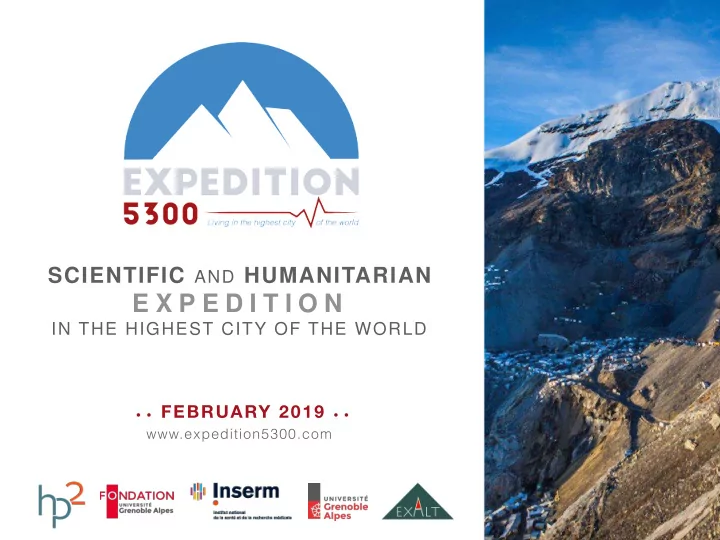
SCIENTIFIC AND HUMANITARIAN
E X P E D I T I O N
IN THE HIGHEST CITY OF THE WORLD FEBRUARY 2019
www.expedition5300.com
E X P E D I T I O N IN THE HIGHEST CITY OF THE WORLD FEBRUARY 2019 - - PowerPoint PPT Presentation
SCIENTIFIC AND HUMANITARIAN E X P E D I T I O N IN THE HIGHEST CITY OF THE WORLD FEBRUARY 2019 www.expedition5300.com A N EXPEDITION IN THE HIGHEST CITY OF THE WORLD LED BY A WORLD-CLASS LABORATORY FROM GRENOBLE ALPS UNIVERSITY
SCIENTIFIC AND HUMANITARIAN
E X P E D I T I O N
IN THE HIGHEST CITY OF THE WORLD FEBRUARY 2019
www.expedition5300.com
AN EXPEDITION IN THE HIGHEST
CITY OF THE WORLD LED BY A WORLD-CLASS LABORATORY FROM GRENOBLE ALPS UNIVERSITY
WWW.EXPEDITION5300.COM WWW.HP2.UNIV-GRENOBLE-ALPES.FR
02|30
H Y P O X I A , W H AT I S I T ?
T E A M O F R E N O W N E D R E S E A R C H E R S
S C I E N T I F I C A N D H U M A N I TA R I A N E X P E D I T I O N
U N I Q U E A N D O U T S T A N D I N G
O N A LT I T U D E , H Y P O X I A A N D G E N E T I C S
Decrease in the amount of oxygen available in the blood or tissues. This situation is associated with a rise in altitude or certain pathologies (respiratory for example). At the cerebral level, hypoxia results in a decrease in cognitive performance, memory issues, slowness of ideation and, in extreme cases, loss of consciousness. Hypoxia is associated with a series of cardio-respiratory and biological responses that may be protective or deleterious.
“ “
IN THE HIGHEST CITY OF THE WORLD
W H O I S L E A D I N G A
03|30
L e d b y H P 2 L a b o r a t o r y, t h e international leader in altitude and hypoxia research that will collaborante with other laboratories. In total, more than 15 scientific and medical experts directly involved in this project. U n d e r s t a n d m e c h a n i s m e s o f altitude adaptations to treat p a t i e n t s w i t h r e s p i r a t o i r e p a t h o l o g i e s a t s e a l e v e l . Supports (material, knowledge,…) to the local population. La Rinconada, in Peru is the highest city in the world (5300m) where more than 50 000 inhabitants are living permanently. Setting a laboratory of physiology and human biology in the heart of La Rinconada. To develop new treatments of diseases related to lack of oxygen and advance research in other areas : technology, space, ... Scientific and humanitarian expédition
2019.
04|30
Participate in an exceptional scientific and human adventure. EXPEDITION 5300 is the first expedition in the world to study permanent habitation at such an altitude. Contribute to developing our knowledge on the limits of human adaptation to the extreme environment
Expected benefits both for highlanders and for lowlanders travelling or working at high altitude. Spin-off in Space Exploration : future lunar and Mars missions will take place in space modules where oxygen concentration will correspond to similar altitudes. To explore new treatment stratégies for chronic diseases, in particular respiratory patients suffering from a decreased oxygen level because of their pathology. Associate your profile to an expedition with a strong scientific, innovative and human dimension with the best specialists in the world.
05|30
PRESENTATION LET’S SHARE
Contacts
Appendices
Project Adventure
PROJECT PRESENTATION
In 15 years, the Hypoxia Physiopathology (HP2) laboratory of INSERM and Grenoble Alpes University has become the French leader and one of the most recognized international groups in the field of hypoxia research. The work of this team has led to many high- level scientific publications and have a strong societal impact, in particularly a significant impact in the field of altitude and for people traveling or residing there for an extended period or permanently. Studying the mechanisms that allow highlanders to live with a very limited quantity
altitude hypoxia, is critical to identify and understand the extreme limits of the adaptation capacities of the guman body to its environment. Humanity has distinguished itself through millennia by its formidable abilities of adaptation to its living environment and its
contribution to the development of habitation throughout the planet Earth.
08|30
L A R I N C O N A D A ?
UNDERSTAND THE MECHANISMS THAT ALLOW THE HUMAN BODY TO ADAPT TO FUTURE ENVIRONMENTAL CHANGES. TO SUPPORT SPACE RESEARCH BY REPRODUCING ALTITUDE CONDITIONS SIMILAR TO LIFE ON MARS. TO DEVELOP OTHER AREAS OF RESEARCH THANKS TO OUR RESULTS : TECHNOLOGICAL AND MEDICAL ...
A T R U E O P P O R T U N I T Y T O D E V E L O P O U R KNOWLEDGE AND ADDRESS FUTURE SCIENTIFIC, MEDICAL AND SOCIAL CHALLENGES.
This is the highest city in the world, nestled in Peru with nearly 50,000 inhabitants living at over 5000 m altitude. While it is generally considered that permanent human life is not possible beyond 5000 m, the population of La Rinconada is challenging current knowledge
particulary to hypoxia. La Rinconada inhabitants are born, grow and work at an altitude higher than Mont Blanc that climbers hardly reach due to the lack of
A significant part of the local population shows difficulty in tolerating the lack of oxygen and develops symptoms which we know only superficially and whose treatment strategies have still to be determined. Analyze, understand, act, these are the main objectives of EXPEDITION 5300 to enable Research and Medicine to move forward.
09|30
The development of scientific knowledge on the human adaptations and maladaptations to extreme environments, and in particular high altitude hypoxia, is a central element of this project. Much larger issues can be addressed as the entire project unfolds. In La Rinconada where the population is remote, there are difficult living conditions due to the environment (isolation, lack
concentration of population, industry lack of modern infrastructure) and relative poverty. Our project aims to make this city better known to the public and international institutions, to initiate medical, health and educational projects benefiting to local population.
IMPLEMENTATION OF COLLABORATIONS AND PARTNERSHIPS BETWEEN PERUVIAN AND FRENCH SCHOOLS SCIENTIFIC AND MEDICAL TRAINING SCIENTIFIC AND MEDICAL EQUIPMENT FOR LOCAL STAFF CREATION OF PREVENTION MATERIALS ON THE E F F E C T S O F H I G H A LT I T U D E F O R L O C A L POPULATION EXTENSION AND AWARENESS VIA CONFERENCES O N T H E S P E C I F I C I T I E S O F H Y P O X I A , T H E ENVIRONMENT,…
11|30
Learn more ? For more information on our research, please refer to the note we sent you as an attachment.
PHYSIOLOGIST, EXPERT IN HYPOXIA - AND EXPEDITION LEADER CARDIOLOGIST SPECIALIZED IN EXERCISE SCIENCES DOCTOR AND PHYSICIAN DOCTOR IN SPORT MEDICINE AND REHABILITATION PERUVIAN DOCTOR, PHD STUDENT OF HP2 LABORATORY RESEARCH DIRECTOR, EXPERT IN GENETICS AND EPIGENETIC MEDICL CONSULTANT, EXPERT IN GENETICS PHYSIOLOGIST AND PROFESSIONAL MOUNTAIN GUIDE PHYSIOLOGIST, HAEMATHOLOGIST EXPERT PHYSIOLOGIST, SPECIALIST IN RESPIRATORY CONDITIONS IN HYPOXIA
12|30
C O M M U N I C AT I O N T E A M
THIS CENTER OF EXPERTISE JOINS THE MAIN EXPERTS AND CENTRAL INSTITUTIONS OF FRANCE AND ALPINE COUNTRIES IN THE FIELD OF MOUNTAIN AND ALTITUDE HEALTH. EXALT IS A COLLABORATIVE NETWORK INITIATING AND SUPPORTING RESEARCH PROJECTS AND INNOVATION IN RELATION TO ALTITUDE. THE EXPEDITION5300 PROJECT IS SUPPORTED BY EXALT.
T E C H N I C A L P A R T N E R S
CENTER OF ALTITUDE EXPERTISE (EXALT)
LOUIS LAFORET AXEL PITTET
MARKETER, COMMUNICATION SPECIALIST VIDEO MAKER PHOTOGRAPHY
13|30
THIS CHAIR WAS LAUNCHED IN 2018 AND SUPPORTS THE RESEARCH IN THE FIELD OF MOUNTAIN AND ALTITUDE
SCIENTIFIC AND MEDICAL STAFF OF UNIVERSITY GRENOBLE ALPS TOGETHER WITH PRIVATE CONTRIBUTORS AND PARTNERS ASSOCIATED WITH THIS PROJECT.
CHAIR «MOUNTAIN, ALTITUDE, HEALTH » OF UNIVERSITY GRENOBLE ALPES FOUNDATION
EXPERIENCED EXPEDITION LEADER A W O R L D - C L A S S S C I E N T I F I C T E A M
SAMUEL VERGÈS LABORATORY HP2
In developed countries, the increased prevalence of several chronic diseases (sleep apnea, obesity, diabetes, etc.) goes hand in hand with a profound change in lifestyles, especially concerning the amount
reduction in physical activity has become a major factor in the occurrence of chronic pathologies with cardiovascual and metabolicrepercussion. The research of the Exercise-Hypoxia team are providing positive outcomes to the area
bring better preventative measures.
COMMUNICATION
In 2011, my team led an original project at Mont-Blanc where a real laboratory was settled in at the VALLOT Observatory at an altitude of 4300 m. Volunteers spent 7 days to analyse cerebral changes during high altitude exposure. (Appendices) In 2015, my team participated in an international scientific expedition in the Himalayas (Manaslu) together with 7 countries, studying the cardiorespiratory and metabolic adaptations of 50 volunteers carrying out a trek up to more than 5000 m altitude. These projects have resulted in numerous high-level scientific papers, mass-market communications (lectures, films, TV shows, etc.) and significant media exposure in regional and national media detailing the results. We decided to work with communication specialists to transcribe as faithfully as possible this unique expedition to the
communication with media. In addition to this, we will create a 26 or 52 minutes documentary of this expeiditon in original way. It will also focus on the daily lives of high altitude population. In short, this is a first in the field of altitude research !
A COMMUNICATION TEAM COME WITH US
14|30
LEARN MORE ?
I N C L U D I N G A C O M M U N I C A T I O N T E A M F O L L O W I N G U S
15|30
TO FINANCE OUR EXPEDITION, OUR NEED HAS BEEN ESTIMATED TO 300 000 €.
LOGISTIC : 50 000 € BIOLOGICAL ANALYSIS : 100 000 € PUBLIC COMMUNICATION : 20 000 € SCIENTIFIC COMMUNICATION : 20 000€ PURCHASE MEDICAL EQUIPMENT : 100 000 € OTHER : 10 000 €
DEPENDING ON THE NUMBER OF SUBJECTS ANALYSED RESEARCH LABORATORY AT LA RINCONADA FLIGHTS, GROUND TRANSPORTATION , ACCOMMODATION,
16|30
MEDIA, DOCUMENTARY, SOCIAL NETWORK,…
THE REMUNERATION OF RESEARCHERS AND PART OF MEDICAL AND SCIENTIFIC MATERIAL ARE PROVIDED BY THE PARTNER INSTITUTIONS OF THIS PROJECT.
DISSEMINATION OF KNOWLEDGE
WINTER 2018
PROJECT LAUNCHED WITH DR HANCCO, PERUVIAN
RESEARCHER
MARCH 2018
LAUNCH UGA CHAIR "MOUNTAIN, ALTITUDE, HEALTH"
JUNE 2018
GRENOBLE,
AUGUST 2018 2ND STEP
PURCHASE SCIENTIFIC AND
MEDICAL EQUIPMENT
JULY 2018 1ST STEP
PRESENTATION OF THE PROJECT TO THE FRENCH AND PERUVIAN AUTHORITIES
SEPTEMBER 2018
FINALISATION OF THE RECRUITMENT OF
THE TEAM OF RESEARCHERS AND PHYSICIANS
FIRST MEETINGS OF THE TEAM.
ON-SITE PILOT STUDY - OBSERVATIONS - LOGISTIC
OCTOBER 2018 3RD STEP
LOGISTIC (FLIGHTS, ACCOMMODATION AND CO.)
OCT - DEC 2018
PRELIMINARY TESTS AND FINAL
PREPARATION OF INVESTIGATIONS
JANUARY 2019
EXAMINATIONS SCIENTIFIC AND
MEDICAL TEAM IN GRENOBLE
(SAME PROTOCOL AS THAT USED
IN PERU).
FEBRUARY 2019 LA RINCONADA
6 WEEKS OF EXPERIMENTATION AT 5300M ALTITUDE, 40 INHABITANTS + 10 RESEARCHERS
MARCH 2019 FRANCE
RETURN TO FRANCE FOR ANALYSIS
MAY - JUNE 2019
RESULTS INTERPRETATION
AUGUST 2019
PRESENTATION OF THE FIRST
RESULTS
DECEMBER 2019
SUBMISSION OF THE FIRST SCIENTIFIC
PUBLICATIONS
17|30
PARIS - LIMA - PUNO
2 DAYS
PUNO
3 DAYS
CONFERENCES HOSPITAL VISITS SCHOOLS
LA RINCONADA
TRANSPORT EQUIPMENT LIMA-PUNO
1 DAY
40 PATIENTS + TESTS 1 NIGHT
UNDER OBSERVATION
LA RINCONADA
30 DAYS
INSTALLATION
LA RINCONADA
2 DAYS
BACKING UP
2 DAYS
END OF VISITS
LIMA - PARIS
2 DAYS
PUNO
18|30
TRANSPORT EQUIPMENT PUNO - LA RINCONADA TRANSPORT EQUIPMENT LA RINCONADA - PUNO
JUMP WITH US !
BY ASSOCIATING YOU WITH
20|30
DEVELOP ORIGINAL COMMUNICATION ACTIONS THAT MEET YOUR NEEDS BY WORKING WITH OUR COMMUNICATION TEAM CONNECT YOUR PROFILE WITH A UNIQUE VEHICLE TO THE WORLD JOINING THE BEST INTERNATIONAL RESEARCHERS
E N G A G E Y O U R T A R G E T
STORY AFFECTIVELY PASSION IMPLICATION
FORM AND AMBITION
ORIGINALITY
TO TALK TO CREATE LINK PROOF TO WORK TO PROPOSE
21|30
THANKS TO OUR COMMUNICATION TEAM, IT IS POSSIBLE TO CONSIDER A STRONG PARTNERSHIP TO MEET YOUR AMBITIONS WHILE HAVING A REAL FOLLOW-UP.
MEDIA COMMUNICATION DIGITAL COMMUNICATION PRESS KIT PRESS CONFERENCE PRESENCE IN OUR PRESENTATION VIDEOS
22|30
MAGAZINES, NEWSPAPERS, PQR, PQN, MEDIA TV, RADIO / PRESENCE ON WEBSITE WITH LINK. SOCIAL NETWORK : FACEBOOK, INSTAGRAM,… PRESENCE OF YOUR LOGO, A HALF-PAGE DEDICATED TO YOUR ACTIVITIES. LARGE SCALE DISTRIBUTION IN GRENOBLE - INVITATION OF PARTNERS AND JOURNALISTS - LIVE BROADCAST RS / YOUTUBE MANY PATCHES / TEASERS PRESENTATION, LOGO PRESENCE, ...
MANAGEMENT COMM’ MEDIA, SOCIAL NETWORK PRESS RELATIONSHIP AND PATCH WEBSITE
SOCIAL NETWORKS - PARTNER ADS - VIDEO PATCHES - INTERVIEWS - SHOWCASING OUR
COMMUNICATION ACTIONS UPSTREAM TO BE DISSEMINATED DURING THE EXPEDITION ...
ADVANCING YOUR SKILLS / KNOW-HOW
OUR COMMUNICATION TEAM WILL BE PRESENT 24/7 DURING THIS ADVENTURE TO FOLLOW THE EXPEDITION AS CLOSELY AS POSSIBLE !
ARTICLES AND DAILY REPORT FOR THE DAILY AND SPECIALIZED PRESS. UPDATED WEBSITE ... ABILITY TO ADAPT TO YOUR NEEDS TO HIGHLIGHT YOUR PRODUCTS / SERVICES, ...
23|30
FINALISATION OF A DOCUMENTARY OF 26 OR 52 MINUTES ACKNOWLEDGMENT EVENING
TV / RADIO / REGIONAL MEDIA / NATIOANAL MEDIA / SPECIALTY PRESS
POPULARISATION OF OUR WORK - DOCUMENTARY FOR SCIENTIFIC AND HUMANITARIAN PURPOSES - PARTICIPATION SCIENTIFIC FESTIVALS / MOUNTAIN - PROPOSAL TO THE MEDIA FOR DISTRIBUTION. PREVIEW OF THE RESULTS - REVIEWS AND EXCHANGES WITH THE WHOLE TEAM PRESENTATION OF THE RESULTS - DESCRIPTION OF THE EXPEDITION - WRITING ARTICLES FOR THE GENERAL PUBLIC PRESS AND SPECIALIZED PRESS
OUR DESIRE TO BUILD A LONG-TERM RELATIONSHIP IS ALSO DEFINED BY COMMUNICATION ACTIONS CONDUCTED DOWNSTREAM AND WORKED WITH YOU TO ENSURE THAT NOTHING IS A COINCIDENCE.
24|30
POSSIBILITY OF PRIVATE EVENING ACCESS TO DATA RELATED TO OUR RESEARCH CUSTOMIZED EXPERTISE
REQUESTS, DESIRES, NEEDS ? WE CAN CO-BUILD CUSTOMIZED PROMOTION ACTIONS WITH OUR COMMUNICATION TEAM.
25|30
AND MAYBE MORE ?
UPSTREAM WORK WITH THE COMMUNICATION TEAM, SETTING UP A MEDIA PLAN IF NECESSARY ACCORDING TO YOUR NEEDS AND REQUESTS, TO DO WITH OUR RESEARCH TEAM EVENING OF THANKS WITH TESTS / GAMES / EXERCISES ON YOUR COLLABORATORS, ... TO DEFINE WITH OUR RESEARCH TEAM ACCORDING TO YOUR NEEDS AND POSSIBLE APPLICATIONS
SILV E R
5 0 0 0 €
G O L D
2 0 0 0 0 €
PLATINUM
5 0 0 0 0 €
P R I V I L E G E
8 0 0 0 0 €
THESE ARE ONLY INDICATIVE LEVELS THAT MAY VARY DEPENDING ON THE TYPE OF PARTNERSHIP ENVISAGED.
LEARN MORE ?
SPONSOR
A UNIQUE EXPEDITION IN THE WORLD
ASSOCIATE
YOUR IMAGE TO THE BEST INTERNATIONAL RESEARCHERS
BENEFITS IN VARIOUS DOMAINS
SPACE EXPLORATION, TECHNOLOGICAL APPLICATIONS, HUMANITARIAN PROJECT
TAX EXEMPTIONS FOR A PARTNERSHIP OR SPONSORSHIP
60% REDUCTION OF TAXES CEILING
27|30
* Variable conditions depending on the collaboration envisaged. Contact us for more information.
CONTACTS
WE WILL ANSWER QUICKLY TO YOUR QUESTIONS AND REQUESTS.
Axel PITTET
SAMUEL@EXPEDITION5300.COM AXEL@EXPEDITION5300.COM
PR OJE C T LEAD ER
29|30
COMMUNI CATI ON LEADER
+33 4 76 76 68 60 +33 6 46 21 10 87
CR INSERM, Laboratoire HP2 (U 1042), Université Grenoble Alpes UM Sports Pathologies, CHU Grenoble Hôpital Sud, Avenue Kimberley 38 434 Echirolles, France Laboratoire HP2 (U 1042), Université Grenoble Alpes UM Sports Pathologies, CHU Grenoble Hôpital Sud, Avenue Kimberley 38 434 Echirolles, France
WWW.EXPEDITION5300.COM
30|30
APPENDICES
THEY SUPPORTED US
Former partnerships in our past expeditions
INTERNATIONAL SCIENTIFIC EXPEDITION “MEDEX" MANASLU 2015
TO WATCH TO WATCH
“EXPERIMENTATION VALLOT” EXPÉDITION MONT-BLANC 2011
SCIENCES
N
La montagne, terrain de recherches des scientifiques
L’altitude, en raison de ses conditions extrêmes,
nombreux sujets d’études comme, par exemple les stratégies d’adaptation du corps humain à la raréfaction de l’air, la recherche des victimes d’avalanche ou encore le traitement des gelures.
A haute altitude, la pression partielle des gaz qui composent l’air que l’on respire diminue et chaque inspiration apporte moins d’oxygène à l’organisme. Cette asphyxie partielle se traduit par le « mal des montagnes ». BOERMANS, MENNO/HOLLANDSE HOOGTE-REAA R T I C L E NEWSPAPER LES ÉCHOS 12/01/2010
ARTICLE MONTAGNE MAGAZINE ARTICLE CAHIER PRATIQUE
A R T I C L E NEWSPAPER LE FIGARO A R T I C L E NEWSPAPER LE DAUPHINÉ LIBÉRÉ